Enterprise LLM Visibility: Planning GEO for Enterprise Brands
LLM
Enterprise LLM Visibility: Planning GEO for Enterprise Brands

 ChatGPT
 Claude
 Perplexity
 Grok
 Google AI
 You
 WhatsApp
 LinkedIn
LLM visibility (often called AI visibility) is whether AI assistants such as ChatGPT, Gemini, Copilot and Google’s AI Mode name your brand, cite your pages and describe you accurately when buyers ask about your category. For enterprise brands it is decided by four gates that open in order: Crawl (can a bot fetch the page?), Comprehend (can it tell what the page says?), Convince (is it worth quoting?) and Convert (can you show the return?).
This is the written version of my talk at LLM Mastery in Chiang Mai on 15 November 2026. It covers why AI search skips big brands, the 12-week plan we use at Prosperity Media to plan GEO for enterprise brands before we touch a single page, and what we do at each gate. If you run enterprise AI SEO, this is the order of work. If you are new to the field, start with what generative engine optimisation (GEO) is. Every figure links to its source. Client examples are anonymised to industry level.
Why enterprises fund AI search before it pays back
Enterprise SEO has a paradox right now. AI search sends far less traffic than organic search, yet it already takes a real share of the budget.
The paradox
Twelve percent of the budget. About one percent of the visits.
12%
of US enterprise digital marketing budget went to AI search (AEO/GEO) in 2025
1.08%
of website traffic came from AI referrals across 1,215 enterprise domains
94%
of US enterprises plan to increase AI search investment in 2026
The two big numbers come from different samples, a survey and customer analytics, so read them as a contrast rather than a ratio. The point stands: leadership is funding AI search ahead of the return. In Australia we see the same thing. Clients who said no to SEO a few years ago are back in the conversation because of AI, and they arrive with budget.
Attribution is the reason the return looks small. In Profound’s research presented at Zero Click Sydney, fewer than 2% of AI chats that recommend a brand produced a tagged referral, because people leave the chat and search for the brand instead. Whatever GA4 shows for AI is the floor, not the total. Our State of AI Search white paper covers the wider picture. It also changes how you report, which I cover under Convert.
Why AI search skips big brands
Authority gets you considered. It does not get you named.
Ahrefs studied 75,000 brands and found that 26% of brands with a Domain Rating above 40 had no AI Overview mentions at all. Big, well-linked sites are being skipped. When Ahrefs looked at which signals line up with being named, branded web mentions came first and raw backlink counts came last.
Brand authority
Brand mentions track AI Overview visibility three times as closely as backlinks.
Brand demand helps, but it is not the winning factor on its own. Links still matter (branded anchor text is the second strongest signal), but after a point AI names the brands people talk about and cites the pages that state the facts. Ahrefs is clear that these are correlations, not causes, and the study covers AI Overviews only. For the site-level reasons brands lose AI brand visibility, see the GEO blind spot.
Track branded and non-branded prompts separately
Big brands get named when the question already contains the brand. Most buyers do not ask that way.
Branded vs non-branded
Big brands get named when asked by name. Most buyers don’t ask by name.
76%
of AI answers naming Optus came from questions that already named Optus (1,000 answers, six engines)
60%
of shoppers named no brand when they started (study of 2,430 shoppers)
If you blend branded and non-branded prompts in one visibility score, the branded ones carry it and the brand always looks healthier than it is. Monitor branded prompts for accuracy and sentiment. Measure growth on the category prompts where no brand is named, because that is where the next customer is deciding.
Knowing the fix is easy. Shipping it is not.
Deployment
The enterprise problem isn’t knowing. It’s deploying the change.
73%
of enterprise organisations run headless architecture in some form
558 KB
median JavaScript per mobile page, 44% of it unused
28%
of technical SEOs get 80% or more of their recommendations implemented
Most enterprise sites run some form of headless or JavaScript-heavy architecture, so the quick fixes are rarely quick. Add the stakeholders (brand, legal, security, platform, product) and each change has to win several arguments before it ships. Much of the plan later in this article exists to win those arguments with evidence before you ask for engineering time.
A migration, a news story and two days
Adorn Cosmetics, an Australian beauty brand, is the clearest recent example of how fast this moves. Per the founder’s account in 7NEWS’ report and PPC Land’s coverage, the business was pushed to upgrade to a new Adobe build with a projected 34% to 94% growth. A local agency built it. Sales fell about 30% at launch, she says, and $1M a year of social advertising stopped reaching the site.
The aftermath
Two days from a news story to “gone bust” in AI answers.
2 days
from the 7NEWS story to AI listing Adorn as gone bust. Until 8 November, every engine we tracked called Adorn legit and well regarded.
Which cosmetic company has gone bust?
Adorn Cosmetics: hit severe financial distress and collapse following a disastrous e-commerce website migration to an Adobe platform.
Is Adorn a good brand?
Customer feedback is generally positive… One caution: a report dated November 10, 2026 says the company is facing severe financial difficulties. Check current stock, delivery and returns first.
I am not making a claim about what went wrong in Adorn’s build. The pattern is familiar from our own audits, though: poorly set-up Edge Delivery and agency rebuilds, heavy JavaScript and product data that never reaches the HTML. Edge Delivery Services can work well. The cost comes from setting it up badly. We break down the migration itself in what went wrong with Adorn’s e-commerce migration, and how to avoid it in enterprise SEO migrations.
The second lesson is about news. AI engines pick up news quickly and they probe the whole category, not just the brand in the story. We have seen a category news story pull a competitor with no negative press into the same answers. If you only watch prompts about your own brand, you miss that.
Old facts keep coming back
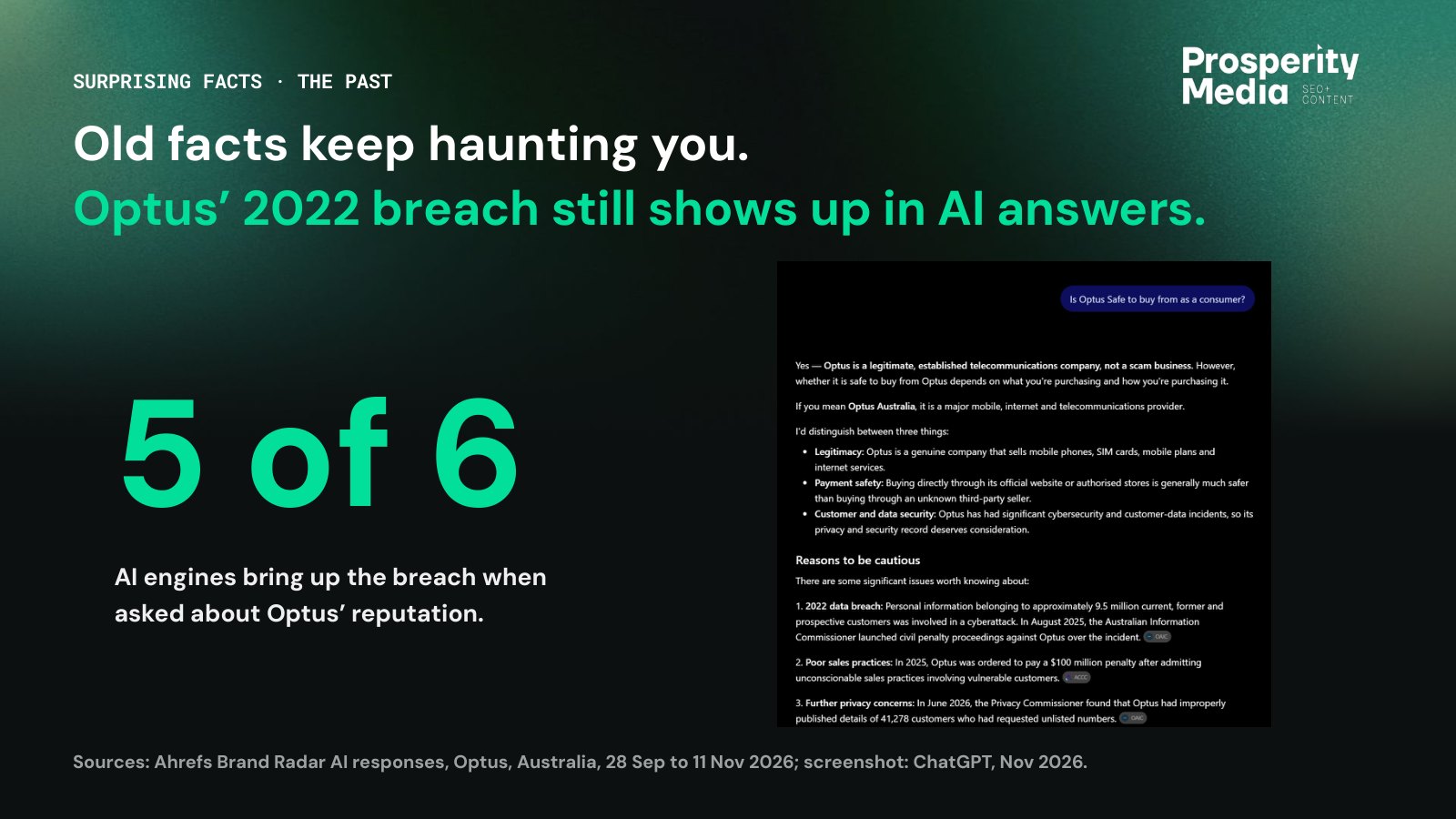
A breach from 2022 still shapes answers about Optus in 2026. You cannot delete that history, but you can make sure the record of what you did about it is just as easy to find. Publish what changed, with dates, on pages AI can read, and get that account repeated by the sources the engines already cite. Otherwise the old story is the only complete one available.
How we plan GEO for an enterprise, in 12 weeks
One size does not fit all. Industries behave differently, and so do markets within the same industry. So we plan by buyer, category and engine first, then build. A typical enterprise plan runs 12 weeks and starts before kick-off.
How we plan GEO
Twelve weeks of planning, and it starts before kick-off.
Before kick-off Active work Runs in the background
Weeks 1 to 4 Understand: Who asks, where, and what we will track
1a Stakeholder discovery Test the map with brand, legal and service teams (weeks 1 to 2)
1b Market and engine mapping Engine use by market, language and age (starts before kick-off, week 1)
1c Prompt set from buyers Branded, category and comparison prompts (starts before kick-off, weeks 1 to 2)
1d Tracker and Brand Radar set-up Engines, competitors, markets (starts before kick-off, weeks 1 to 3)
1e Baseline runs begin Repeated runs, not one screenshot (week 4, runs in the background, weeks 5 to 12)
Weeks 5 to 8 Diagnose: What AI cites, and what it believes about you
2a Category citation analysis Which sources each engine cites (weeks 5 to 6)
2b Truth notebook signed off The facts the business stands behind (weeks 5 to 6)
2c Interrogate every engine Ask like a buyer would (weeks 6 to 7)
2d Truth gaps and their sources Where AI and the facts disagree (weeks 7 to 8)
2e Baseline settles Four weeks of repeated runs (runs in the background, weeks 5 to 8)
Weeks 9 to 12 Plan: One plan per engine, re-checked every model change
3a Per-engine priorities Different sources, different fixes (weeks 9 to 10)
3b Fix the source Own pages first, then third parties (weeks 10 to 12)
3c Forecast and KPIs Numbers we report against (weeks 11 to 12)
3d Model-change watch Re-plan when an engine updates (runs in the background, weeks 9 to 12)
Use the gap between signing and kick-off
Enterprise sign-off takes time: procurement, legal, security and access requests. We use that gap. At pitch we already have a public-data snapshot: AI visibility from Ahrefs Brand Radar, which engines the client’s buyers use in each market, and the sources AI cites in the category. Between signing and kick-off we draft the prompt set from real buyer questions, scan category citations engine by engine and get the access list ready (Search Console, CDN logs, CMS). Tracking switches on during week one, and stakeholder sessions test the market map instead of building it from scratch.
Step 1: Map buyers to AI engines, market by market
Start with who your buyers are and which assistants they use, then check whether that matches who you are targeting. Usage changes by market, by language and by age.
Map buyers to engines
Who uses which assistant, by market, by age and by platform.
Compare
51%
of Australians use generative AI weekly, ahead of the US, Japan and the UK in the same survey.
China is in neither survey. India is in the news survey only.
| Market | Top three assistants | AI use, youngest and oldest | Oldest group’s top pick |
|---|---|---|---|
| Australia | ChatGPT, Gemini, Meta AI | 68% of 18 to 24s, 31% of 65+ | ChatGPT, 16% of 65+ |
| United States | ChatGPT, Gemini, Copilot | 66% of 18 to 29s, 23% of 65+ | ChatGPT, 19% of 65+ |
| United Kingdom | ChatGPT, Gemini, Copilot | 79% of 16 to 24s, 12% of 75+ | ChatGPT, 54% of AI users 65+ |
| India | ChatGPT, Gemini, Perplexity | 81% of 18 to 24s, 50% of 35+ | Not published |
| Japan | ChatGPT, Gemini, Copilot | 92% of 15 to 19s, 34% of 60s | Gemini, 27% of 60s |
| China | Doubao, Qwen, DeepSeek | Not published as rates | Not published |
Each market uses a different survey, measure and set of age bands (see its tab), so compare the pattern, not the exact numbers.
Actionable takeaway ChatGPT ranks first and Gemini second in every market except China. Japan is the outlier for older buyers: from the 40s up, Gemini leads.
Australia
77%
of people aged 16+ used an AI tool in the past year. That is 17.4M people.
| Platform | All 14+ | 14 to 17 | 18 to 24 | 25 to 34 | 35 to 49 | 50 to 64 | 65+ |
|---|---|---|---|---|---|---|---|
| ChatGPT | 45% | 59% | 58% | 62% | 59% | 33% | 16% |
| Gemini | 21% | 27% | 23% | 25% | 27% | 18% | 13% |
| Copilot | 17% | 13% | 11% | 21% | 24% | 18% | 10% |
Roy Morgan publishes age splits for these three only. Claude reaches 3% of Australians 14+, with no age split. Meta AI, Grok and Apple Intelligence have no published Australian age data.
Actionable takeaway Track ChatGPT and Gemini first. Copilot climbs to 24% of 35 to 49 year olds, so add it for business buyers.
United States
49%
of US adults use AI chatbots. 66% of 18 to 29 year olds do.
| Platform | All | 18 to 29 | 30 to 49 | 50 to 64 | 65+ |
|---|---|---|---|---|---|
| ChatGPT | 44% | 61% | 55% | 37% | 19% |
| Gemini | 24% | 30% | 34% | 20% | 11% |
| Copilot | 17% | 17% | 22% | 19% | 10% |
| Meta AI | 14% | 14% | 17% | 13% | 10% |
| Grok | 8% | 9% | 10% | 7% | 3% |
| Claude | 6% | 10% | 9% | 4% | 1% |
Pew does not report Perplexity, DeepSeek or Apple Intelligence. Not every difference between age groups is statistically significant.
Actionable takeaway ChatGPT leads every age group. Gemini peaks at 34% of 30 to 49 year olds, and Copilot holds 19% of 50 to 64s, so track both for business buyers.
United Kingdom
54%
of UK adults have used AI tools, and 79% of 16 to 24 year olds.
| Platform | All users | 16 to 24 | 25 to 44 | 45 to 64 | 65+ |
|---|---|---|---|---|---|
| ChatGPT | 79% | 90% | 83% | 74% | 54% |
| Gemini | 33% | 31% | 35% | 33% | 34% |
| Copilot | 30% | 18% | 31% | 37% | 17% |
| Claude | 13% | 14% | 16% | 12% | 5% |
| Meta AI | 8% | 7% | 8% | 8% | 11% |
| Apple Intelligence | 7% | 6% | 6% | 7% | 11% |
| Grok | 5% | 5% | 6% | 4% | 4% |
The base is people who used a generative AI tool in the past year, not all adults. The 65+ base is small.
Actionable takeaway ChatGPT reaches 90% of young UK users. Copilot peaks at 37% of 45 to 64 year old users, so weight it for B2B, and keep Gemini level across every age.
India
63%
of working-age adults (18 to 64) use generative AI outside work.
No representative survey splits Indian platform use by age yet. The nearest signal: users aged 18 to 24 send just under half of all ChatGPT messages in India, against about a third worldwide. Telco bundles also move the market: Airtel gave its customers Perplexity Pro in 2025, Reliance Jio bundled Google AI Pro (for 18 to 25 year olds at launch), and OpenAI made ChatGPT Go free for a year.
Actionable takeaway Young buyers drive Indian AI use. Check which assistant the big carriers are giving away this quarter before you set engine priorities.
Japan
59%
of people aged 15 to 69 have used generative AI.
| Platform | All | 20s | 30s | 40s | 50s | 60s |
|---|---|---|---|---|---|---|
| ChatGPT | 33.5% | 47% | 41% | 33% | 30% | 24% |
| Gemini | 33.1% | 41% | 33% | 34% | 33% | 27% |
| Copilot | 12.5% | 14% | 11% | 15% | 13% | 10% |
Age splits are published for these three only. Across all ages, Claude is used by 4.2% and Perplexity by 2.0%.
Actionable takeaway ChatGPT leads under 40. From the 40s up, Gemini leads, so a Japanese campaign aimed at older buyers should track Gemini first.
China
700M+
people use generative AI. 70% of users are under 40.
| Platform | Born 2000s | 1990s | 1980s | 1970s | 1960s |
|---|---|---|---|---|---|
| Doubao | 15.9% | 27.1% | 22.9% | 14.3% | 6.4% |
| Qwen | 18.1% | 34.8% | 16.7% | 10.7% | 5.0% |
| Yuanbao | 15.3% | 34.4% | 18.5% | 13.1% | 6.2% |
This shows how each app’s users split by age, not the share of each age group that uses the app. Rows do not add to 100%: QuestMobile does not show the other cohorts. No 2026 age split is published for DeepSeek or Kimi.
Actionable takeaway Targeting Chinese-speaking buyers? Track Doubao, Qwen and DeepSeek alongside ChatGPT. Qwen and Yuanbao skew to users born in the 1990s.
Three things to take from this.
- Age changes the plan. I worked with a menswear brand whose buyers were mostly dads, an age group with much lower AI use. We still did the LLM work, but framed it as future-proofing, and set expectations with the client so nobody judged it on this quarter’s revenue.
- Selling to business buyers? Track Copilot. It reaches 17% of US adults, and many enterprises have not approved ChatGPT or Claude for staff use. If Copilot is the only assistant your buyer’s IT team allows, that is the engine that matters, and Bing data matters more than you think.
- Local engines and local deals decide some markets. In India, the most-used assistant has shifted with telco bundles, as carriers gave subscriptions away to their customers. In China the leaders are Doubao, Qwen and DeepSeek, not the engines Western teams track. If you target Chinese-speaking buyers and only watch ChatGPT, you miss most of the conversation. We wrote up how to reach Chinese LLM users in Australia.
Step 2: Baseline your AI visibility with GEO tools, over four weeks
Use whichever tools fit the size of the business and the budget. We combine a market-wide view, a daily prompt tracker and Bing’s first-party data. We built our own tracker, GEOverview, for client work, but nobody needs to build a tool to start.
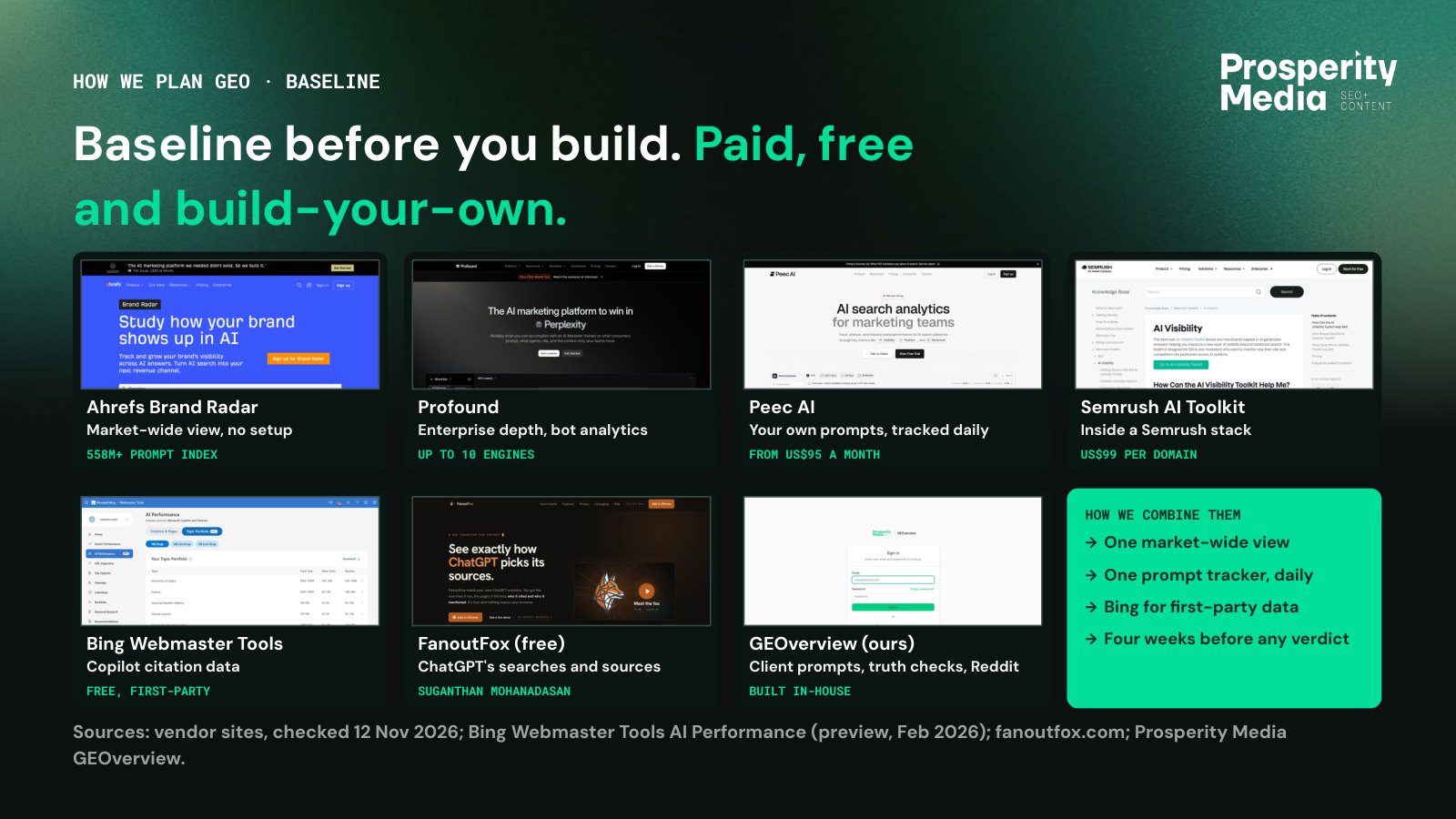
Baseline tools
Paid, free and build-your-own.
| Tool | Best for | Note |
|---|---|---|
| Ahrefs Brand Radar | A market-wide view with no set-up | 558M+ prompt index |
| Profound | Enterprise depth and bot analytics | Up to 10 engines |
| Peec AI | Your own prompts, tracked daily | From US$95 a month |
| Semrush AI Toolkit | Teams already inside a Semrush stack | US$99 per domain |
| Bing Webmaster Tools | Copilot citation and grounding-query data | Free, first-party |
| FanoutFox | Seeing ChatGPT’s searches and sources | Free, by Suganthan Mohanadasan |
| GEOverview | Client prompts, truth checks, Reddit | Prosperity Media, built in-house |
Then baseline properly. SparkToro’s research found AI answers change almost every time you ask.
Baseline
One run is not a baseline. AI answers change almost every time.
<1%
of repeated runs gave the same brand list for the same prompt
- Mention rate
- Share of answers that name you
- Share of voice
- Your mentions against competitors and the market
- Citation share
- Answers that link to your site
- Source map
- The domains AI cites in your category
- Sentiment
- How answers describe you
- Accuracy
- Whether your facts are right
Segment the baseline by market, and tag prompts by audience where you can. A brand can do well with one audience and be absent for another. If you can tie a KPI to the marketing metric the client’s team is already measured on, you will win the marketing manager’s support, and usually the local SEO lead’s too.
Step 3: Learn what AI cites in your category
Two Australian categories show how different the answer can be.
Know your category
One size doesn’t fit all. Learn what AI cites in your niche.
Regulated medical · Australia
71%
of answers named the brand but cited another site: YouTube, Reddit, social media and forums
0 of 7 key brand pages named an author, a reviewer or a source.
What works: evidence the medical and legal team can sign off.
Childcare · Australia
39%
of AI citations went to Google Maps listings, not websites or directories
The government’s childcare finder blocks AI crawlers and shows them no service details.
What works: Business Profiles first. Pay only for listings AI can read.
In the regulated medical category, Australian rules limit what the brand, clinics and publishers can say. The engines filled the gap with user experience: forum comments, YouTube videos of people describing their own treatment, and Reddit threads. In childcare, Google Maps listings took the citations, ahead of both websites and directories. The fixes are completely different, which is why we never reuse a playbook across categories without checking first.
Step 4: Check what AI believes about you
Last year at this same event I heard Steve Toth present his Trust Alignment Framework, and I have built it into our whole process since. Enterprise brands carry a lot of lag between what is true and what is published, and the stale version keeps resurfacing. (More on this in four reasons AI gets your brand wrong.)
- Truth notebook. The business signs off each fact it stands behind.
- Interrogate every engine. Ask the way a buyer would.
- Find the truth gaps. Where AI and the facts disagree.
- Fix the source. Own pages first, then third parties.
- Monitor and re-ask. On a schedule, not once.
Measure in three layers, never one score
Our GEO framework
Three layers, never one score.
Layer 1 · Presence
Are we in the answer?
- Prompt coverage
- Recommendation rate
- Linked citation rate
- Comparative win rate
- Representation accuracy
Layer 2 · Readiness
Can AI use our site?
Layer 3 · Business impact
Does it convert?
- Observed
- AI referrals and direct sessions
- Own proxy
- Branded search lift, surveys
- Third-party proxy
- Vendor AI traffic share
- Modelled
- Planning only, never reported
Report each layer on its own. A blended score can fall and nobody can say why.
Map where search and AI overlap
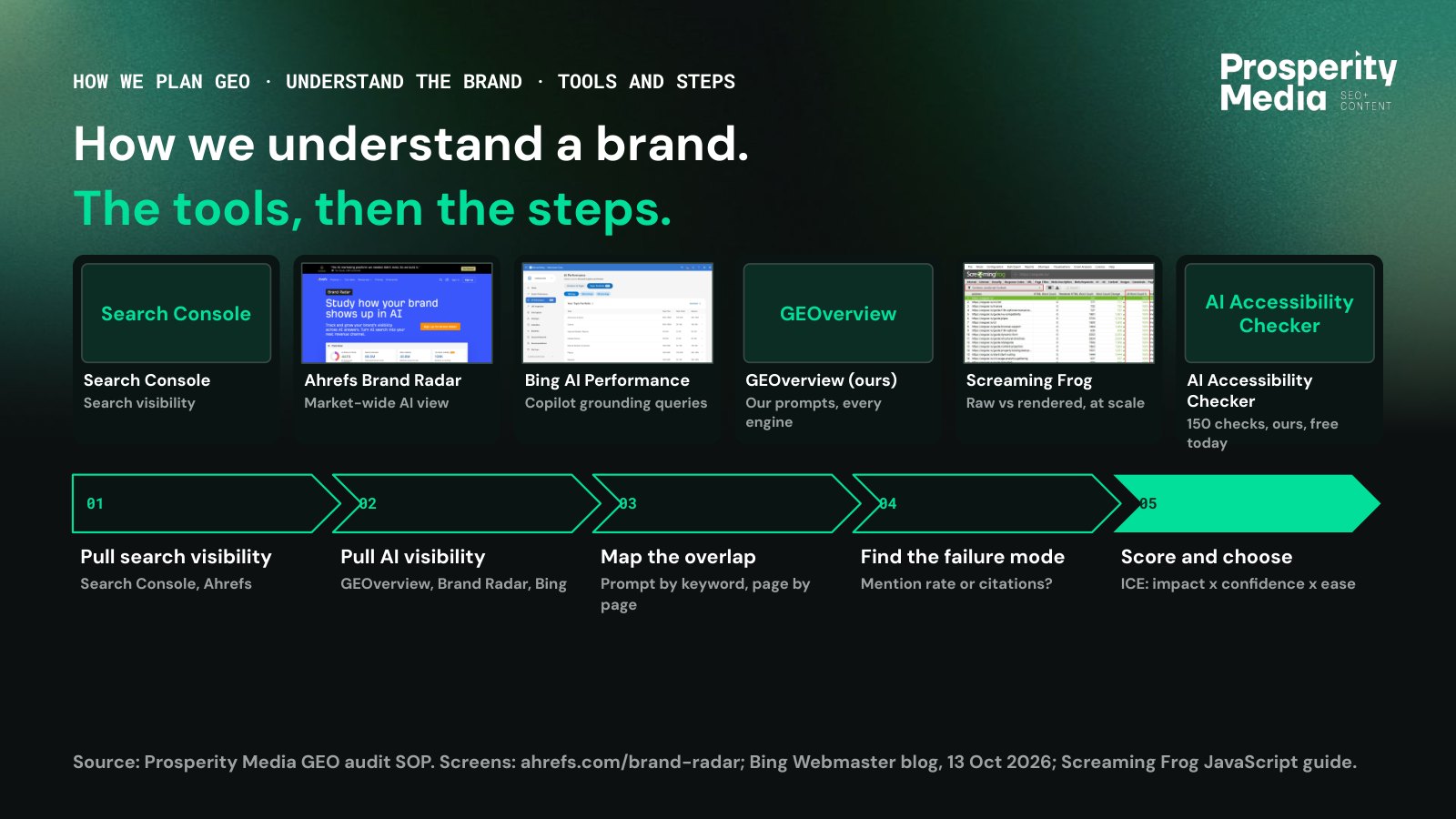
We pull search visibility from Search Console and Ahrefs, and AI visibility from GEOverview, Brand Radar and Bing Webmaster Tools. Bing’s AI Performance report deserves more attention than it gets: it shows the grounding queries Copilot used, which is first-party data no other AI platform gives you. Screaming Frog compares raw and rendered HTML at scale, and you will be surprised how much content only exists after JavaScript runs.
Then we map one onto the other, prompt by keyword and page by page. Search and AI only partly overlap, and the gap tells you where to work.
The overlap
Search and AI only half overlap. The gap tells us where to work.
AI names or cites you ↑
Search: ranks in the top 10 →
SEO
Cited, not ranking
Feed it to search: titles, internal links.
Protect
Ranking and cited
Keep it fresh and watch model changes.
Convince
Neither
Earn mentions on the sources AI cites.
Comprehend
Ranking, not cited
Fix comprehension: JavaScript, structure, entity.
52%
median overlap of a category’s search and AI top 25
1 in 4
categories where search and AI agree on #1
37%
of search top-10 slots go to domains missing from the AI top 25
You do not need to rank to appear in AI answers, and appearing in AI answers does not mean you rank. Run the two plans together anyway. Fixes that win both let you show a return from search while AI attribution catches up.
“We don’t show up in AI” is two problems
Diagnose
“We don’t show up in AI” is two problems. They need different fixes.
Mention rate
Do we get into category answers?
One national marketplace sat in the bottom quartile on category prompts.
Fix: earn mentions where AI looks.
Citation mechanics
When named, do they cite our pages?
The same marketplace was the #1 cited domain when the brand was named.
Fix: comprehension and crawl work.
Split that complaint into the two numbers before you fund a fix. They need different work.
Step 5: Plan per engine, and re-plan when models change
Each engine cites different sources, so each needs its own priorities. And an engine update can rewrite the picture in weeks. This is the same retailer’s blog in two engines over 2026.
Re-plan on model change
One blog, two engines, two different stories.
ChatGPTGoogle AI Overviews
Show the data table
| Date | ChatGPT citations | AI Overviews citations |
|---|---|---|
| 15 Jan | 0 | 0 |
| 1 Mar | 0 | 0 |
| 1 May | 0 | 25 |
| 1 Jul | 30 | 23 |
| 1 Sep | 0 | 80 |
| 10 Nov | 9 | 117 |
Between January and May the blog grew in both engines together. Then the models changed. By September, ChatGPT citations had fallen to zero while Google AI Overviews kept climbing to 117. If we had planned once and walked away, we would have missed both stories. Track model changes and re-plan when an engine updates.
The four gates: Crawl, Comprehend, Convince, Convert
Once the plan is agreed, the build follows four gates. They open in order. If Crawl fails, nothing after it matters: a page that cannot be fetched cannot be cited, however good it is.
Gate 1, Crawl: can a bot fetch the page?
What we do, in order: align robots.txt with the firewall, ship the low-effort discovery files, and test the way the bots do.
robots.txt asks. Your CDN decides.
Most teams check robots.txt and stop. For enterprise brands the real decision sits in the web application firewall (WAF) and CDN bot rules. If the firewall blocks a bot, robots.txt is irrelevant. Cloudflare runs about 29% of websites (W3Techs), and since July 2025 new Cloudflare sites block AI crawlers by default.
robots.txt vs WAF
robots.txt asks. Your CDN decides. And they often disagree.
| Bot | robots.txt | Firewall |
|---|---|---|
| PerplexityBot | Allowed | 403 blocked |
| GPTBot, ClaudeBot | Disallowed | 403 blocked |
| ChatGPT-User | Allowed | 200, menus only |
Export your firewall bot rules and check them line by line against robots.txt.
Decide per bot, not one rule for all
One rule for every bot is how brands block the bots that send customers. Decide by class, and write the reason down.
Bot policy
Decide per bot class, and write the reason down.
| Bot class | Examples | Default | Why |
|---|---|---|---|
| Training crawlers | GPTBot, ClaudeBot | Your call | Allow if you want your facts in future models. Block if your content is what you sell. |
| AI search fetchers | OAI-SearchBot, PerplexityBot | Allow, nearly always | They cite you and send clicks. |
| User-triggered agents | ChatGPT-User, Perplexity-User | Challenge abuse, don’t block | A person is waiting for the answer. |
| Marketplace and shopping agents | Meta’s shopping agent | Allow where you sell | Blocking costs nothing in a channel where you have no shop. |
For a large retailer, I do not want product pages going into training data, but I do want user-triggered fetches allowed. The reason is price. If a model learned the lowest price a product ever sold for, it can repeat that figure to a shopper at the moment they are about to buy, and talk them out of it. A user-triggered fetch reads today’s page instead.
A blocked agent can still get a 200
Do not read a 200 response as a good signal. In our spot checks, a bot-protection page was served to an AI agent with a 200 status. Your uptime monitor says everything is fine; the agent gets nothing. On one fashion retailer, an automated browser loaded the first page, then got a challenge page, also served as 200, on all three pages after it.
Request your key pages as GPTBot and ChatGPT-User, and check the page content and title, not the status code. A spoofed user agent is not the real bot, so confirm in server or CDN logs.
Log what bots actually do
Peter Macinkovic published a cheap method using Cloudflare’s Log Explorer: filter HTTP requests by verified bot category, and have a Worker copy them into a D1 database every 15 minutes, so you keep rows past the 30-day default retention. From there you can build your own dashboard of crawl volume, status codes, and AI bots against search bots.
Bot logs
Fields worth keeping.
- EdgeStartTimestamp
- ClientRequestPath
- ClientRequestUserAgent
- VerifiedBotCategory
- EdgeResponseStatus
- OriginResponseStatus
- CacheCacheStatus
- RayID (for de-duplication)
Actionable takeaway Ask enterprise IT for a Worker or Log Explorer view, not raw log files.
On enterprise accounts you will not have Cloudflare access yourself. Take someone from the IT team out for a drink, explain what you need, and ask for a Worker or a Log Explorer view rather than raw log files.
Ship the low-effort files
When I scanned 175 Australian domains in September 2026, only 1.1% offered a machine-action file. These are cheap to ship:
- UCP manifest. The Universal Commerce Protocol file tells shopping agents what your store supports, such as checkout. If you are in e-commerce, make sure it is there. We cover the trade-offs in UCP adoption.
- AI info page. One page of signed-off company facts: legal name, what you do, where you operate, key numbers, with dates. Ours is here.
- Sitemap for agents. Lists your machine-readable pages. Useful when the site is hard to crawl and most URLs are only reachable through JavaScript.
Platforms give some of this away. 99% of Shopify stores ship a verified UCP manifest by default, against 2.6% of custom builds. Treat platform files as the floor and customise them. Shopify’s default llms.txt, for example, mostly promotes Shopify and gives an agent little to work with. And llms.txt is not an access fix: as one respondent to Aleyda Solis’ SEOFOMO survey put it, if bots cannot see your HTML, no llms.txt is going to save you. Fix access and rendering first.
Gate 2, Comprehend: can AI tell what the page says?
What we do, in order: get content out of JavaScript, serve a lighter version, and fix local and entity signals.
AI crawlers download your JavaScript. They don’t run it.
JavaScript
AI crawlers download your JavaScript. They don’t run it.
11.5%
of ChatGPT’s crawler requests fetched JavaScript files
23.8%
of Claude’s crawler requests fetched JavaScript files
0
of those files were executed by either crawler
This is JavaScript SEO with a new audience. Most of the content on enterprise sites arrives through JavaScript requests, and the major AI crawlers do not execute it. Google renders JavaScript for its own index, but you cannot assume the same of the rest. Prerendering services such as Prerender.io and SEO4Ajax serve bots a rendered HTML copy, which gets around the server-side rendering problem without asking anyone to leave their tech stack. That matters on enterprise, where legacy stacks are the norm and a replatform is a two-year argument. Our technical SEO checklist covers the rendering checks in more depth.
Custom headless builds can hide every product
One client had zero of 1,806 product pages reached by a link-only crawl. Every page existed and every page returned fine. None of them were linked in a way a crawler could follow, and the sitemap alone was not enough for discovery. Compare raw HTML with the rendered page on your top templates, every release.
Serve a lighter version
When Cloudflare served one page as markdown instead of HTML, it used 80% fewer tokens: 16,180 down to 3,150. Cloudflare offers markdown negotiation through its Markdown for Agents feature, and you will be surprised how often agents ask for a .md file over HTML. On Cloudflare or a CDN that supports it, turn it on and list your .md pages for agents.
Tell namesakes and markets apart
AI blends brands that share a name and markets that share a brand.
Namesakes
AI blends namesakes and markets.
Is Adorn legit in Australia?
Yes, Adorn Cosmetics is a legitimate… (Note: If you are actually thinking of Adore Beauty… that is also a completely legitimate, publicly listed Australian company.)
Is Adorn legit in Australia?
Yes, if you mean Adorn Cosmetics… there are several businesses using the name “Adorn”.
- Name the entity. Legal name, ABN, address and sameAs links in schema.
- Separate the markets. hreflang, local pages and one profile per location.
- Say who you are not. An FAQ that answers the confusing question outright.
Schema tells AI who you are, and what is yours
Plenty of people will tell you schema is not the most important thing, and on its own it is not a citation lever. When Ahrefs tracked 1,885 pages that added JSON-LD against 4,000 controls, citations barely moved once the controls were accounted for. Where schema earns its place on enterprise sites is identity. LLMs are often confused about what a large brand does, its history and where it operates, and schema markup is how you settle it. (For product catalogues, see ProductGroup schema at scale.)
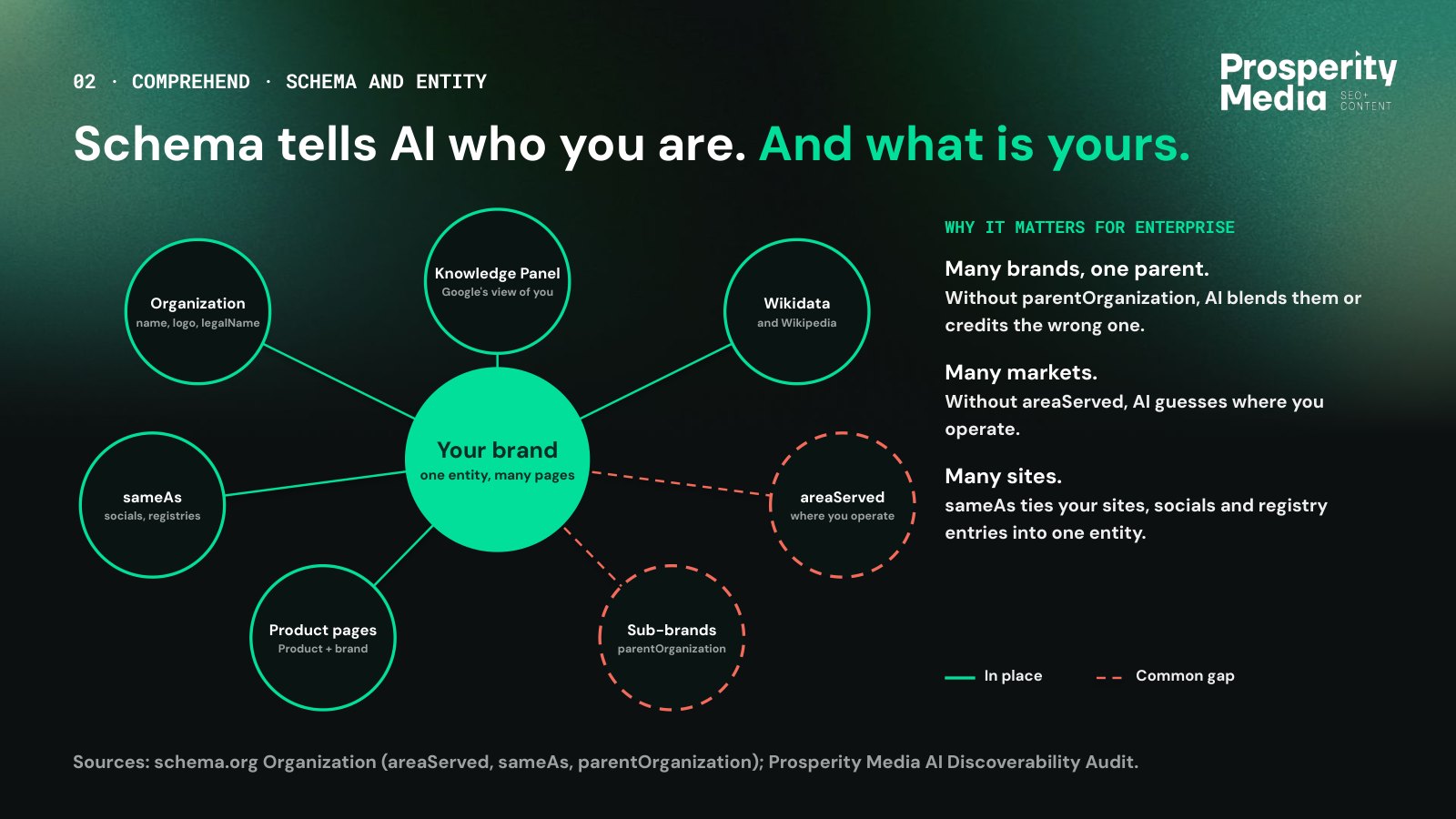
Here is what that looked like for one Australian insurer. Its Google rankings were #1 in every state. Its AI mention rate was not.
Entity case
One insurer: strong at home, hard to find next door.
Its Google rankings were #1 in every state.
The audit found no areaServed on the insurance site, no Organization markup on product pages, and a sister organisation with the same name that declared a home-state service area. Every engine concluded the insurer only operated in its home state. The fix: audit the Knowledge Panel, Wikidata and Wikipedia for each entity that shares the name, add Organization, areaServed and sameAs to every product page, and re-run the same state prompts to test it. A minimal version of that markup:
Illustrative markup
Organization, areaServed, parentOrganization and sameAs, on every product page.
JSON-LD (placeholder values, swap in your own)
{
  "@context": "https://schema.org",
  "@type": "InsuranceAgency",
  "@id": "https://www.example.com.au/#org",
  "name": "Example Insurance",
  "legalName": "Example Insurance Pty Ltd",
  "url": "https://www.example.com.au/",
  "areaServed": [
    { "@type": "State", "name": "New South Wales" },
    { "@type": "State", "name": "Victoria" },
    { "@type": "State", "name": "Queensland" }
  ],
  "parentOrganization": { "@id": "https://www.examplegroup.com.au/#org" },
  "sameAs": [
    "https://www.wikidata.org/wiki/Q00000000",
    "https://www.linkedin.com/company/example-insurance",
    "https://abr.business.gov.au/ABN/View?abn=00000000000"
  ]
}Check every place the facts live, not just one. If your schema, your Knowledge Panel and Wikidata disagree, the conflict creates the problem. A Wikipedia entry, where you qualify for one, adds a lot.
Three checks we run on every audit, all free
- View as a bot. Raw HTML against the rendered page. RenderFox does this for free.
- Freshness. dateModified in schema and a visible “Updated” date on the page.
- Entity check. A Wikidata entry, and sameAs links that match it.
Try it
Is your price in the HTML?
Terminal
curl -A "ChatGPT-User" https://yoursite.com/product | grep -c "\$1,299"Swap in your URL and a price from the page. 0 means AI can’t see it.
Actionable takeaway Run the price check on your top five templates before the next release.
Gate 3, Convince: is it worth quoting?
What we do, in order: map who AI cites, earn mentions there, and publish citable evidence (original data, named experts, comparisons).
Same topic, three markets, three source lists
Mentions are not citations, and different engines do not cite the same sources. We pulled teeth-straightening questions across six AI engines in three markets.
Mention sources by market
Same topic, three markets, three different source lists.
| Market | Top cited sources | Clinic sites’ share |
|---|---|---|
| Australia | Orthodontists’ association, Reddit, YouTube | 50% |
| Singapore | Three local dental clinic sites | 58% |
| India | YouTube, a dental chain, Healthline | 49% |
Pull the cited domains per market before you plan any outreach. In India the list included medical publications. Few teams can get a placement in a medical journal quickly, so knowing that early changes what you promise.
In Australia, small clinic sites win, and each engine reads differently
Small sites win
In Australia, small clinic sites win. Each engine reads differently.
83%
of clinic-site citations went to sites with Domain Rating under 30
| Engine | Leans on |
|---|---|
| ChatGPT | Health publishers 21%, journals 15% |
| Perplexity | Forums and reviews 14% |
| Google AI Mode | Social and video 9% |
Plan placements per engine: journals and health publishers for ChatGPT, forums and reviews for Perplexity, social and video for Google AI Mode.
AI cites lists, whoever builds them
List sites
AI cites lists, whoever builds them.
6,526
“best of” lists on bestinhood.com, ranked from Google Maps ratings, in 63 cities
332
AI citations in Australia: ChatGPT 169, Perplexity 116, Copilot 47
35
Domain Rating
bestinhood.com builds “best of” lists from Google Maps ratings, and the engines cite it heavily. List every list site AI cites for your category, and get your listing right on each. Our GEO citation analysis found listicles take 26.9% of AI citations in Australia. If you publish your own comparison pages, show the method and do not quietly put yourself first.
Pay only for mentions AI can read
Test a listing before you buy it. Last year the government’s childcare finder was one of the best places to be listed. It now blocks AI crawlers, so a listing there does nothing for AI visibility. Many directories are also JavaScript-heavy, so a listing that exists may never be read.
Readable sources
Plain HTML beats details buried in tabs.
Before paying for a listing, fetch it as ChatGPT-User and find your details in the HTML.
Your own channels are the easiest enterprise win
Earned coverage still matters (see how digital PR influences LLMs), but getting an enterprise to agree to a new third-party programme is slow. Getting it to use channels it already owns is faster. YouTube is the #1 cited source in India and #3 in Australia in the categories we track. Reddit is #2 in Australia and, in Ahrefs’ study of mention types, the strongest correlate of AI visibility. Even if a brand cannot run a Reddit account, it can answer the threads that are shaping its reputation.
Answer the top three Reddit threads about your brand this month, as the brand, with dated facts.
Gate 4, Convert: can you show the return?
What we do, in order: track SEO and AI together, let agents transact, and prove lift against controls.
Track SEO and AI in one report
Return on investment from LLM responses alone is very hard to justify, because GA4 only sees the minimum. Report AI referrals with proxies beside them: AI visibility as mention and citation share, branded search trend, and direct traffic to pages you do not promote. Read them together. Combining SEO and AI in one report also lets you show a return while AI attribution catches up.
Let agents transact: agentic commerce starts with a readable price
Let agents transact
Shopping agents shortlist a few stores.
3
merchant sites, at most, that Meta’s shopping agent searches by default. It is told to prefer well-known merchants.
I tested this while booking my hotel for this trip. I asked an AI agent to compare booking sites. Of the four it tried, it could read live prices on one. One never loaded its hotel list in a form the agent could read, one ignored my dates and one rate-limited it. The best deal turned out to be on a site the agent could not read, and I only found it because I checked by hand. Most buyers will not.
That was not robots.txt. It was how each site renders and gates live prices for automated visitors. Keep price, stock and product facts identical across your site, your feeds and Merchant Center, and make sure an agent can read them without a login or a challenge page. You do not need to build UCP or MCP endpoints on day one to get there.
Make forms agent-ready
Agent-ready forms
Can an agent finish your form? Test taps and fields like a bot would.
| Check | How to test | Effort |
|---|---|---|
| Tap targets 24×24 px or more | Lighthouse tap-target audit | Varies |
| A label on every field | Lighthouse accessibility audit | 15 to 30 min a form |
| Real buttons, not clickable divs | Walk the accessibility tree | 30 to 60 min |
| No invisible overlays | Inspect empty high z-index layers | 30 min audit |
Layout shift matters here too. If buttons move while the page loads, an agent clicks the wrong thing, or the value you earned on the visit bounces away. Run an AI agent through your top three forms before every release.
Prove lift against controls
Pick pages that are already cited, so you have a baseline. Keep matched control pages that you leave alone. Change one thing, wait at least 30 days, and report the gap against the controls, not the raw lift. The Ahrefs schema study shows why: raw AI Mode citations rose 43%, but against matched controls the lift was 2.4%.
Four-gate readiness checklist
Every action from the talk, in gate order. Tick what your site already does. Your progress stays in this browser.
Readiness check
Where does your site stand?
Book an AI Access Audit for your site
150
checks across Crawl, Comprehend, Convince and Convert, plus security
Every finding in this article came out of our AI Access Audit, the same audit we run for enterprise clients. We test whether AI crawlers and agents get past your firewall, whether they can read your content and prices without JavaScript, whether your entity signals are clear, and whether an agent can finish a purchase or a form. You get a report scored gate by gate, with fixes ranked by impact, confidence and ease.
Request an AI Access AuditSee our GEO services
Working on a large or multi-brand site? See our enterprise SEO work.
Questions
What is LLM visibility?
LLM visibility, often called AI visibility, is how often and how accurately AI assistants such as ChatGPT, Gemini, Copilot and Google’s AI Mode mention your brand, cite your pages and describe your facts when people ask about your category. It is measured with mention rate, share of voice, citation share, sentiment and accuracy, across repeated runs of the same prompts.
How do you measure AI visibility for an enterprise brand?
Run the same set of buyer prompts on each engine your buyers use, repeatedly, for at least four weeks, because AI answers change almost every time. Track mention rate, share of voice, citation share, the source map, sentiment and accuracy. Report presence, site readiness and business impact as separate layers, and split branded from non-branded prompts so branded questions do not inflate the score.
How do you track brand mentions in AI search?
Combine a market-wide tool such as Ahrefs Brand Radar, a daily prompt tracker such as Peec AI, Profound or your own, and Bing Webmaster Tools’ AI Performance report for first-party Copilot data. Segment by market and audience, and watch for model changes, which can move citations sharply within weeks.
Can AI crawlers execute JavaScript?
Mostly no. Vercel and MERJ found that 11.5% of ChatGPT’s crawler requests and 23.8% of Claude’s fetched JavaScript files, but neither crawler executed them. Content that only appears after JavaScript runs is invisible to them. Prerendering services such as Prerender.io or SEO4Ajax serve bots rendered HTML without a rebuild.
How do you block AI crawlers without losing AI visibility?
Decide per bot class. Training crawlers such as GPTBot are a business call. AI search fetchers such as OAI-SearchBot and PerplexityBot should almost always be allowed, because they cite you and send clicks. User-triggered agents such as ChatGPT-User should be challenged for abuse, not blocked. Then make sure your firewall and CDN rules say the same thing as robots.txt, because the firewall wins.
What is llms.txt, and does it help?
llms.txt is a plain-text file that lists the pages a site wants language models to read. It is cheap to add, but it is not an access fix: if bots cannot fetch or render your HTML, llms.txt will not save you. Fix firewall rules and rendering first, and customise platform defaults, which are often generic.
How do you get cited by ChatGPT?
Make sure ChatGPT’s crawlers can fetch your pages and read the facts without JavaScript. Then map which domains it already cites for your category and earn mentions there, publish citable evidence such as original data and named experts, and keep facts identical across your site, feeds and profiles. ChatGPT leans on health publishers and journals in some categories and on listicles in others, so check your category first.