
4 Reasons AI Gets Your Brand Wrong (and How to Fix Them)
AI
4 Reasons AI Gets Your Brand Wrong (and How to Fix Them)

 ChatGPT
 Claude
 Perplexity
 Grok
Grok
 Google AI
 You
You
 WhatsApp
 LinkedIn
A practical framework for diagnosing and fixing brand misrepresentation in AI search.
If you have watched an AI assistant confidently recommend three of your competitors for a query your brand fits perfectly, you have probably asked the same questions we hear from clients every week: Why does this keep happening? Is our own content to blame? Can we fix it?
Large Language Models (Google’s AI Overviews and AI Mode, ChatGPT, Perplexity, Gemini, and Claude) now sit between your brand and the people searching for it. For a decade, SEO was about which page ranked. The question now is what a model says about you when someone asks.
The good news is that brand misrepresentation is not a mystery. It comes from a few well-known quirks in how large language models work. Once you can identify the type of error, you can pick a fix that fits. This article combines three recent research papers and turns them into a simple framework for shaping your brand in AI search.
Key Takeaways
- Brand misrepresentation is four distinct failures: stale knowledge, clashing signals, entity confusion, and bad retrieval.
- Most brand knowledge a Large Language Model appears to lack is already stored. The real bottleneck is that information recall, not whether the fact was ever learned.
- A brand must clear three layers to appear in an answer: presence, recall, and selection, yet most marketers only target presence.
- Never ask an AI why it misrepresented you. Diagnose it by testing prompts systematically and watching behaviour.
- Improve brand visibility in AI search by building a retrievable fact graph: make facts explicit, corroborate them widely, and anchor your entity with clean structured data.
“The AI Gets Us Wrong” Is Four Different Problems
Before you reach for a fix, it helps to notice that “the AI describes our brand inaccurately” bundles several failures that need different treatments.
- Thin or ageing knowledge. The model only knows a little about you, or it learned about you a while ago. When it hits a gap, it guesses by copying what it sees from similar brands or repeating old facts: a discontinued product, last year’s pricing, an abandoned positioning. In hallucination terms this is an imitative falsehood, reproducing a pattern from adjacent data instead of your own truth.
- Clashing signals. Your site, an old press release, and a review aggregator each assert something different. With no clean source of truth, the model resolves the conflict toward whatever repeats most or looks most authoritative.
- Entity confusion. Shared names, common-word brands, or two companies in one space, where one entity quietly inherits another’s attributes.
- Bad retrieval. In grounded systems like AI Overviews or Perplexity, the model fetches the wrong page (a competitor comparison, a stale cache) and summarises it blindly. In short, the answer is accurate to a bad source.
This matters because each problem needs its own solution. Stale knowledge needs coverage, clashing signals need consistency, entity confusion needs disambiguation and bad retrieval needs better pages winning the fetch.
Brand misrepresentation is not its own separate phenomenon either. It maps cleanly onto the hallucination types researchers in the space have already categorized.

The table above is Cossio’s (2025) taxonomy of LLM hallucinations. Brand misrepresentation lands across several of these categories at once, most often the extrinsic, factuality, faithfulness, and amalgamated types.
Mapping each way your brand shows up wrong onto its place in that taxonomy points straight at the intervention it implies:
| How the brand shows up wrong | Hallucination type | Underlying mechanism | What it needs |
|---|---|---|---|
| Thin / ageing knowledge | Extrinsic / factuality (imitative falsehood) | Sparse or outdated encoding and gap-filling from lookalike brands. | Coverage and content freshness |
| Clashing signals across sources | Faithfulness / contextual | No clean source of truth and the model favours the most-repeated claim. | Consistency across owned and third-party sources |
| Entity confusion / merged brands | Amalgamated (knowledge overshadowing) | Shared names and common words collapse two entities. | Entity disambiguation and structured anchoring |
| Right answer, wrong page fetched | Faithfulness (retrieval failure) | Grounded system retrieves and summarises a poor source. | Better pages winning the fetch; corroboration |
Recall Is the Real Bottleneck
One of the biggest findings from Google Research’s Empty Shelves or Lost Keys? study is that factual errors often happen because models fail to recall information, not because they never learned it.
The researchers tested whether facts were:
- Encoded: stored in the model at all.
- Recalled: retrieved when the model is asked directly.
- Recognised: identified when the correct answer is shown among other options.
Across roughly 2,150 facts, 13 models and four million responses, the leading models had encoded around 95–98% of the facts tested. But they still failed to recall a significant share of information they clearly had stored.
The study compares this to owning a key but not being able to find it when you need it.
For brands, this matters when a Large Language Model recommends three competitors for a query your brand clearly fits. This does not necessarily mean the model knows nothing about your brand. The right information may already be there, but the association did not surface.
This problem is especially strong for less common, long-tail facts. Models may encode these facts at similar rates to popular ones, but recall them much less reliably. The research also helps explain the “reversal curse”, where a model can understand that A relates to B but struggles when the same relationship is asked in reverse.
This gives us a three-part framework:
- Presence: does accurate information about your brand exist online?
- Recall: can the model retrieve that information when prompted?
- Selection: does the model choose your brand when answering the user’s question?

Most SEO and content strategies focus heavily on the presence layer. This research suggests that, for AI visibility, recall is the hidden bottleneck.
Don’t Ask the AI Why It Got Your Brand Wrong. Its Answer Might Be a Guess
When an AI gets your brand wrong, our first instinct is to ask it why. But research from Anthropic shows we shouldn’t trust that explanation too much.
The study tested whether models could accurately recognise what was happening inside their own reasoning. Even the strongest models at the time, Claude Opus 4 and 4.1, only detected an injected thought about one in five times under the best conditions, and small changes in wording could also affect the result.
In simpler terms, an AI can give a convincing explanation for why it recommended a competitor without actually knowing whether that explanation is true. The answer may sound logical, but it could simply be a plausible story created after the fact.
We’re now in the Claude Opus 4.8 and Gemini 2.5 era, so the exact numbers may have improved, but the core finding is still worth keeping in mind.
So rather than asking, “Why did you recommend them instead of us?”, it is more useful to test the model systematically. Change the wording, context and prompts, then look for patterns in what appears and what does not.
Build a Retrievable Fact Graph
If recall is the constraint, the content job changes shape. Recall rewards entities, then attributes, then relationships, then contexts (a dense, consistent web of associations a model can reconstruct on demand).
- Make facts explicit. Swap “crafted with revolutionary engineering” for machine-readable variables such as category, key specification, standout feature, and ideal use case.
- Corroborate widely. Retailers, reviews, articles, and structured data should all communicate the same information. This gives large language models multiple reliable ways to find and confirm the facts instead of relying on just one page.
- Anchor the entity. A clean Wikidata entry, a warranted Wikipedia presence, and a clear schema markup together cut down both confusion and stereotype-filling.
Because of the reversal curse, testing in just one direction like “Does the AI know us?” can make your recall look better than it really is.
Instead, test your brand in five different directions:
Brand → Product: What does this brand make?
Product → Brand: Who makes this product?
Attribute → Entity: Which product is best for [specific use case or need]?
Problem → Entity: What is good for [task or problem]?
Entity → Attribute: How many functions does this product have?
Take MYOB as an Example
A lot of GEO advice boils down to “create more informational content so the models learn about MYOB”. But if recall is the bottleneck, the question shifts from “Does AI know MYOB?” to “Can AI retrieve MYOB from different facts, entities, problems, and use cases a buyer might approach it through?”.
That means publishing more than “MYOB provides powerful accounting solutions for Australian businesses”. You want the underlying relationships to be unmistakable so the model can reach MYOB from any of them.
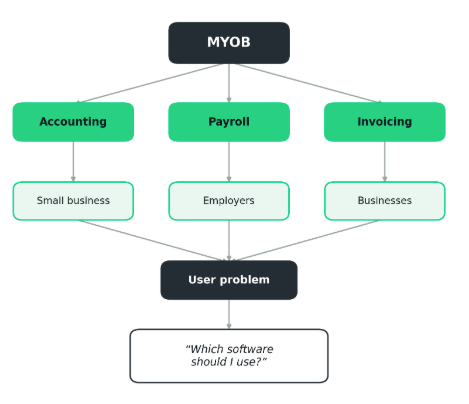
Each concept a buyer might start from should resolve back to MYOB, not only the brand name itself.
Tested against MYOB, the five directions become:
Brand → Product: What accounting and payroll products does MYOB offer?
Product → Brand: Who provides accounting software such as MYOB Business?
Attribute → Entity: Which platforms offer integrated payroll for Australian businesses?
Problem → Entity: I need to manage accounting, invoicing, and payroll for a small Australian business. What should I consider?
Entity → Attribute: What does MYOB Business include, and how do its payroll and invoicing features work?
We call this multi-directional retrieval: the goal is getting MYOB retrieved whether the buyer starts from accounting, payroll, invoicing, a problem, or a comparison.
At Prosperity Media, we use a brand coverage audit as part of our GEO offering to test these associations in two main ways.
- We generate bottom-of-funnel questions based on the brand’s entities and the types of questions a potential customer might ask. This tests whether the model can work backwards from a product, need or attribute to the right brand (Product → Brand and Problem → Entity).

- We use an internal query fan-out tool that simulates the types of related searches AI Overviews may generate from an initial query. This helps us test the reverse direction: whether the brand is strongly associated with the relevant products, features, topics and use cases (Brand → Product and Entity → Attribute).

Combined, these tests show not just whether an AI knows the brand, but how reliably it can retrieve the right brand associations from different starting points.
How to Measure It: From Mention-Counting to a Recall Matrix
Most brand tracking platforms only show how often an AI assistant mentions you. That measures presence at best, and it blurs the three failure layers together. Instead, use a recall matrix: for each brand or product, ask the same set of simple test questions across the AI models that matter, then score each answer on a few clear measures (how often you’re mentioned, how accurate the facts are, how often sources are cited, where you appear in the answer, and how often you’re recommended) rather than just tracking mentions.
| Probe type | Example prompt | What a failure reveals |
|---|---|---|
| Direct recall | What is this product, and what does it do? | Core attributes not reachable from the entity |
| Reverse recall | Who makes this product? | One-directional access (reversal-curse pattern) |
| Attribute recall | How many functions does this product have? | Specific long-tail facts encoded but not recalled |
| Contextual recall | Which product suits homemade frozen desserts? | Problem to entity association never fires |
| Comparison | This product versus a named rival | Framing that favours or omits the brand |
| Recommendation | Best option for larger batches? | Selection failure despite adequate recall |
Why Work With Prosperity Media on AI Search
Fixing brand misrepresentation in AI takes hands-on experience, not just theory. Our Sydney team applies this approach across client accounts every day. If you’re ready to improve your brand’s visibility in AI search, get in touch with our team today.
