
The GEO Blind Spot: 6 Website Types Losing AI Visibility
AI
The GEO Blind Spot: 6 Website Types Losing AI Visibility

 ChatGPT
 Claude
 Perplexity
 Grok
Grok
 Google AI
 You
You
 WhatsApp
 LinkedIn
Most businesses have a performance blind spot, even when they make diligent efforts to monitor their most important metrics. SEO teams check rankings, traffic and conversion rates daily, sifting through data with a fine-tooth comb.
What many companies don’t check is whether they’re primed for an AI engine to mention them. By the time they’ve established the fact, months of invisible losses have already cost them untold leads.
As AI-generated answers become the first and last stop for a growing number of search queries, websites that don’t get cited are quickly losing visibility in the tools and platforms where most consumers discover and research their next purchase.
This Prosperity Media guide explains the types of websites at risk, the warning signs to watch for, and the proactive steps you can take to earn your place in the answers your customers are asking for.
Key Takeaways
- AI Overviews now appear on roughly 48% of tracked Google searches, more than doubling since early 2025
- When AI Overviews do show up, they reduce click-through to the top-ranking page by around 34.5%.
- Zero-click searches, where a user gets their answer from AI and never clicks through to a website, have climbed to 68% of all Google searches in 2026.
- Disappearing in the GEO era doesn’t mean losing your ranking. It means being left out of the answer users never look past.
- The websites most at risk are those with thin content, anonymous authorship, poor structure, and SEO habits built for a search landscape that no longer exists.
- The most visible brands in AI search aren’t necessarily the biggest or the best-known. They’re the ones that make it easy for an AI engine to verify their expertise, trust their authority, and extract a useful answer.
The Websites Ranking Without Being Seen
When we talk about websites vanishing from search, it’s worth being precise about what that means. It’s not a ban or a penalty. Your website will still exist, your rankings might even remain strong, and to the naked eye nothing will look obviously wrong. What changes is whether anyone ever sees you.
Google’s own AI Overviews now appear on 48% of tracked search queries, up from just 31% a year earlier. Pew Research found that when one of those summaries appears, users click through to a website just 8% of the time, compared with 15% when it doesn’t. That equates to roughly half the click probability, on a feature that now touches almost half of all searches.
This is the zero-click pattern in motion, and it’s no longer a fringe case. Similarweb’s clickstream data puts the US zero-click rate, searches that end without any click at all, at 68% in early 2026, up from 60% just two years before. The businesses that spent years earning and holding the top organic spot are watching that spot matter a little less every month. This is what makes citation the new search visibility battleground, not a nice-to-have.
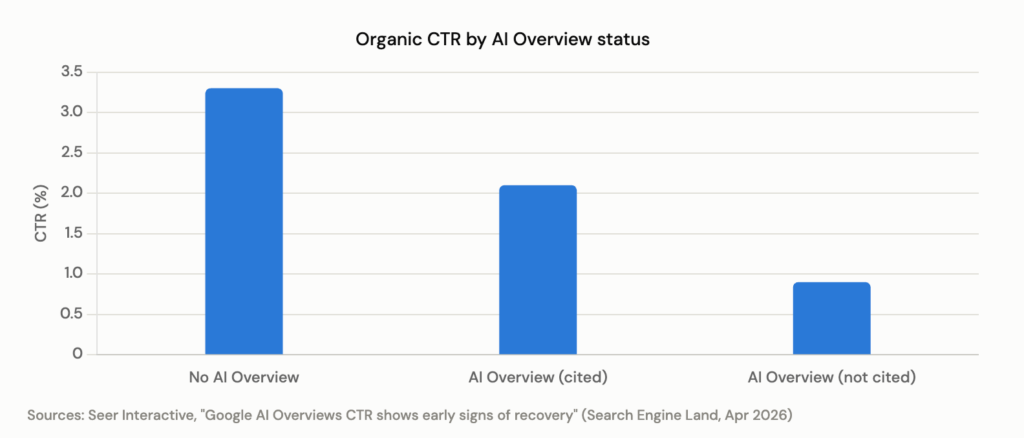
Seer Interactive’s tracking looked at websites already ranking on page one and found their organic click-through averages roughly 3.3% on searches with no AI Overview at all, compared with 2.1% when their page is cited inside one, and just 0.9% when it isn’t.
Even a page doing everything right by traditional SEO standards sees its best-case click-through more than halved the moment an AI Overview appears, and cut by nearly three-quarters if it isn’t one AI chooses to cite.
Is AI Nurturing Your Leads or Your Competitors’?
With the emergence of the zero-click pattern, countless businesses have noticed a trend. Organic traffic is declining, but conversion rates are rising. This is because users who once visited websites for research now get that information from AI engines, causing a natural drop in traffic. However, those who do eventually visit a business’s website have already established the facts and are prepared to buy, hence the spike in conversions.
HubSpot’s January 2026 survey of more than 3,000 CRM buyers found 42% used AI search during their evaluation process, and those buyers were 36% more likely to purchase than those who didn’t.
Today’s consumers are doing their research somewhere your website may never appear, and by the time they do land on a site, an AI engine has often already done the work a sales team used to do. It’s answered their early questions, compared their options, and narrowed the field before a human was ever involved. In effect, AI is nurturing leads. The question is whether it’s nurturing them on your behalf, or your competitor’s.
The Websites with a GEO Blind Spot
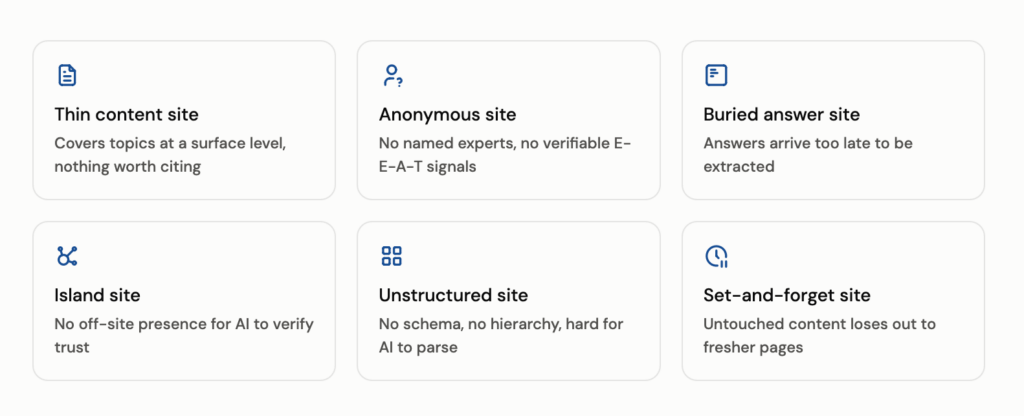
The websites most at risk of losing search visibility tend to share recognisable traits. In many cases, they were built using SEO approaches that worked perfectly well until recently. You’ll be pleased to learn that the same foundations can often be adapted for GEO rather than rebuilt from scratch.
See if any of the following scenarios sound uncomfortably familiar. If they do, follow the practical steps to help turn the situation around. None of these flaws are fatal. Fix them one at a time, and you can watch your GEO visibility recover in real time.
The Thin Content Site
This is the site designed to rank rather than to help, covering topics at a surface level, including all the right keywords without ever saying anything particularly useful. For years, this approach worked well enough to justify the investment. AI search has made it obsolete.
AI engines are looking for useful, informative sources, and thin content, by definition, doesn’t hit the mark. If your pages don’t provide satisfying answers to the questions users ask, an AI engine will simply find a page that does and cite it instead.
This is partly a coverage problem. Most AI engines don’t pull an answer from a single page. They break your query into a series of related sub-questions, a process known as query fan-out, then stitch an answer together from whichever pages cover each piece best.
If your content covers the head term but fails to address the follow-up questions a reader would naturally have next, you’re effectively handing that territory to whoever did make the effort to cover it.
Ask yourself: If an AI engine read your most important pages, would it find the insights comprehensive and useful enough to be worth quoting?
Actionable Steps:
✔ Audit your highest-traffic pages and ask whether they say anything a competitor’s content team couldn’t have written in an afternoon. Where the answer is no, create deeper content.
✔ Use tools like Qforia to simulate the query fan-out process to produce content with the informational depth AI is likely to cite.
✔ Add expert perspective, real examples, and specific answers that only an authority in your field could provide.
The Anonymous Site
No author bios, no named experts, no About page that tells visitors who is responsible for creating the content. In traditional SEO, this was a missed opportunity. In AI search, it’s a liability.
AI engines are designed to assess trustworthiness, and a site with no identifiable human expertise behind it sends all the wrong signals. Without clear evidence of experience and authority, a site is less likely to be cited as a credible source regardless of how good the content might be.
This is E-E-A-T in action: experience, expertise, authoritativeness and trust. It’s the framework Google popularised that AI engines have inherited. Arguably, it’s more influential than ever.
As well as prose, E-E-A-T is demonstrated through structured data. Person and Organisation schema, sameAs links pointing to verified LinkedIn or industry profiles, and consistent name-and-detail formatting across your site all give AI engines something tangible to check an author against.
Without strong E-E-A-T signals, even a highly qualified writer can seem anonymous to a machine that has no way to confirm they’re a real expert.
Ask yourself: If someone wanted to verify who wrote your content and why they’re qualified without leaving the page, could they?
Actionable Steps:
✔ ️ Add author bios to every piece of content on your site, including credentials, experience, and links to other places that person exists online.
✔ ️ Build out your About page to tell the story of your business, your team, and why you’re qualified to speak on the topics you address.
✔ Add Person and Organisation schema to your site, with sameAs links pointing to verified profiles on LinkedIn and other industry bodies.
The Buried Answer Site
These are the pages that dance around a topic without ever directly answering the question the user arrived with. It’s often the legacy of an old content strategy whereby padding out word count was considered a virtue. AI engines have limited patience for this kind of content.
AI is searching for clear, direct information when generating an answer, and meandering content gets passed over in favour of a page that provides a clear, succinct and upfront answer.
Most AI engines don’t read a page top to bottom the way a person does. They retrieve it in passages, pulling out the specific chunk of text most relevant to the query and largely ignoring the rest.
If your direct answer is buried under three paragraphs of scene-setting and preamble, the AI engine may never reach and retrieve the relevant passage, even if the rest of the page is well written.
AI engines are searching for a sentence they can lift on its own and have it still make sense out of context. That’s called the inverted pyramid. It’s not a new idea, but a newly urgent one in the GEO era.
Ask yourself: Could you delete every paragraph before your answer and still have a complete, standalone response?
Actionable Steps:
✔ Restructure your content so the most important answer appears early, ideally within the first two or three paragraphs, before any background or context.
✔ Approach content writing as though your reader only has thirty seconds. In AI search, that reader is a machine deciding in milliseconds whether your page is worth citing.
✔ ️Include key takeaways at the beginning of your content, making it easy for AI engines to parse the scope and depth of what’s covered.
The Island Site
This is the site that exists almost entirely in isolation, with no mentions from other websites, no press coverage, no directory listings, and no third-party validation of any kind.
In traditional SEO, backlinks were often enough to get by with. In AI search, the broader concept of off-site presence is even more central to how your credibility is verified.
AI engines don’t just assess what your website says about itself. They assess what the wider web says about you. A site that nobody else references, links to, or mentions is a site that AI engines have no external reason to trust.
Backlinks are still essential, but AI engines are trained on enormous volumes of web text, allowing them to pick up on unlinked brand mentions, forum discussions, social media mentions, and directory listings. This means a Wikidata entry or an active Reddit presence can move the needle more with GEO than a traditional guest post will. GEO-ready brands tend to think far beyond their website and show up across a wide range of online surfaces.
Ask yourself: Does your brand exist anywhere on the internet other than your own website?
Actionable Steps:
✔ Get listed in relevant industry directories and pursue media coverage wherever it’s available. If you have the budget, Digital PR can have a transformative impact.
✔ Contribute guest articles to publications in your field to establish recognisable off-site authority.
✔ Establish a strong presence on YouTube, LinkedIn, podcasts, industry forums, and any other platforms important to your audience.
The Unstructured Site
Good content that’s poorly organised has always been a problem to avoid. In the context of AI search, it’s an even more critical issue. No schema markup, inconsistent heading hierarchies, and walls of unbroken text all make it unnecessarily difficult for AI engines to parse what a page is about and extract meaningful answers.
AI engines are efficient by nature. They’re unlikely to make extra effort interpreting content that isn’t structured in a way they can easily understand. This means a competitor with a clearer, better-organised page on the same topic will always get priority over yours.
To avoid this, Article and Organisation schema help establish what the page is and who’s behind it. FAQPage and HowTo schema give AI engines a direct, structured route to follow when retrieving a specific answer from that page. Pair these with clean heading hierarchy and short, single-idea paragraphs, and you’ve created a page that a machine can parse in seconds
Ask yourself: Could an AI engine read your page and immediately understand what question it answers?
Actionable Steps:
✔ Implement schema markup across your key pages and use clear, descriptive heading hierarchies throughout.
✔ Break content into logical, scannable sections that each address a single idea. These are known as content “chunks”.
✔ Treat content structure not as a formatting preference but as a means of communication with AI. The easier your content is to interpret, the more likely an AI engine is to extract and cite it.
The Set-and-Forget Site
This is a site where the content was written once, performed reasonably well, and has been left untouched ever since. There have been no updates, no new perspectives, and no signs of ongoing engagement with a changing industry.
Previously, evergreen content could perform well for years on end with minimal upkeep. With GEO, this low-maintenance approach is no longer sustainable.
Freshness is everything to AI engines. They want to surface updated content to ensure they’re offering users the latest information. Many AI search engines blend their training data with real-time crawling, so a page that was last touched two years ago will likely get bypassed in favour of one a competitor updated last month, even if yours is still factually accurate.
Ask yourself: When did you last update your most important pages, and does that content still reflect the current state of your industry?
Actionable Steps:
✔ Add a regular content review cycle into your workflow. You should prioritise pages that drive the most traffic and focus on the topics most likely to be queried in AI search.
✔ Updating doesn’t mean starting every piece from scratch. Adding recent statistics, refining the structure, or expanding a section can be enough to signal to AI engines that your content is current and actively maintained.
✔ Display a visible “last updated” date on your key pages. It’s a small signal, but it gives both readers and AI crawlers an easy way to confirm the content is current without having to infer it.
Where Does Your Website Stand?
It’s critical to understand that GEO invisibility won’t suddenly announce itself. It’s a slow decline in traffic that’s easy to explain away until the trajectory gets too expensive to ignore.
The businesses with full visibility in AI search are the ones that have treated the shift as an opportunity to grasp rather than a problem to manage. Now, they’re capturing buyers who’ve already done their research and are ready to act.
At Prosperity Media, we help Australian businesses build the technical foundation, credibility and authority that AI engines cite billions of times a day.
If this guide has you wondering where your own website stands, book a free GEO audit with one of our experts. We’ll tell you exactly where you are and what’s standing between you and the customers already searching for what your business has to offer.
