How to Elevate Your Car Rental SEO
SEO
How to Elevate Your Car Rental SEO

 ChatGPT
 Claude
 Perplexity
 Grok
Grok
 Google AI
 You
You
 WhatsApp
 LinkedIn
For car rental companies, search is no longer just a traffic channel. It’s a revenue channel and, increasingly, the place where customers decide which brand to trust before they ever reach an OTA, comparison site or booking engine.
Travellers compare prices, vehicle types, locations and reviews across multiple platforms. The brands that win in 2026 will be the ones that appear when customers search for airport car hire, one-way routes, family trips and destination-specific needs. That visibility now matters across Google, Maps, OTAs or Large Language Models (LLMs) such as ChatGPT, Gemini, Perplexity and AI Overviews.
That is where SEO and Generative Engine Optimisation (GEO) become commercially important. SEO helps capture demand from traditional organic search. GEO helps your brand become visible, cited and recommended inside AI-generated answers. Together, they can reduce reliance on paid media and third-party distribution, increase direct bookings and give your business more control over the customer journey.
I have worked on car rental SEO, GEO and content strategies across Australia and New Zealand for more than four years, with some campaigns delivering over 12,000% ROI. If I were leading a car rental SEO and GEO strategy in 2026, these are the areas I would prioritise.
Key Takeaways
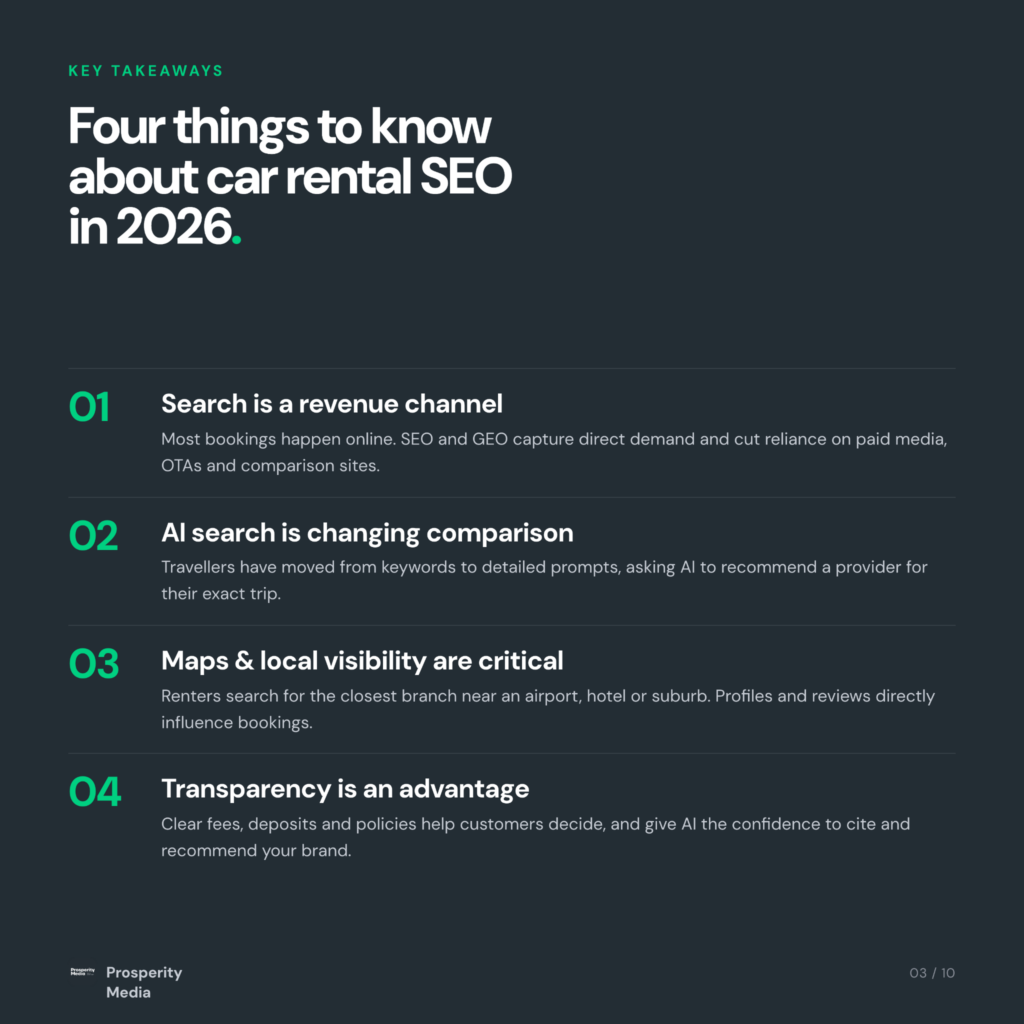
- Search is a revenue channel for car rental brands. With most bookings happening online, SEO and GEO can help brands capture direct booking demand and reduce reliance on paid media, OTAs and comparison sites.
- AI search is changing how customers compare car rental companies. Travellers are moving from simple keywords to detailed prompts, asking AI platforms to recommend providers based on trip type, location, vehicle needs, fees, reviews and trust signals.
- Local SEO and Maps visibility are critical to the booking journey. Many renters search for the closest branch near an airport, hotel, train station or suburb, so Google Business Profiles, reviews and local landing pages can directly influence bookings.
- Transparency is becoming a competitive advantage. Clear information on fees, deposits, insurance, one-way charges, tolls, pick-up requirements and cancellation policies helps customers make decisions and gives AI platforms more confidence when citing or recommending your brand.

Why does SEO matter in the car rental industry?
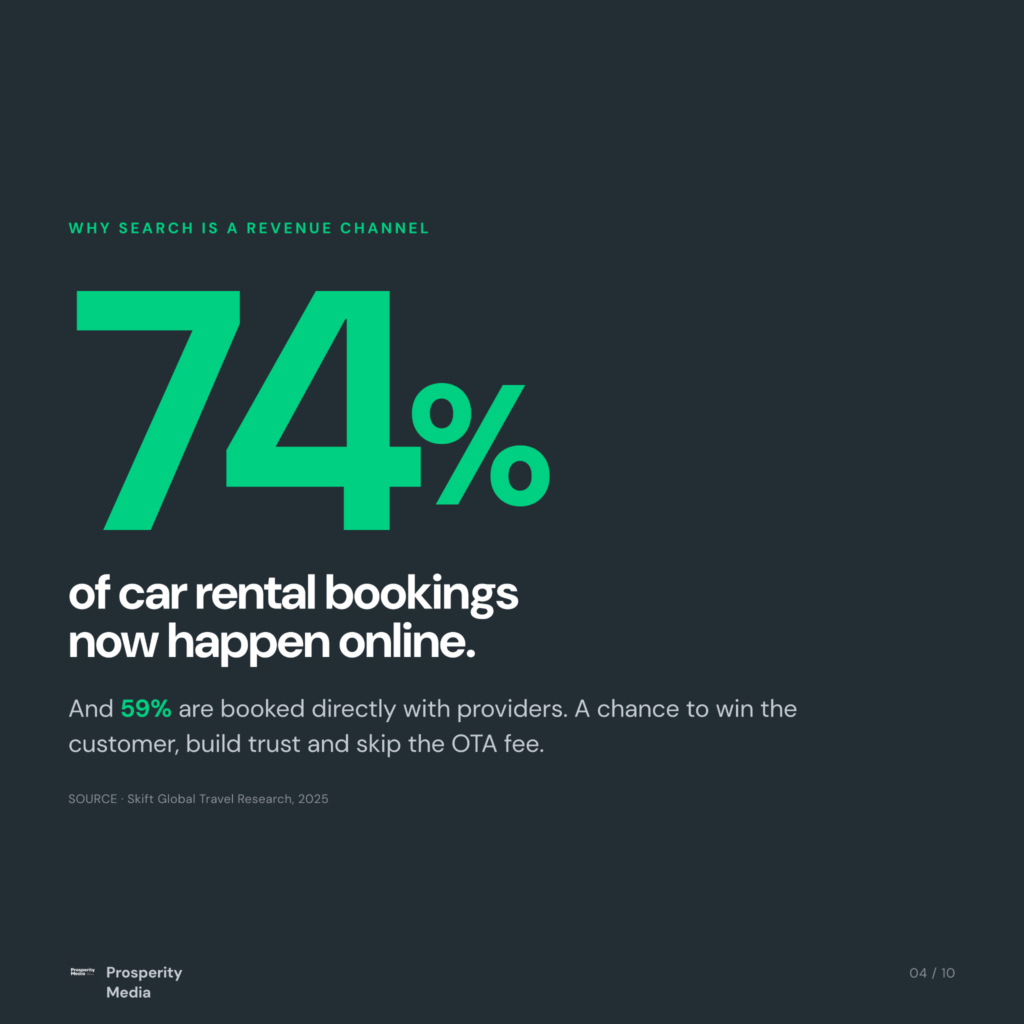
In 2025, Skift Global Travel Research Company reported that over 74% of global car rental bookings are made online and 59% are made directly with providers. For car rental companies, this makes SEO more than a visibility channel. It is a way to capture direct booking demand and reduce reliance on paid media, OTAs and comparison sites.
When customers are not loyal to a specific rental brand, they are likely to search non-branded queries such as airport car hire, car rental Australia, one-way car hire or hire car near me. Brands that appear in these searches have the opportunity to win the booking, build trust and turn a first-time customer into a repeat customer.
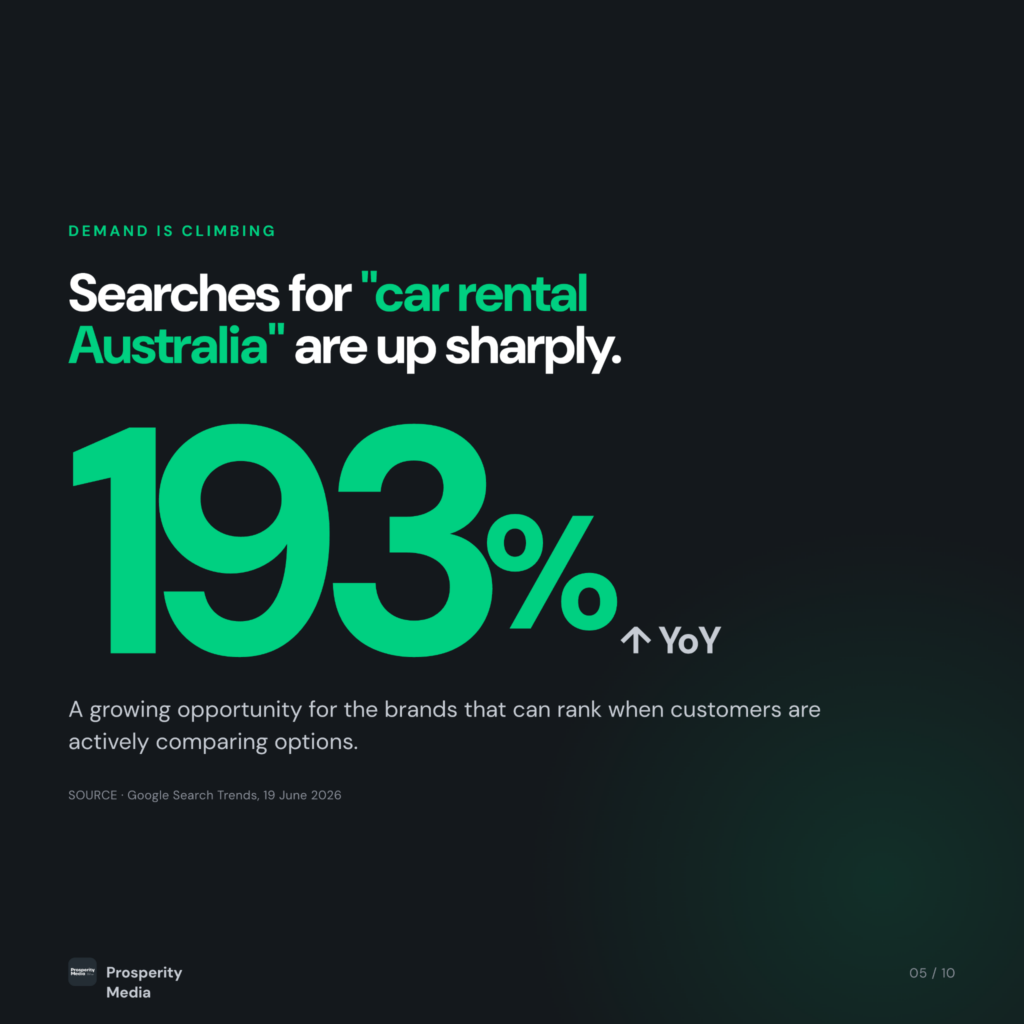
Demand is also rising. Google Trends shows searches for “car rental australia” increased by 193% over the past year among other car hire queries. This is a growing opportunity for brands that can rank when customers are actively comparing options.
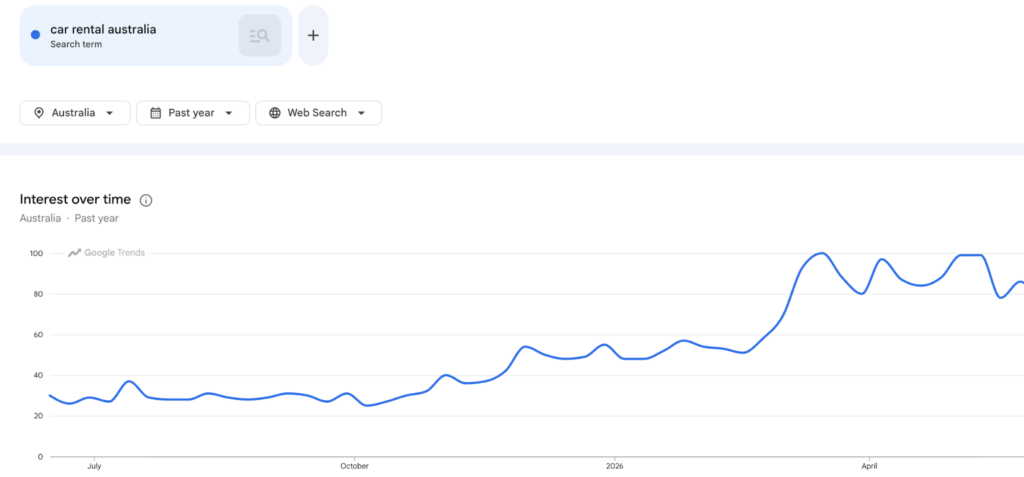
Source: Google Search Trends 19th June 2026.
How is AI search changing the way people book car rentals?
Search behaviour is shifting from simple keywords to personalised prompts and conversations. In Australia and New Zealand, traditional search demand is still heavily location-based, with queries such as “car rental Sydney” or “car hire Auckland Airport”. But AI search allows customers to be far more specific, from asking for the best vehicle for a surf trip to comparing short-term fleet options in Brisbane.
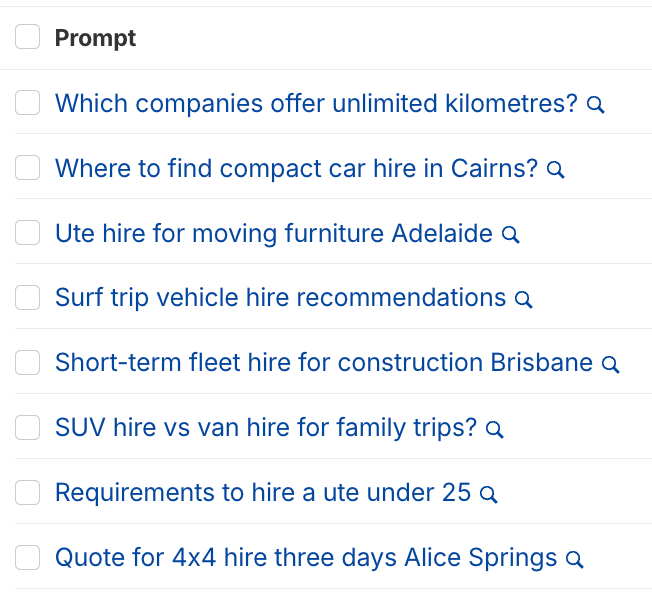
Source: Ahrefs Brand Radar
This changes how car rental brands need to show up. Customers are no longer only looking for a list of providers. They are asking AI platforms to compare brands, recommend options and explain which company best suits their needs. I think AI search challenges car rental brands to create content that speaks to specific customer needs, not just broad keywords. The brands that perform well will be the ones that clearly show how they help different audiences, from families and business travellers to tourists and fleet customers, and why those customers should choose them over another provider.
However, it’s not just about what you say about your own brand. AI-generated answers can pull from multiple sources, including brand websites, review platforms, forums, news articles, YouTube videos and local business profiles. This means SEO is no longer just about what you publish on your own website. It is also influenced by what customers, publishers and third-party platforms say about your brand, so having a strong online presence is crucial.
What makes a car rental SEO and GEO strategy stand out?
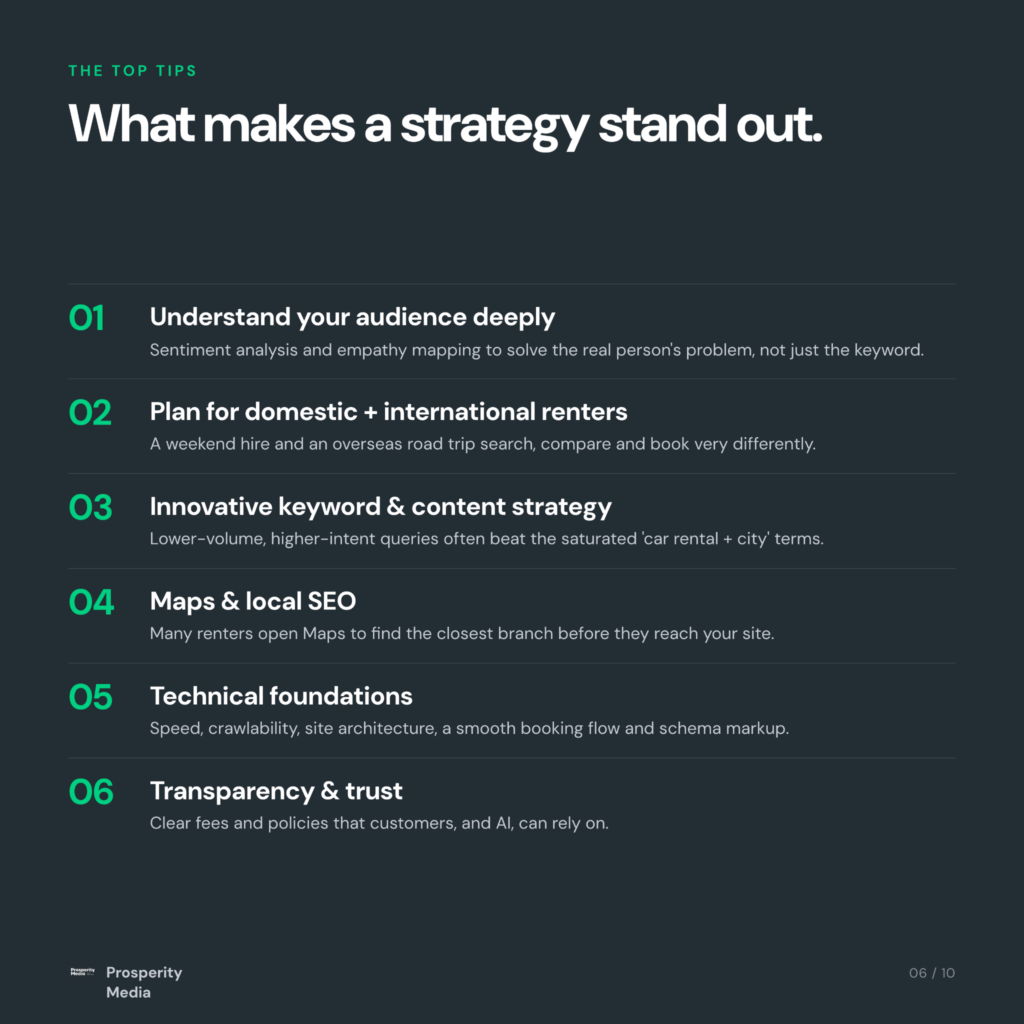
1. Deeply understanding your audience
AI search can answer highly detailed prompts and personalise responses to the searcher in a way that static search results can’t. One of the ways LLMs work is through query fan-out. So instead of only answering “best car rental companies in Sydney”, an AI platform may break that search down into more specific needs, such as “best for families”, “best for business travellers” or “best for drivers under 25”.
This means car rental content needs to go deeper than broad location keywords. To appear for a query like “best car rental company for families”, it is not enough to say you serve families. You need to understand what families actually care about, such as space, safety, child seats, luggage room, airport convenience, pricing transparency and flexible pick up options, then show how your service solves those needs.
I start content strategies with sentiment analysis and empathy mapping. I take the time to understand a target audience’s pain points, questions, considerations and decision-making factors by looking at forums, reviews, communities and competitor content.
This helps ensure every content recommendation is shaped around the real person looking for a solution, not just the keyword we want to rank for.
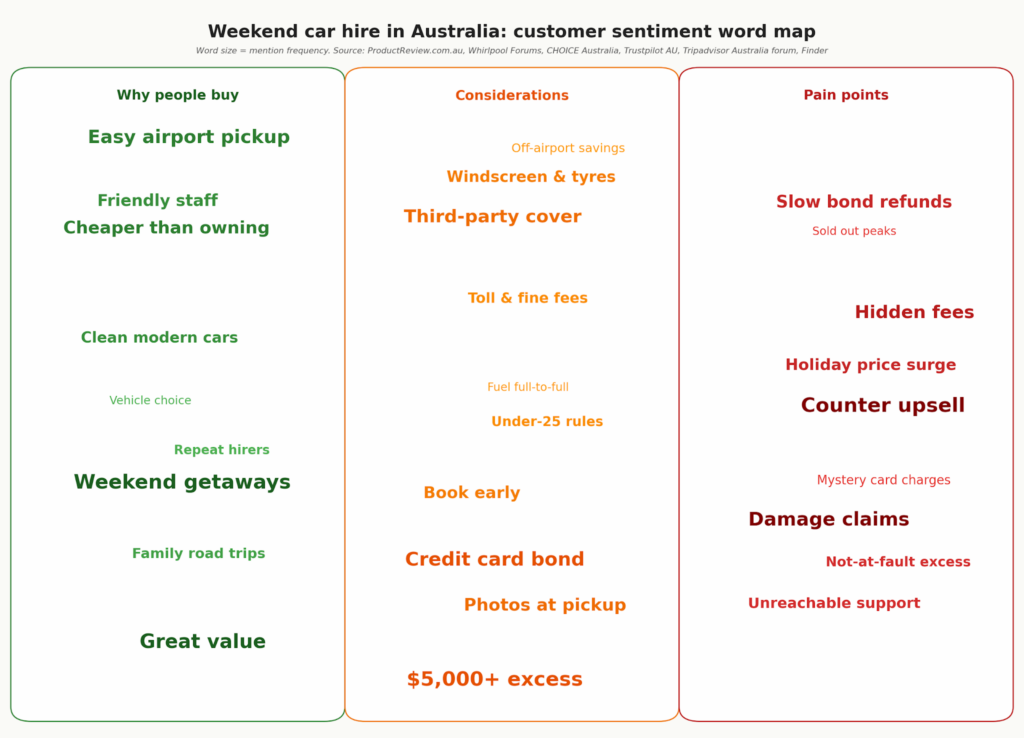
Source: Prosperity Media Sentiment Analysis
2. Build a strategy for domestic and international audiences
Domestic and international renters do not always search, compare or book in the same way. A local customer may be looking for a weekend hire car, an insurance replacement vehicle or a short-term rental close to home. An international traveller may be planning a longer road trip, comparing one-way routes, checking licence requirements or trying to understand tolls, insurance, bond payments and airport pick-up options.
One mistake I often see in car rental SEO strategies is focusing on traffic in general, rather than breaking down what different traveller groups actually need.
A visitor from the United States, Singapore, the United Kingdom or New Zealand may all be looking for car hire in Australia, but their questions, concerns and booking behaviour can be very different.
That is why I would complete keyword and audience research across your top domestic and international markets. The car rental industry is competitive and saturated with global brands, OTAs and comparison sites. Finding and answering the niche questions different renters have can give your brand a real competitive edge.
3. Innovative keyword research and content strategy
“Car rental + city” keywords are often the highest-searched queries in the car rental industry. They are also usually the most competitive.
In my experience, some of the best content opportunities sit in lower-volume keywords. These searches often show how customers have moved from a broad query, such as “car rental Sydney”, to a more specific need, such as “one-way car hire Sydney to Brisbane”, “car rental with child seats” or “ute hire for moving house”. These searches may have smaller volumes, but they often reveal clearer intent.
That is why I would not only focus on location pages. I would support the whole site with additional content for car rental services, audience-led content and helpful guides that answer the real questions.
The customer sentiment analysis should also shape your on-page SEO content. This is where SEO, content strategy and trust building all come together.
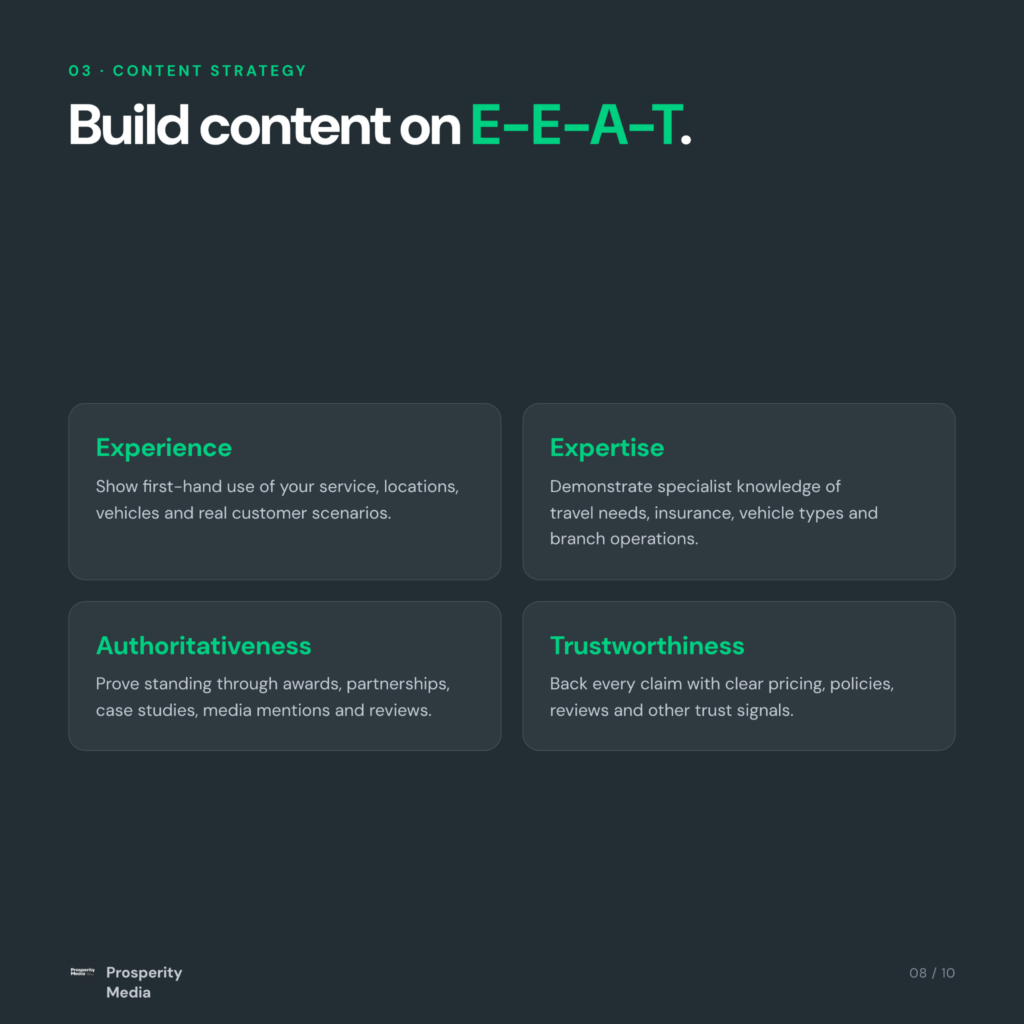
I also align content recommendations with Google’s quality rater guidelines and the E-E-A-T framework:
- Experience: Show first-hand experience with your service, locations, vehicles and customer use cases.
- Expertise: Demonstrate the specialised knowledge your team has about car rental, travel needs, insurance, vehicle types and branch operations.
- Authoritativeness: Show why your brand has authority in the market through awards, partnerships, case studies, media mentions, customer reviews and industry experience.
- Trustworthiness: Make sure your content is accurate, transparent and useful. Back up claims with clear pricing information, policies, reviews, awards and other trust signals.
I broke down my approach to E-E-A-T in content strategies at the 2025 Sydney SEO Conference. You can watch the full talk here:
4. Maps and local SEO
It can be surprising how much organic visibility car rental businesses can get through Maps and local search results. Many renters do not start by searching for a brand. They open Google Maps or search locally to find the closest branch to their home, hotel, airport or train station.
For car rental companies, this makes local SEO a key part of the booking journey. If your branches are not visible, accurate and compelling in local results, you may lose the customer before they even reach your website.
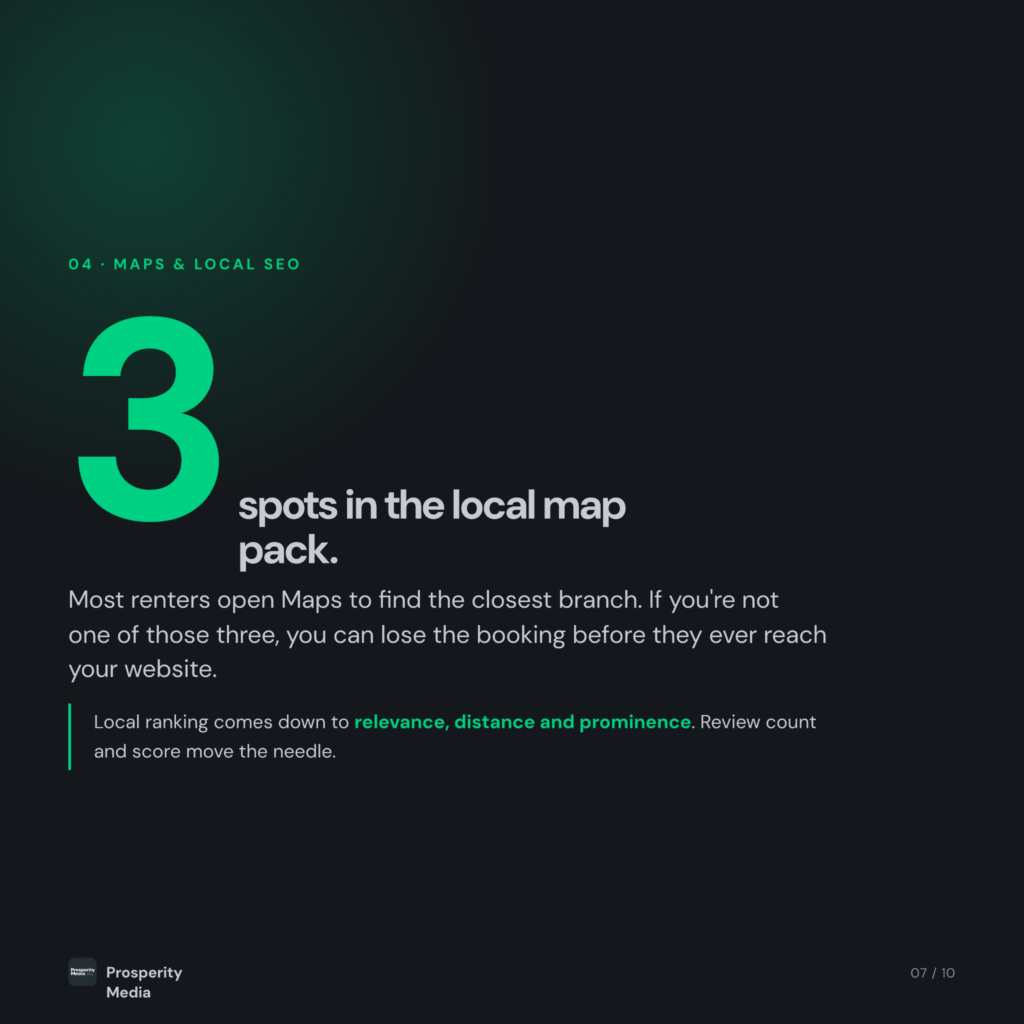
In Google’s local search results, the map pack usually only features three car hire companies:
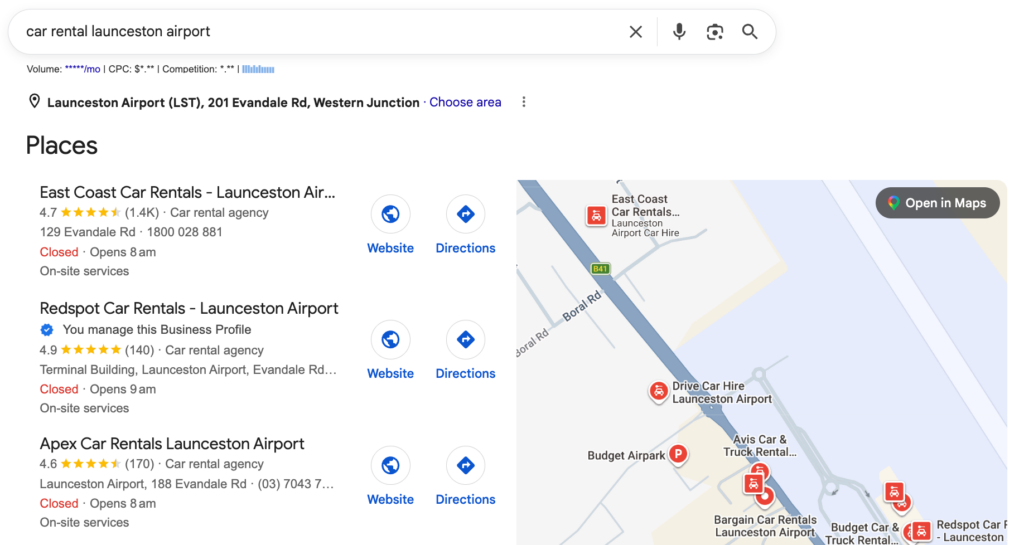
Source: Google Map Pack Search
The businesses that appear in these positions have stronger visibility and a better chance of winning the click, call, direction request or booking.
Use your keyword research and sentiment analysis to shape each Google Business Profile. Your descriptions, services, photos, posts and FAQs should reflect what renters actually care about.
Reviews also play a major role. Google says local results are mainly based on relevance, distance and prominence, and that review count and review score can help local ranking. That is why car rental brands should have a clear strategy to encourage happy customers to leave reviews, respond to feedback and build a stronger reputation across each branch.
5. Technical foundations
Website speed is not only important for search engines. It also matters for customers. If someone is comparing vehicles, checking availability or trying to complete a booking, a slow or clunky website can quickly become a lost sale.
For car rental websites, technical SEO needs to support the full customer journey. That means making sure important pages can be crawled and indexed, the site architecture is easy to understand, the booking flow is smooth, and the website performs well across mobile and desktop.
We regularly audit websites using a 100-point checklist, covering site speed, indexing issues, internal linking, site architecture, structured data and other technical factors that can affect organic performance. These health checks are important because even the best content strategy can underperform if search engines struggle to crawl, understand or trust the site.
Schema-structured data is also worth prioritising. It helps search engines better understand your locations, services, FAQs, reviews, breadcrumbs and key business information. For car rental brands, this can support stronger visibility across organic search, local search and AI-generated results by making your content easier for search engines and AI systems to interpret.
“Schema helps add an additional contextual layer to your web pages and enrich the visual experience of how they look in search engines. Schema isn’t necessarily a ranking factor but can assist rankings by influencing click through rates via rich results like star ratings.
“Some go to schema types we recommend for a multi-location car rental company is organisation schema for the home page, FAQ schema for a dedicated FAQ page per location (great for GEO), AutoRental schema for each location’s landing page (a subtype of LocalBusiness schema), breadcrumb schema across the site for signalling structure, BlogPosting schema for your blog posts, and Contact schema for your contact page.”
Aaron Taylor, General Manager at Prosperity Media and technical SEO lead for car rental campaigns for over 4 years.
6. Transparency and trust
When we conduct GEO brand audits as part of our GEO service, one of the common issues we see is a lack of transparency in on-page content. This can be one of the reasons a brand is not cited, recommended or favoured in an AI-generated answer.
For example, vague headlines like “no hidden fees” may sound reassuring, but they do not always give AI platforms enough detail to work with. If a customer searches for car rental fees, AI needs clear and specific information about what is included, what may cost extra, how your pricing works and what customers should know before they book.
This is where transparency becomes a competitive advantage. If you do not clearly define who you are, what you offer, what you do not offer and how you compare, AI may fill those gaps using third-party content, customer reviews, competitor pages or general industry assumptions.
Read more about this concept in our GEO Whitepaper.
Top things I would implement if I were the head of marketing for a new car rental company
- Fully optimised and consistent brand messaging across Google Maps, Bing Places, Apple Maps and Yelp.
- Persona-led content strategy.
- Schema implementation.
- Engaging and easy-to-use web design.
- Complete transparency on processes, fees and terms.
- Innovative Digital PR strategies with data and value-add for the travel market.
The experience we’ve had in car rental SEO, GEO and content
We’ve worked with both global enterprise car rental brands and local operators across Australia and New Zealand for more than four years. In that time, search in the car rental space has changed quickly. From Google Core Updates giving more visibility to comparison sites, to the goalposts moving from simply ranking in the top three organic results to being cited in AI Overviews.
That is why we do not treat car rental SEO as a simple content or technical exercise. Every campaign is shaped by both technical SEO expertise and creative content strategy. The work is grounded in how search engines crawl and rank pages, but also in what real travellers need before they book.
This ability to adapt has helped us deliver strong results for car rental clients, including three APAC Search Awards and one Global Search Award.
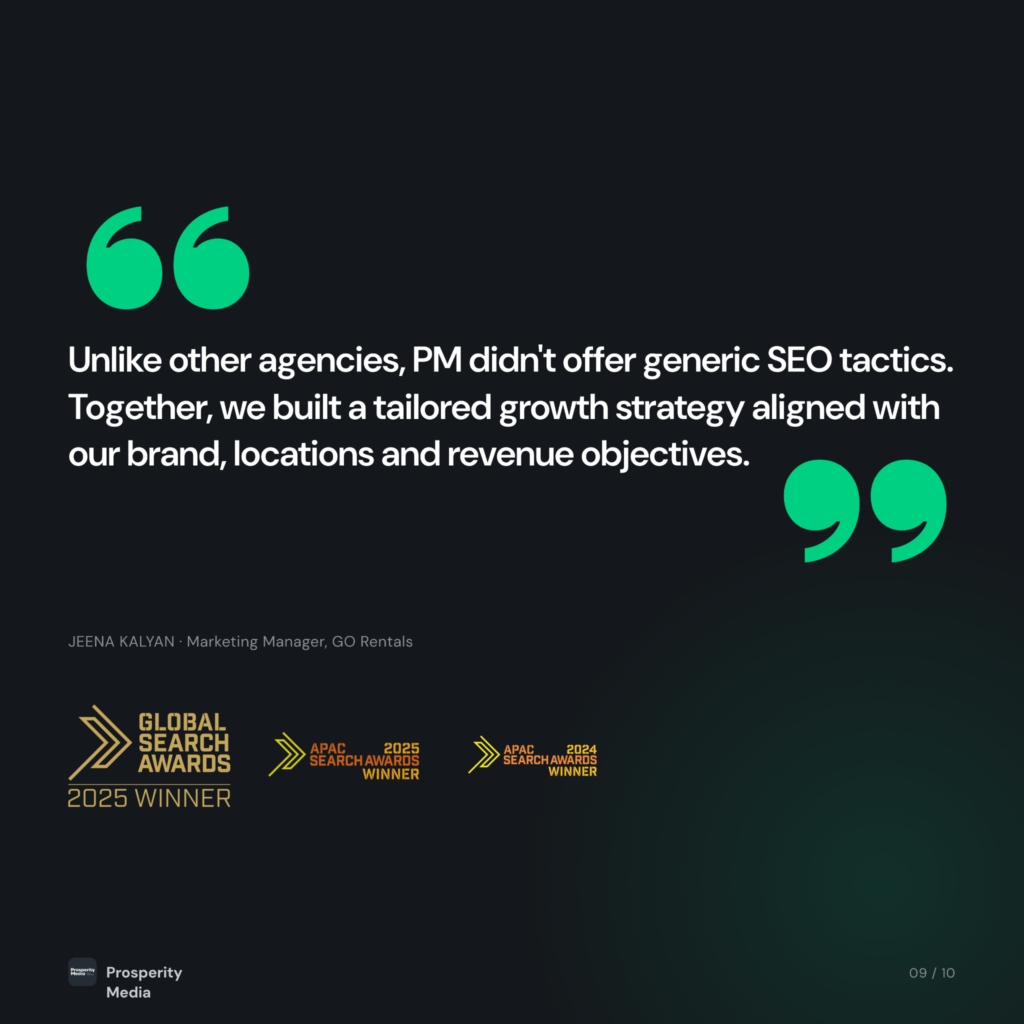
“Unlike other agencies, PM didn’t offer generic SEO tactics; together, we built a tailored growth strategy aligned with our brand, locations, and revenue objectives. They were proactive rather than reactive, consistently bringing new opportunities to the table.”
Jeena Kalyan, GO Rentals
See our Car Rental SEO Case Studies: