
Add to Cart: How Prosperity Media is Winning the Digital Shelf
Digital Business
Add to Cart: How Prosperity Media is Winning the Digital Shelf

 ChatGPT
 Claude
 Perplexity
 Grok
Grok
 Google AI
 You
You
 WhatsApp
 LinkedIn
With millions of busy Australians swapping shopping trollies for touchscreens, the battle for product visibility is no longer fought in the supermarket aisle. It’s fought in the search results of supermarket apps and websites.
Digital shelf optimisation is the practice of strategically enhancing product listings on shopping platforms, so that when customers scroll through a list of options, your product is among the first they see. It draws on keyword research, a nuanced understanding of retail search algorithms, and a specialist approach to copywriting.
In this Prosperity Media blog, we’ll explore why many Australian brands are discovering digital shelf optimisation to be one of their most influential marketing channels. We’ll also use our work with a major food and drink brand to explain the process in full and show exactly what’s achievable when you get it right.
Key Takeaways
- Australia’s online grocery market is worth over $11.2 billion and growing every day. The way Australians shop for food has changed permanently, and all brands need to adjust to this new status quo.
- Online supermarkets like Coles and Woolworths use search algorithms similar to Google. Where your products appear in search results is not fixed, and climbing the rankings is not outside your control.
- Digital shelf optimisation combines keyword research, brand copywriting, and retail media expertise to improve a product’s search ranking on supermarket platforms. It is a distinct discipline from traditional SEO.
- Brand voice is critical all the way to the point of purchase. A well-optimised product listing not only ranks well, but rings true and converts browsers into buyers.
- Testing should be integral to the process. Higher search volume doesn’t always mean bigger results, and continuous A/B testing is what separates good campaigns from great ones.
- Prosperity Media has spent years developing the tools, expertise, and processes required to run best-in-class digital shelf campaigns. Our work shows what’s possible when the right team helps elevate the search visibility of your products.
The Supermarket in Your Pocket
Imagine that it’s your child’s birthday party tomorrow, and you’ve just realised you’ve forgotten the snacks. You’ve got a work deadline bearing down, dinner with friends after, and no time to set foot in a supermarket. Luckily, it’s 2026. You can use the supermarket app on your phone to order everything you need for a morning delivery. Problem solved and crisis averted.
You start with the obvious: potato chips. You type it into the search bar, and a long list of options fills the screen. Dozens of colourful chip packets cascade down three pages. You scan the first few options, spot a familiar brand, and add it to the cart.
In this scenario, what are the chances you would have scrolled through all three pages, past two hundred-odd choices, before making a decision? For most people, no chance at all. You picked from what was in front of you, which means whoever was positioned at the top of that page was already well-positioned to be your choice.
If your brand has products on Coles, Woolworths, Amazon, or another online shopping platform, appearing high in search results offers an enormous competitive advantage. However, you’d probably assume the position is completely out of your control. The platforms simply decide the order, and that’s that. There’s no outside influence and no way to increase your visibility. Well, in this case, you’d be wrong.
Online shopping platforms work a lot like Google. There are keywords, ranking algorithms, and optimisation strategies that brands can leverage to climb higher on the digital shelf.
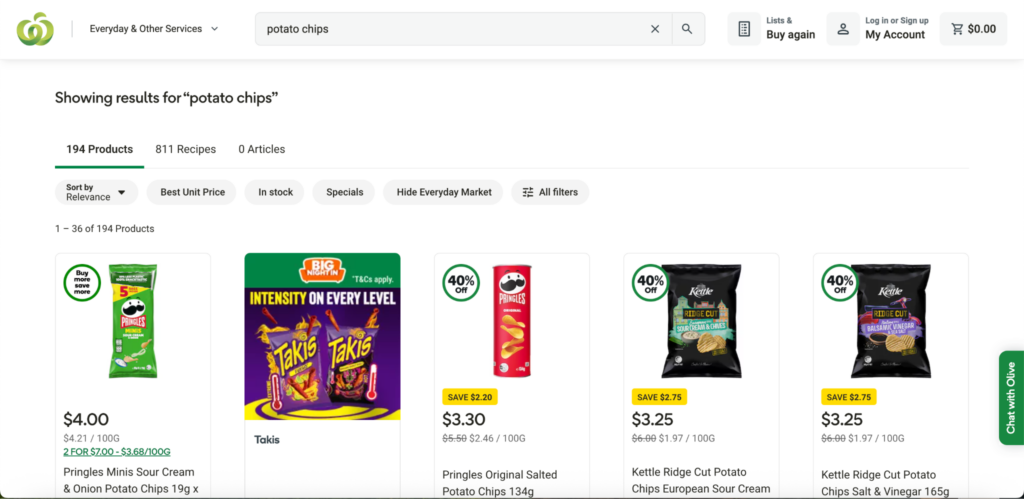
A search on Woolworths for “potato chips” returns a list of almost 200 products. Appearing near the top of results primes your product to be purchased, while only featuring at the end dramatically reduces your visibility.
At Prosperity Media, we’ve been working with our client for several years to optimise the visibility of their full portfolio of snacks and drinks. If you do search for potato chips on Coles or Woolworths and find one of their brands first, that’s no accident. It’s the result of extensive keyword research by our SEO team and optimised product descriptions written by our content specialists, all designed to help our client claim the coveted top spots in the search results.
The Online Grocery Shopping Boom
IBISWorld reports that Australia’s online grocery market is now worth over $11.2 billion and has grown at a compound annual rate of 14.7% between 2020 and 2025. The pandemic forced millions of Australians online out of necessity. However, when the doors reopened, the habit remained.
Figures from IBISWorld show that online shopping has been both Coles and Woolworths’ strongest growth channel over the past two years. Coles in particular recorded a 27.5% jump in online sales in the twelve months to March 2025.
Commenting on the surge in an interview with IT News, Coles CEO Leah Weckert points to a deliberate investment in the digital experience as the biggest driver of growth.
Weckert observes that enhancements to the Coles app, including shoppable recipes and self-serve refunds, have enhanced the user experience, giving people more reasons to digitise their grocery shopping beyond the obvious advantage of convenience.
Dematic reports that Coles has built several warehouses measuring 90,000+ square feet over the past two years, with robots capable of picking and packing 50-item orders in under five minutes. Instead of simply watching the online grocery shopping trend unfold, the supermarkets are proactively building entire fulfillment ecosystems that facilitate its ongoing expansion.
Further growth is a foregone conclusion. MarketResearch.com has forecast that the Australian online grocery market will be worth AUD $51 billion by 2034, accounting for as much as three-quarters of all grocery purchases.
What do these lofty figures mean? Well, the supermarket of the future isn’t a brick-and-mortar store with a gauntlet of products that you push a trolley through. It’s an online space with more tempting options for consumers than ever before, governed by an algorithm that determines which options are most prominent. The brands that understand this change will be the ones filling Australia’s online shopping carts in the years ahead.
Digital Shelf: From Aisle to Algorithm
For food and drink brands, the rising popularity of online grocery shopping creates a new playing field. Physical shelf space has always been tightly contested. Eye-level placement and end-of-aisle positioning have always been the prized real estate that brands have vied over. However, that fight is steadily migrating into a digital environment that many brands haven’t fully mapped.

For food and drink brands, the aisles of the physical supermarkets remain a priority, but the digital shelves of shopping platforms are more valuable than ever before. Post-Covid 19, that value has grown faster with every passing year.
What’s surprising is that the digital shelf is far from a new phenomenon. Coles and Woolworths have had fully functional online stores for well over a decade, yet a significant number of brands selling through these platforms have never given their optimisation efforts the level of attention they deserve. The product listings are basic, any covered keywords are a lucky byproduct of a generic description, and ultimately, low search rankings reflect a low level of effort.
In an online marketplace where millions of Australian shoppers have their credit cards ready from one moment to the next, the decision not to optimise for product visibility is worse than adopting a neutral position. It’s a conscious choice to fall behind the competition.
What Makes a Winning Digital Shelf Campaign?
Digital shelf optimisation is about ensuring that when a shopper searches for something you sell, your product is among the first options they see. Achieving a high ranking requires a process built on data, and it starts with keyword research.
Cartology Keyword Research
At Prosperity Media, our primary keyword research tool is Cartology. This is a retail insights platform built specifically for the supermarket environment. Unlike general SEO tools, Cartology is designed from the ground up around how shoppers search within the online supermarket ecosystem, making it uniquely valuable for understanding in-platform search behaviour.
We supplement the data extracted from Cartology with Ahrefs to broaden our view of e-commerce habits, giving us a comprehensive picture of how Australians are searching for food and drink products across our target online retailers.
What this research often underscores is that shoppers don’t only search for a product. They search for a moment or an occasion. Take corn chips as an example. Our keyword research might uncover strong search volumes not just for “corn chips”, but for more specific, intent-driven terms, such as:
- Corn chips for nachos
- Corn chips for salsa
Individually, each of these represents a specific shopper with a clear purpose. When we layer in another high-volume search term like “Mexican night”, an opportunity to tie together a cluster of keywords emerges.
Identifying Keyword Clusters
Rather than optimising for each of the three terms laid out above in isolation, we weave them together into a concise product description paragraph that reads naturally for the shopper while tapping into a cluster of high-volume keywords. For a listing, that might read something like this:
“Our spicy corn chips are the ultimate addition to your next Mexican night. If you’re loading up corn chips for nachos, or looking for perfectly scoopable corn chips for salsa, they deliver a satisfying crunch and bold flavour that will have everybody reaching for more.”
This single paragraph targets three high-volume search terms in a way that feels like it was written for the reader, not the algorithm. Crucially, the keywords are captured in language and a writing style that is consistent with a distinct brand voice.
Brand Voice & Micro-Copywriting
Many brands invest heavily in a range of marketing channels, yet neglect their presence within online shopping platforms. Product descriptions are flat, generic, stripped of brand voice, and, ultimately, completely forgettable. It’s a big opportunity missed.
A shopper reading a product description is as close to the point of purchase as they’ll ever be, and the copy on the screen in front of them should be a branded asset specifically designed to sway them at a critical moment in the buyer’s journey.
If a consumer is comparing a handful of options near the top of a supermarket app’s search results, compelling copy that emphasises the appeal of a product could be the variable that tips the scales in your brand’s favour.
At Prosperity Media, we work across more than 20 unique brands for a single client’s portfolio. For each brand, we’ve developed detailed brand guidelines covering tone of voice, ideal customer profiles, and clear dos and don’ts that are guided by the client’s legal and branding compliance teams.
The listings, known as SKUs, also come with strict character and format constraints. They have to be short, succinct, and impactful while still offering broad keyword coverage. If this sounds like an intricate balancing act, it’s because it is. In the world of digital shelf optimisation, micro-copywriting is a critical skill.
“The Prosperity Media writers who work with digital shelf aren’t just good writers. They’re specialists in packing meaning, personality, and search value into a very tight word count. I’ve worked as a copywriter across a few industries, but the copy we create for PepsiCo is among the most challenging I’ve encountered. That said, when you get the process right and watch a product climb the listings, it’s very satisfying.” – Adam Wyatt, Prosperity Media Content Specialist & Copywriting Lead on the PepsiCo project.
Analysing Campaign Performance
Getting a listing optimised is the starting point, not the final hurdle. Once our updated SKUs are live, we track their performance using Data Impact, a specialist retail analytics platform that monitors product rankings and conversions across online supermarkets in real time.
The data tells us exactly how a listing is performing after optimisation, where further gains are possible, and whether competitors are outranking our products for target keywords.
In a channel where ranking and consumer buying patterns can change quickly, we rely on that level of visibility to track the impact of every optimisation campaign accurately.
Testing & Refining
Performance tracking is only valuable if you’re willing to act on what it tells you. A central component of our approach is a test-and-learn methodology, whereby we treat every optimised listing not as a finished product, but as a live hypothesis.
We regularly run A/B tests across SKUs and product titles, pitting different keyword combinations and structural approaches against each other to understand which has the biggest positive impact for a specific product and category.
For example, the keyword “high-protein snacks” has a Cartology yearly search volume of over 16,000, while “party snacks” sits at a more modest 8,500. One of our client’s nut brands is a party food staple, but also a good source of protein, making the product a logical fit for both terms.
You’d be forgiven for assuming that “high-protein snacks” is the stronger opportunity due to having almost double the search volume. However, when we placed SKUs targeting each keyword into competition with one another, “party snacks” won convincingly, likely because it aligns more closely with how shoppers actually think about the brand.
What does this tell us? Well, a longstanding SEO adage: search volume is an important guiding metric, but relevance to the user and brand fit are equally important, if not more.
However, we made no assumptions about which search term represented the bigger opportunity. Instead, we tested both to validate the best return on our efforts, which paved the way for a much larger batch of optimisations across the whole product line.
Claim Your Space on the Digital Shelf
Digital shelf optimisation requires a unique combination of supermarket search algorithm expertise, retail marketing knowledge, and brand copywriting skills. It’s comparable to traditional SEO, but requires a specialist skill-set that most agencies haven’t fully developed.
For many food and drink brands, using in-house capabilities and resources to climb the rankings isn’t a viable option. Access to Cartology and Ahrefs alone represents a substantial ongoing cost. That’s before you factor in the time required to develop platform expertise, create optimised SKUs, and run continuous testing cycles for your product portfolio.
At Prosperity Media, our team has spent years developing the systems, tools, and knowledge needed to run best-in-class digital shelf campaigns. The results of the work is proof of what’s possible when you tap into our wealth of experience.
If your brand has products on Coles, Woolworths, Amazon, or any other online shopping platform, and you’re not actively optimising your digital shelf presence, it’s likely that the competitors outranking you already are. However, with the right strategy and execution, that gap can be closed quickly.
Book a free consultation today to find out how a digital shelf optimisation campaign can help put your products at the top of the search results next time a customer is ready to click “add to cart”.
