How to Target Chinese LLM (AI Search) Users in Australia
AI
How to Target Chinese LLM (AI Search) Users in Australia

 ChatGPT
 Claude
 Perplexity
 Grok
 Google AI
 You
 WhatsApp
 LinkedIn
TLDR
● China is Australia’s largest source of net overseas migration and of international students.
● Chinese-speaking students and migrants often ask Doubao, DeepSeek or Qwen for advice, not ChatGPT.
● Those assistants answer from Zhihu, Baidu Baike, WeChat articles and Toutiao, where few Australian brands publish.
● On questions that don’t name a brand, assistants pick brands that many sources mention. One mention on your own site does little.
● Google barely sees this audience researching banks, insurance or property, so the research is happening somewhere else.
China is Australia’s largest source of net overseas migration and of international students. For banks, insurers, universities and property developers, that makes Chinese-speaking Australians a market worth winning. Chinese SEO in Australia has usually meant translated pages and a Baidu listing. But a Chinese student choosing a bank account often asks Doubao or DeepSeek, not Google or ChatGPT. Those assistants answer from the Chinese web, and few Australian brands publish there. This post covers how to target them: who the audience is, which assistants they use, what those assistants read, and where your brand needs to be.
Who arrives from China, and stays
In 2024-25, 69,860 people born in China moved to Australia and 34,700 left. That net gain of 35,160 was the largest from any country of birth. By June 2025 Australia had 731,540 China-born residents, its third-largest overseas-born group.
Students add to that. Department of Education figures show China supplied 23% of the 738,694 international students studying here in the year to August 2026, about 170,000 people. Visitors come too: 106,990 short-term trips from China in August 2026 alone, second only to New Zealand.
Each group makes big decisions in its first months here: a bank account, health cover, a course, a lease or a home. A lot of that research happens in Chinese, and often before they land.
What they search for on Google, and what they don’t
We compared Chinese and English search volumes for Google Australia in Ahrefs. Chinese-language searches are common for exchange rates and universities. For banks, insurance and property they are close to zero.
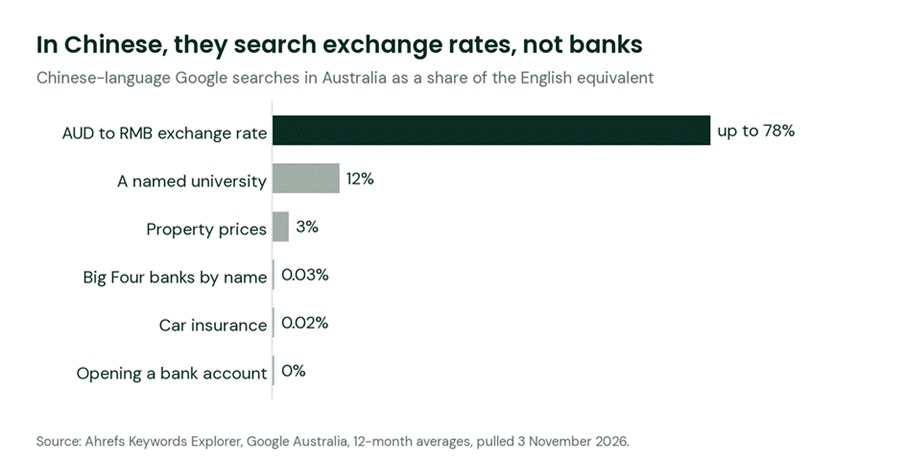
| Need | Chinese search | AU searches a month | English search | AU searches a month |
| Exchange rate | 澳币人民币汇率 (and about 24 variants) | 32,000 (up to 76,000 across all variants) | aud to rmb, aud to cny | 97,000 |
| A university | 墨尔本大学 | 1,900 | university of melbourne | 16,000 |
| Property prices | 悉尼房价 | 100 | sydney house prices | 3,400 |
| Big Four banks | Chinese bank names combined | About 660 | English bank names combined | 2.22 million |
| Car insurance | 澳洲车险 | 30 | car insurance | 122,000 |
| Opening an account | 澳洲银行开户 | 0 | open bank account australia | 300 |
Most of these searchers are already in Australia. Australia accounts for 48% of worldwide Google searches for 墨尔本大学 (University of Melbourne) and about 97% for 澳币人民币汇率. Mainland China isn’t counted, because Google is blocked there.
When they do search in Chinese, they land on English pages. For the Chinese names of CommBank, NAB, Allianz and the University of Melbourne, the top-ranking page gets most of its traffic from the English brand name. None of them appears to have a Chinese page that ranks. Chinese rental searches go to community sites such as Yeeyi and 滴答网 rather than the big property portals.
Treat these figures as a floor. Much of this audience’s research happens on Baidu, WeChat, Xiaohongshu and Douyin, or inside a Chinese AI assistant, and Ahrefs measures none of those. Many people also search in English: the acronym OSHC (Overseas Student Health Cover) gets 9,700 searches a month.
Which AI assistants they use
Doubao is the assistant most Chinese users open. QuestMobile’s June 2026 ranking puts it at 382 million monthly users, more than Qwen and DeepSeek combined and 77% of the 499 million people using AI apps in China.
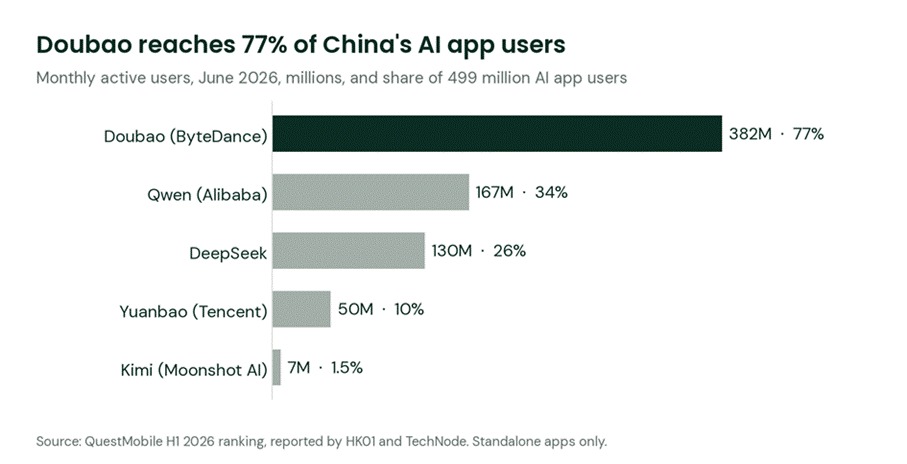
Those are standalone apps only. QuestMobile counts another 755 million people using AI built into their phones and 644 million using AI inside other apps.
Mainland China isn’t on OpenAI’s list of countries where ChatGPT is supported, so students and migrants arrive in Australia already using these assistants. They keep using them for decisions about money, study and housing here.
How this differs from other Australians
Most Australians who use AI use ChatGPT. Roy Morgan found that 58% of Australians aged 14 and over used an AI tool in an average four weeks in early 2026: ChatGPT 45%, Gemini 21%, Copilot 17% and Claude 3%. Telsyte puts Australia’s AI user base at 17.4 million people aged 16 and over.
Those assistants lean on the English web. Profound’s analysis of 680 million citations found Wikipedia makes up 7.8% of ChatGPT’s citations and Reddit 6.6% of Perplexity’s, and Peec ranks Reddit, YouTube, LinkedIn and Wikipedia as the most-cited sites overall. We looked at the Australian side in more detail in what LLMs cite in Australia and why. Chinese-speaking Australians largely use other assistants that read a different web.
| Wider Australian market | Chinese-speaking students and migrants | |
| Main assistant | ChatGPT, used by 45% of Australians aged 14 and over | Doubao, used by 77% of China’s AI app users |
| Others | Gemini 21%, Copilot 17%, Claude 3% | Qwen 34%, DeepSeek 26%, Yuanbao 10% |
| What answers draw on | Reddit, YouTube, LinkedIn, Wikipedia, publishers and brand sites | Zhihu, Baidu Baike, WeChat articles, Toutiao and Sohu |
| Google AU searches for the assistant | “chatgpt”: 11.47 million a month | Doubao about 10,600, Qwen about 4,150, Kimi 2,600 |
| Measured in Australian surveys? | Yes | No |
The two columns use different measures. The Australian figures are shares of the population, and the China figures are shares of AI app users in China. Read them as a pattern rather than a direct comparison.
AI already shapes big decisions here. AustralianSuper research found 17% of Australians use AI for financial decisions, and 45% of those use it to compare financial products.
DeepSeek is the one Chinese assistant that reached the mainstream, and it didn’t stay. Australian Google searches for it peaked in January 2025, and StatCounter has shown it at 0% of Australian AI chatbot referrals since October 2025.
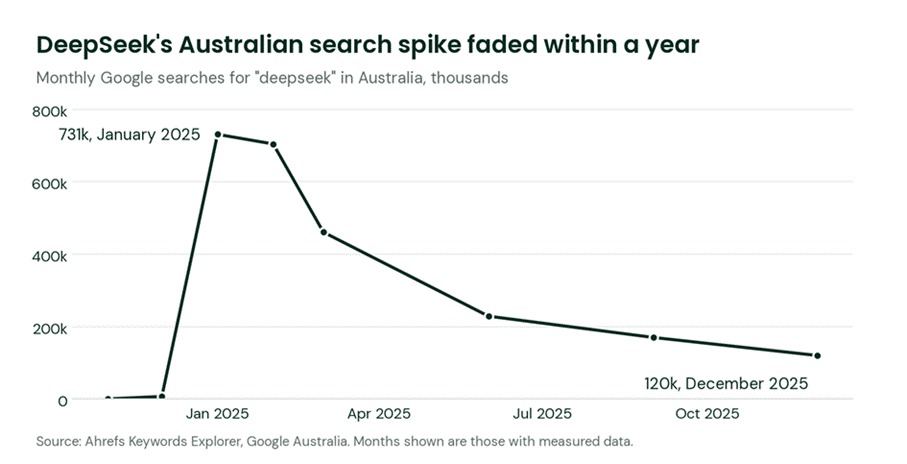
Doubao is growing from a small base: Australian searches for “doubao” rose 173% in a year, from 1,341 to 3,656 a month.
So a brand that has worked on its ChatGPT visibility can still be missing from Doubao, and no Australian report will show it. None of them splits results by language or country of birth, and we found no survey of which assistants Chinese students or Chinese-Australians use once they’re here.
Where Chinese AI assistants get their answers
Chinese assistants mostly cite Chinese platforms, and three of them favour sites owned by their parent company. Researchers at Fudan University measured 10 assistants and found that Chinese and English engines form largely separate citation networks. Chinese engines rarely cite English sources apart from GitHub and arXiv, so an English-only brand site is mostly out of their reach.
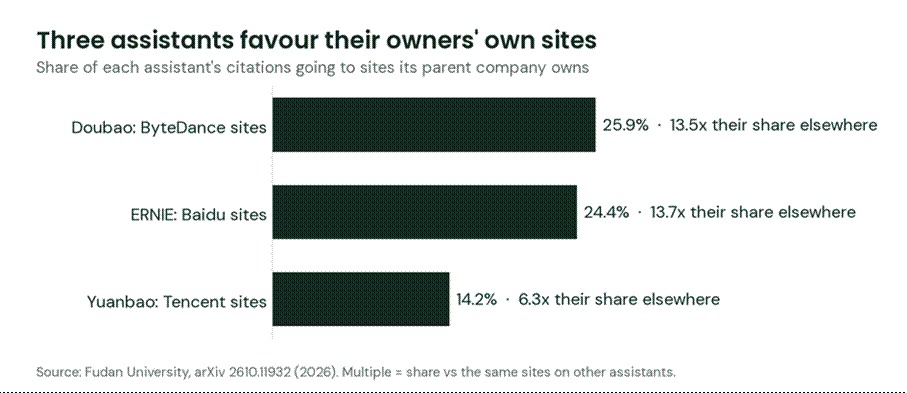
| Assistant | Owner | What it leans on |
| Doubao | ByteDance | ByteDance sites, Toutiao above all (13.6% of its citations) |
| ERNIE (Wenxin) | Baidu | Baidu sites, Baijiahao above all (20.0%) |
| Yuanbao | Tencent | Tencent sites, led by WeChat Official Account articles |
| DeepSeek | DeepSeek | The widest mix: its top 20 sites carry only 20.5% of its citations. In our tracking it cited Zhihu, Baidu Baike, Sohu and WeChat articles most. |
| Qwen | Alibaba | Baidu is its top source (10.1%). Its app and web versions share almost no source pages. |
Third-party content dominates. In a study of 160,860 citations by Aidso, a company that sells AI search monitoring, news, industry portals and social or creator content made up 69% of citations. Brand and corporate sites made up 12.9%.
Where you publish decides whether you get cited. In the Fudan experiments, posts on platforms an assistant prefers were cited within a day. A new self-hosted WordPress site with 40 posts wasn’t cited at all within a week.
When nobody names a brand
On questions that don’t name a brand, assistants include the brands that many separate sources mention. Aidso tracked 632,256 brand mentions on the pages assistants cited, and only 8.3% of those brands made it into the answer. The number of cited sources mentioning a brand predicted inclusion better than anything else.
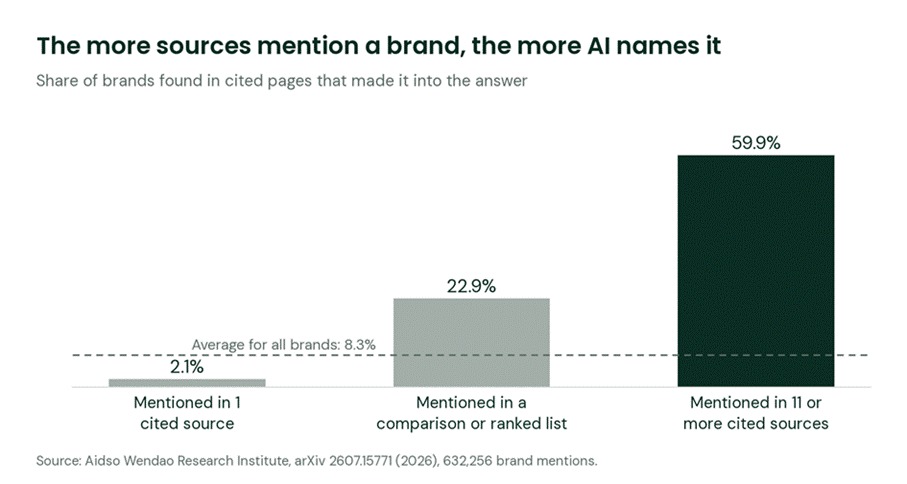
Vague questions rely even less on live sources. For the vaguest questions, 27.5% of brands named in answers appeared in none of the cited pages, so those brands seem to come from what the model already knows. A brand with little presence on the Chinese web is behind on both counts.
We saw the same thing in our own tracking. We asked four assistants a non-branded question about fees for receiving money from China, 20 times in total.
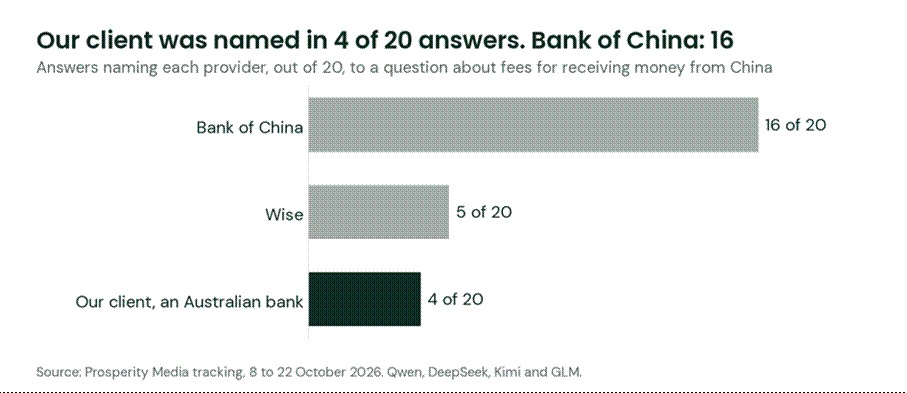
What our own testing showed
When a Chinese question names the brand, the brand does well. Between 8 and 22 October 2026 we ran 24 Chinese-language prompts that named an Australian financial services brand through Qwen, DeepSeek, Kimi and GLM, 421 answers in total. The assistants cited the brand’s own website in 414 of them (98%), and every assistant was between 98% and 100%.
The brand still shared those answers. Bank of China appeared in 83 of them and Wise in 75, ahead of two other major Australian banks at 26 and 25. Across its 128 answers, DeepSeek also cited Zhihu 46 times, Baidu Baike 42 times, Sohu 30 times, WeChat articles 29 times and Baijiahao 26 times.
Branded questions mostly look after themselves. Non-branded questions are where the brand loses ground to Chinese banks and remittance apps.
This was a first test with a small set of prompts, run through each model’s API with web search rather than the consumer apps. Our ongoing tracking extends it to seven assistants, adding Doubao, Yuanbao and ERNIE.
How to target Chinese AI search users
The principles of generative engine optimisation still apply, on different platforms. Western brands get into these answers by publishing in Simplified Chinese on the platforms each assistant reads, and by getting mentioned there by others. A translated page on your own site helps once people already know your name. It does little for the questions that don’t name you.
| Platform | Owner | Assistants that lean on it | What to publish |
| WeChat Official Account | Tencent | Yuanbao, plus Kimi and DeepSeek | Service guides, product explainers, contact details |
| Baidu Baike and Baijiahao | Baidu | ERNIE, plus DeepSeek and Qwen | An accurate encyclopedia entry and explainer articles |
| Toutiao and Douyin | ByteDance | Doubao | Articles and short video for the largest assistant |
| Zhihu | Zhihu | DeepSeek and most others | Expert answers to the questions your customers ask |
| Sohu and NetEase | Sohu, NetEase | Cited across nearly all engines | Articles and partner content |
Then build five habits:
● Get mentioned in many places. Inclusion rises from 2.1% to 59.9% as more sources mention a brand, so earned coverage, partners and community voices count for more than one strong page of your own.
● Write comparisons, definitions and how-to guides. Brands in comparisons and ranked lists were included 22.9% of the time. Long passages get cited in depth far more often: 39% for passages over 1,000 characters, against 10% for those under 100.
● Keep content fresh. Cited pages had a half-life of about 60 days, and for time-sensitive questions the median cited page was 18 days old.
● Write the Chinese your customers write. Mainland users write 澳洲 for Australia, not the formal 澳大利亚, and they need a Chinese name for your brand that they actually use. Have a native speaker check every page and every prompt you track.
● Measure each assistant separately. Their sources overlap little, and Qwen’s app and web versions barely overlap at all. Split your tracking by assistant, and by branded and non-branded questions.
One warning. The Fudan team found that 8 of 10 assistants cited a made-up concept within seven days of it being posted, and Doubao kept citing it after the posts were deleted. For regulated brands, that is a reason to get accurate, compliant content of their own onto these platforms, so the assistants have something reliable to cite.
Frequently asked questions
Can people in China use ChatGPT?
ChatGPT isn’t officially available in mainland China. Chinese users rely on local assistants, led by Doubao, Qwen and DeepSeek, and many keep using them after moving to Australia.
Which Chinese AI assistant has the most users?
Doubao, from ByteDance. It had 382 million monthly users in June 2026, 77% of China’s AI app users, according to QuestMobile.
Where do Chinese AI assistants get their information?
Mostly from Chinese platforms. Doubao favours ByteDance sites such as Toutiao, ERNIE favours Baidu’s Baijiahao and Baike, and Yuanbao favours WeChat articles. DeepSeek draws on the widest mix.
Is Baidu SEO enough for Chinese audiences in Australia?
Not on its own. Baidu Baike and Baijiahao feed ERNIE, and Qwen cites Baidu often, but Doubao and Yuanbao lean on ByteDance and Tencent platforms. You need a presence on each assistant’s preferred platforms.
Does an English website help with Chinese AI search?
Very little. Chinese assistants rarely cite English sources apart from GitHub and arXiv. When the user names your brand, assistants do find your English site. On every other question they rely on Chinese sources.
Where to start
Chinese-speaking Australians research big decisions in assistants that most Australian brands never check. Those assistants read Zhihu, Baidu, WeChat and Toutiao, and on non-branded questions they name the brands that many sources mention. Find out what Doubao and DeepSeek say about you today. Then publish where each one reads, starting with Toutiao and the other ByteDance platforms behind Doubao, the assistant with the most users.
Ask us to check your Chinese AI visibility
Sources and notes
1. Search volumes come from Ahrefs Keywords Explorer for Google Australia: 12-month averages, pulled 3 November 2026. Ahrefs does not measure Baidu, WeChat, Xiaohongshu or Douyin, and Google is blocked in mainland China, so its country figures exclude it.
2. Our own test figures come from Prosperity Media tracking: 25 Chinese prompts run through Qwen, DeepSeek, Kimi and GLM between 8 and 22 October 2026, 441 answers in all, using each model’s API with web search.
3. App user numbers for June 2026 come from QuestMobile’s ranking as reported by HK01. The 499 million, 755 million and 644 million totals come from QuestMobile’s half-year review, which dates them to May 2026.
4. The figures on citation depth, recency and content length in the five habits come from the Aidso study. Aidso sells AI search monitoring, so treat it as vendor research.
5. Data on what Western assistants cite comes from Profound and Peec and is mostly US-based.