
SEO & AI Search News: August 2026
SEO
SEO & AI Search News: August 2026

 ChatGPT
 Claude
 Perplexity
 Grok
Grok
 Google AI
 You
You
 WhatsApp
 LinkedIn
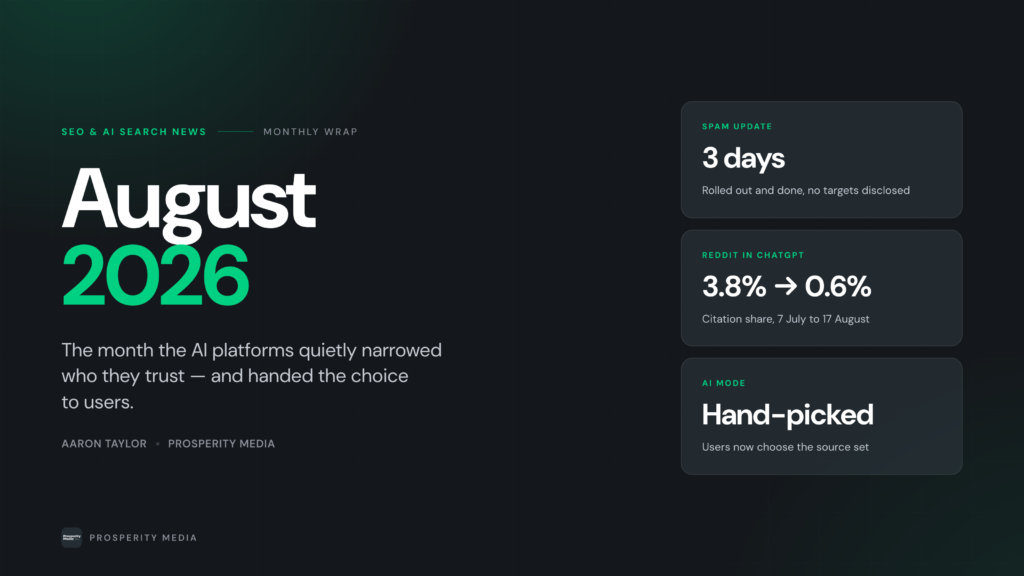
August was the month the AI search platforms started quietly rewriting the rules on who gets cited, and Google finished a spam update so fast most people missed it. Nothing here was announced with a fanfare. All of it changes what I would prioritise going into September.
Here are the five things from August that I think actually matter, what the evidence says, and what I would do about each one.
Key Takeaways
- Google’s August 2026 spam update rolled out and completed in under three days, with no targets disclosed. Scaled thin content and manufactured brand mentions are the likely focus.
- AI Mode now builds quizzes, tutorials, and notebooks from sources the user selects, which reduces the opportunity of using these tactics to drive clicks depending on user-adoption rates.
- Google built upon their embeddable “add as preferred source” button. More than 600,000 unique sources have already been selected, Google is now allowing users to customise their Google Discover feeds via chat.
- ChatGPT’s Reddit citations collapsed from roughly 3.8% to 0.6% of all citations after 8 August. Building an AI search strategy on Reddit threads is no longer a strategy.
- ChatGPT’s background fan-out has tripled, with 6 to 12 parallel searches per prompt now common, so a single page has more chances to be retrieved and more competition for the slot.
- Pew found AI authorship signals on 35% of pages published since ChatGPT launched. Detector-based, so treat it as directional, but the direction is obvious.
1. Google’s August 2026 Spam Update Has Finished Rolling Out
Google released the August 2026 spam update on 18 August and confirmed the rollout was complete on 21 August. Two days and change, which is quick for a spam update, and quick usually means narrow and targeted rather than broad and structural.
As always, Google has not said what it targeted. That leaves us reading the shape of the volatility rather than the announcement, and the shape points at two things: low-quality link patterns, and scaled thin content. The second one is the interesting half. Over the past year we have watched a lot of sites publish AI-assisted content at volume, and a lot of brands buy their way into “brand mention” placements on sites nobody reads. Both are cheap, both are scaled, and both are exactly the sort of pattern a spam update is built to find.
What I would do: pull a 21 August to 24 August segment in Search Console and compare it against the two weeks prior, split by page template and by content type rather than by URL. If a drop shows up, look at whether the affected pages share a production method. Then audit your recent link and brand mention acquisition. If you cannot defend a placement to a client, it was probably not worth having.
2. AI Mode Got A Major Update For Students
Google rolled out a set of study tools inside AI Mode for the back-to-school period. Users can now generate practice quizzes, interactive visuals and simulations, and study documents directly in search, and Gemini Notebook (a repurpose for NotebookLM) is now accessible inside AI Mode. The part worth noting is that people can build those assets from material they supply or select, including their own uploaded notes and slides.
Ignore the education framing for a second. The mechanic underneath is what matters: Google is giving users a way to constrain which sources an AI answer is built from. Grounding an output in a hand-picked source set reduces hallucination, which is a good thing for users, and it makes the citation set smaller and stickier, which is a harder thing for brands. Being one of the ten sources a model might pull from is a very different proposition to being one of three a user deliberately picked.
What I would do: stop optimising purely for retrieval and start optimising for selection. That means content that is unambiguously worth choosing as a reference source: original data, clear definitions, and structure a model can lift cleanly. Our piece on what GEO actually is covers the format side of this in more depth.
3. Google Discover’s Preferred Sources Are Now Easier To Customise
Three changes shipped together. Users can now customise their Discover feed conversationally through the three-dot menu on any card, telling Google they want more or less of a topic and having it remember. Google News on Android picked up customisable audio briefings with source attribution.
That button is not new but it’s the story. It is a small piece of code that turns a reader who already likes you into a permanent slot in their feed. If you run a publisher, a news section, or any brand that earns repeat readership, this is a twenty-minute job with a compounding return. The customisation and audio changes point the same way: Google is handing more feed control to users, and user-declared preference is a much harder signal to compete against than freshness.
What I would do: implement the button on your highest-traffic article templates and your newsletter landing page this week, then measure Discover impressions as a separate segment rather than letting them sit inside your organic total.
4. ChatGPT Lost Almost All Of Its Reddit Citations
This is the biggest one in the list. Promptwatch tracked Reddit’s share of all citations returned by ChatGPT Search falling from around 3.8% to roughly 0.6% between 7 July and 17 August, with the sharp drop landing on 14 August. That is a relative decline of roughly 86%, and it followed a change to ChatGPT’s query fan-out behaviour on 8 August.
Two honest caveats. First, nobody outside OpenAI has confirmed the cause. The popular theory is that Reddit has become too polluted with SEO spam to be trusted as a source, and that is plausible given how hard the industry has pushed on Reddit over the past two years, but it remains a theory. Second, this has happened before and reversed, so treat the level as volatile rather than permanent.
What is not in doubt is the direction of travel. Similar declines are showing in Google’s AI Overviews, and the fan-out change is significant on its own: background searches per prompt have tripled, with 6 to 12 parallel searches now common. More retrieval passes per answer means more chances for your page to be pulled in, and more competition inside every one of those passes.
What I would do: if any part of your AI visibility plan depends on seeding Reddit threads, treat that channel as unreliable and reweight the budget towards earned citations on sources the models still trust. Digital PR remains the most durable lever here, because a citation on a masthead does not evaporate when a platform changes its query behaviour.
5. Rapid Fire SEO And Content Updates
- LinkedIn’s anti-AI button has been used one million times, and the platform says it has cut AI-generated content in feeds by about 40%. User-side filtering of AI content is now a real distribution risk, not a hypothetical one.
- AI Mode queries are at least three times longer than standard Google searches. Long conversational queries reward pages that answer the specific question early, which is an argument for leading with the answer instead of building up to it.
- Pew ran roughly 500,000 pages through an AI detector and found authorship signals on 10% overall, rising to 35% of pages published after November 2022. Detector output is not proof, so hold it loosely. Worth noting that two of the markers Pew used were heavy em dash use and the Oxford comma, which is either a vindication of my writing rules or a personal attack.
- Anthropic released a watermark for Claude-generated text, to be adopted alongside several other AI providers in line with the EU AI Act. Provenance signalling is arriving whether the industry is ready or not.
What I Would Prioritise In September
If you only do four things off the back of this month, do these:
- Segment your post-21 August traffic by content production method, not just by URL, so a spam update hit is visible rather than averaged away.
- Ship the preferred source button if you’re a publisher. Lowest effort, highest ceiling item on the list.
- Reweight AI visibility budget away from Reddit and towards earned citations you control the quality of.
- Rewrite your highest-intent pages to answer first. Longer queries and constrained source selection both reward pages that are immediately, obviously useful.
The common thread across all five stories is that the platforms are narrowing who they trust and handing more of that decision to users. Volume worked when retrieval was broad. It works considerably less well when the source set is small and hand-picked.
If you want a hand working out where your brand currently sits in AI answers, our SEO and content team does this for brands every month. Get in touch.
