Navigating the Complexities of Universal Commerce Protocol (UCP) Adoption
LLM
Navigating the Complexities of Universal Commerce Protocol (UCP) Adoption

 ChatGPT
 Claude
 Perplexity
 Grok
Grok
 Google AI
 You
You
 WhatsApp
 LinkedIn
Key takeaways:
- UCP (launched January 2026) is an open standard for agent mediated commerce, removing the need for merchants to build bespoke integrations for every AI surface.
- Listing products in Google Merchant Center only covers discovery. Without a live UCP transaction server, merchants fall into the “visible but not buyable” trap and lose the sale to a competitor.
- Identity Linking is UCP’s key advantage over ACP’s guest checkout model, letting loyalty status and B2B pricing carry through into agent led purchases, as shown by Microsoft’s pivot to UCP for its Target integration.
- CMS architecture drives implementation cost. Native platforms like Shopify and Salesforce offer hosted UCP support, while self hosted platforms like Magento and WooCommerce require a full custom build.
- A successful rollout runs four workstreams in parallel: catalog data hygiene, infrastructure readiness, identity and security governance, and server side analytics re-architecture.
The transition toward agentic commerce represents the most significant architectural paradigm shift in digital retail since the advent of the mobile web. In this emerging ecosystem, artificial intelligence agents no longer function merely as recommendation engines. They act as autonomous executors capable of discovering, negotiating, and completing transactions on behalf of human users.
The foundation of this transformation is the Universal Commerce Protocol (UCP), an open source standard co developed by Google, Shopify, and a consortium of retail leaders, officially launched in January 2026.
By establishing a common language for platforms, agents, and businesses, UCP theoretically eliminates the “N X N” integration complexity that would otherwise require merchants to build bespoke adapters for every AI interface.
However, the prevailing industry narrative surrounding UCP adoption is dangerously oversimplified, often minimising the profound technical chasm between merely listing a product in an AI directory and successfully executing a secure, agent mediated transaction. Strategic deployment of UCP is not a matter of activating a simple toggle. It is a complex infrastructure undertaking dictated almost entirely by a merchant’s underlying Content Management System (CMS) architecture. Furthermore, competing standards such as the Agentic Commerce Protocol (ACP), rigorous cryptographic mandates like the Agent Payments Protocol (AP2), evolving regional compliance regulations, and the total obsolescence of traditional client side analytics create a highly volatile integration landscape.
Discoverability Versus Execution in UCP
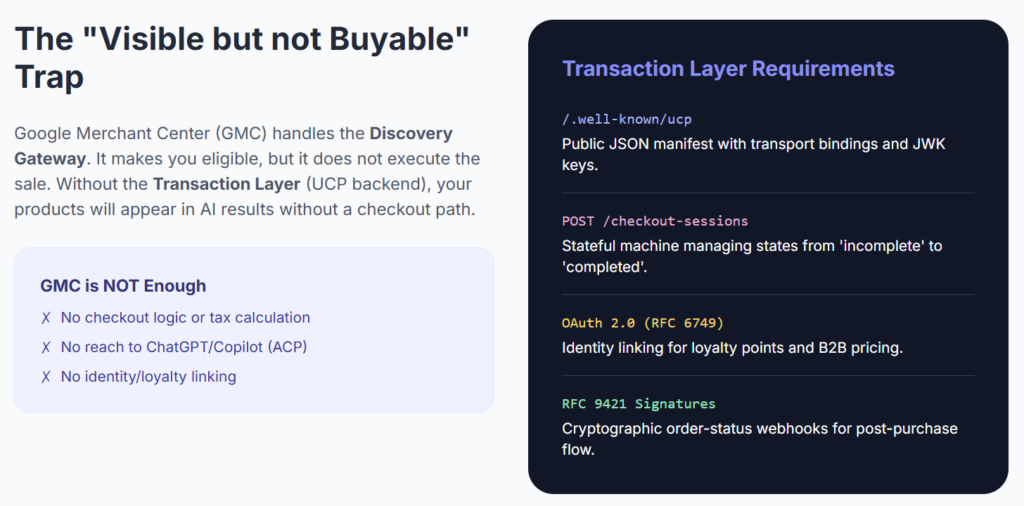
The most pervasive misconception regarding UCP is the conflation of search visibility with transactional capability. Many organisations operate under the assumption that syndicating their product catalog to Google Merchant Center (GMC) is sufficient to participate in agentic commerce. In reality, GMC governs only the discovery and eligibility gateway for Google specific surfaces; it does not operate the transaction layer required to execute a sale.
The Discovery Gateway: Google Merchant Center
For a product to surface within Google AI Mode or the Gemini application with an actionable purchasing interface, the merchant must first satisfy strict data structuring requirements. The critical mechanism for agentic eligibility is the native_commerce product attribute. This boolean flag dictates whether a specific product qualifies for the in surface checkout experience. If omitted or set to false, the product may still appear in generative AI responses, but it will lack the transactional “Buy” button, forcing the user into a traditional click through journey.
Implementing this attribute often requires strategic feed management. Integration specialists frequently rely on supplemental feeds to map the flag consistently across vast catalogs. Furthermore, for regulated goods, merchants must supply a consumer_notice attribute group (containing sub attributes like notice_type and consumer_notice_message). This ensures AI agents can display legally mandated information directly within the chat interface before the user commits to a purchase, shifting compliance burdens directly into the feed architecture.
Generative Engine Optimisation (GEO) and Catalog Integrity
Because AI agents bypass the traditional website frontend, the principles of Search Engine Optimisation (SEO) have evolved into Generative Engine Optimisation (GEO). Agents do not parse marketing copy or render high resolution lifestyle imagery; they consume structured JSON LD and API responses.
If a merchant’s UCP feed outputs a size attribute as “Extra Large” for one product and “XL” for another, the semantic inconsistency forces the agent’s reasoning engine to extrapolate. This significantly increases the risk of an AI hallucination where the agent misrepresents the product.
To optimise for agentic discovery, merchants must:
- Normalise units strictly to ISO standards.
- Enforce taxonomic trees mapped directly to Google Product Categories.
- Deploy semantic overlays using microdata to provide absolute clarity on real time availability and compatibility.
SEO Tip: Read our guide on Structured Data & Schema Markup Best Practices to know how to get the best of features
The Transaction Layer Gap: The Visible but Not Buyable Trap
While GMC handles visibility, it entirely lacks the infrastructure to process a cart, calculate localised taxes, lock inventory, or capture payment tokens. If a merchant sets native_commerce to true but fails to implement a live, responding UCP transaction backend, they fall into the “visible but not buyable” trap. An AI agent attempting to initiate a checkout will encounter a malfunctioning API endpoint and silently route the buyer to a competitor possessing a functional transaction layer.
Crucially, GMC is structurally limited to Google’s ecosystem. It provides no reach into non Google agents, such as ChatGPT Instant Checkout (powered by ACP) or Microsoft Copilot. Furthermore, categories like subscriptions, personalised goods, and final sale items are currently excluded from GMC native commerce eligibility, meaning merchants dominated by these assortments must rely entirely on direct UCP or ACP integrations to reach AI shoppers.
The Architecture of the UCP Transaction Layer
To bridge the gap between discovery and execution, the merchant must deploy a compliant UCP transaction server. UCP operates on a layered, decoupled protocol pattern that separates the shopping service layer (transaction primitives) from capabilities (functional areas like checkout) and extensions (domain specific schemas like fulfillment or discounts).
The Discovery Manifest and Capability Negotiation
The entry point to a merchant’s transaction layer is the discovery manifest. Regardless of the underlying platform, every UCP compliant business must expose a publicly accessible JSON profile strictly over HTTPS at /.well known/ucp. This endpoint must not utilise 3xx redirects and must supply specific caching headers for rapid agent evaluation.
The manifest declares the protocol version, supported services, and the precise network transports available (REST, Model Context Protocol, or Agent to Agent protocol). Most importantly, it lists the capabilities the merchant supports using a reverse domain naming convention. It also publishes accepted payment_handlers and an array of signing_keys used to cryptographically verify outbound webhooks.
The Checkout State Machine and Graceful Degradation
The core transactional component is the Checkout capability, which manages a strict state machine typically exposed over REST or JSON RPC via MCP. A checkout session progresses through defined states: incomplete, ready_for_complete, complete_in_progress, and finally completed or canceled.
UCP acknowledges that autonomous agents cannot handle all commerce scenarios. Regulatory constraints, age verification for alcohol, or highly customised product configurations often require human intervention. When an agent cannot programmatically resolve missing information, the checkout state shifts to requires_escalation.
The Embedded Checkout Protocol (ECP)
To manage escalations gracefully, UCP utilises the Embedded Checkout Protocol (ECP). The merchant server returns a continue_url alongside the escalation status. The AI agent renders this URL securely within the chat interface, establishing a bidirectional JSON RPC 2.0 communication channel. The human buyer assumes control, completes the complex configuration directly in the merchant’s native UI, and finalises the transaction—maintaining continuity without forcing the user to start over on a new tab.
Strategic Trade off: Native vs. Embedded Checkout
- Native Checkout: The entire transaction stays within the AI interface. Offers the lowest friction and highest conversion rates, but sacrifices the branded UI experience. Best for high frequency, low consideration goods.
- Embedded Checkout: The agent handles discovery and cart building but hands off the final step to an iframe or redirect to your site. Preserves brand experience but introduces a friction point. Best for complex, high consideration purchases.
Identity Linking: The Strategic Pivot from ACP to UCP
One of the most technically demanding and strategically vital aspects of UCP adoption is the Identity Linking capability (dev.ucp.common.identity_linking). This integration is a primary differentiator between UCP and the Agentic Commerce Protocol (ACP), highlighting the complexities of executing enterprise grade agentic commerce.
The Limitation of the Delegated Payment Model
In late 2025 and early 2026, the Agentic Commerce Protocol (ACP) gained significant traction for enabling Instant Checkout within ChatGPT. ACP relies on a highly centralised Delegated Payment model utilising Stripe Shared Payment Tokens (SPTs). While excellent for securing payment data, it structurally lacks an identity verification layer beyond the payment instrument itself. Consequently, AI agents utilising ACP were forced to execute transactions essentially as guest checkouts—a fatal flaw for enterprise retailers relying on loyalty programs and B2B pricing.
The Microsoft Copilot and Target Case Study
These limitations prompted a rapid industry realignment. On January 8, 2026, Microsoft initially launched Copilot Checkout utilising the ACP standard. However, recognising the insurmountable barrier the lack of identity linking posed for major retail partners, Microsoft pivoted to UCP just 104 days later.
Partnering with Target, Microsoft leveraged UCP’s Identity Linking capability to solve the loyalty problem. Under this flow, when a user asks Copilot to find a product, the agent queries Target’s UCP endpoint. Upon initiating the checkout, the agent prompts the user to connect their “Target Circle” account, ensuring loyalty points and saved preferences persist across AI sessions.
The Technical Rigor of UCP Identity Linking
Implementing Identity Linking places a profound security and DevOps burden on the merchant server. UCP defines the commerce semantics, but the identity machinery relies strictly on the OAuth 2.0 Authorisation Code flow (RFC 6749).
The merchant must host their own OAuth 2.0 authorisation server, publishing its metadata via RFC 8414. To secure the flow against interception and token theft, merchants are mandated to enforce Proof Key for Code Exchange (PKCE). When an agent attempts to access gated operations without a valid token, the merchant server must emit precise HTTP 401 or 403 responses containing WWW Authenticate: Bearer challenge headers.
CMS Platform Architectures and the Integration Spectrum
The most significant variable determining the cost, complexity, and timeline of a UCP deployment is your Content Management System (CMS) architecture.
Platform Architectural Comparison
| Platform | Architecture | UCP Support Mechanism | Primary Developer Burden |
| Shopify | First party, native | Hosted MCP Servers | Product data hygiene, channel permissions |
| Salesforce | First party, native | SCAPI & SLAS | Resolving complex pricing rules, SLAS config |
| VTEX | First party, native | Microservices Mapping | Data readiness, Order Management mapping |
| commercetools | API First | AI Hub Orchestrator | Deploying the middleware orchestration layer |
| BigCommerce | API First / Headless | Connector App | Manifest origin management on headless domains |
| Adobe Commerce | Self Hosted | Custom Composer Module | Bypassing Varnish cache, manual handler config |
| WooCommerce | Self Hosted | Community Plugins | OAuth maintenance, real time inventory locking |
- Tier 1 (Native Platforms): Platforms like Shopify and Salesforce seamlessly integrate UCP as a hosted service. Shopify exposes highly granular MCP servers to AI agents, handling authentication through strict trust tiers, while VTEX maps UCP capabilities directly into its microservices.
- Tier 2 (API First Connectors): Systems like commercetools (utilising their AI Hub orchestrator) and BigCommerce possess modern API foundations but require middleware or connector applications to translate core primitives into the UCP specification.
- Tier 3 (Self Hosted): For Magento (Adobe Commerce) or WooCommerce, developers must build, secure, host, and maintain every artifact of the specification, placing an enterprise grade DevOps workload onto standard hosting environments.
Strategic Implementation: The Five Critical Questions for UCP Adoption
Before committing to a full rollout, merchants must align their infrastructure with their business strategy by answering five critical questions:
- How does this change discoverability?
Your discovery strategy is no longer about keywords; it is about providing machine readable truth. Is your catalog data structured, real time, and clean enough for an autonomous agent to negotiate a checkout session? - Am I equipped to handle the API infrastructure?
If running a custom stack, your servers must dynamically process session creation (POST /ucp/v1/checkout/create), recalculate taxes, and complete transactions with high concurrency, severing the predictable patterns of human browsing. - How do I maintain data parity and manage fraud?
When an AI agent transacts, you face an “Analytics Void.” You must prioritise server side instrumentation to verify the intent of the agent via AP2 mandates, ensuring full data parity before finalising high value transactions. - Do I remain the Merchant of Record?
Yes. Unlike aggregator platforms, UCP establishes that you retain full ownership of the customer relationship, control over fulfillment logic, and financial liability. - How do regional compliance and payment standards impact deployment?
Agentic commerce faces strict regulatory scrutiny. For example, under the Australian Consumer Law (ACL), if an AI agent hallucinates a favorable return policy, the merchant is culpable. Furthermore, systems must dynamically calculate landed costs (inclusive of 10% GST) before the Cart Mandate is generated to prevent tax exclusive pricing violations.
Conclusion: The Strategic Rollout
The Universal Commerce Protocol is not merely an alternative checkout button; it is the foundational infrastructure for the next evolution of digital retail. It successfully dismantles the siloed, app centric buying journeys of the past decade.
For organisations preparing for this paradigm shift, a phased, strategic rollout is mandatory:
- Immediate Priority: Aggressive catalog data hygiene and configuration of the native_commerce attribute in Google Merchant Center to secure a foothold in AI discovery.
- Infrastructure Audit: Evaluating CMS capabilities to ensure support for high concurrency API requests, manifest hosting, and state machine compliance.
- Identity & Security Governance: Implementing OAuth 2.0 flows and AP2 mandates to ensure identity linking, fraud protection, and loyalty retention.
- Analytics Re Architecture: Instrumenting the UCP API layer to fire webhooks to GA4 Measurement Protocol and Meta CAPI, replacing client side pixels with server side attribution.
Merchants who view UCP as a superficial marketing activation will be outmaneuvered. Those who recognise it as a fundamental restructuring of how systems, identities, and capital flow across the internet will dominate the agentic commerce era.
If you have any questions or need help with your SEO or GEO campaign then get in touch.