
SEO and AI Content: What the Studies and Ranking Tests Actually Say
SEO
SEO and AI Content: What the Studies and Ranking Tests Actually Say

 ChatGPT
 Claude
 Perplexity
 Grok
Grok
 Google AI
 You
You
 WhatsApp
 LinkedIn
Is AI content good for SEO? Should you use it, and if you should, how? Since the early days of ChatGPT, AI adoption for content production has exploded for one obvious reason: it makes work that demands serious time and energy almost effortless. Why hire a content team when the job seems a few clicks away?
Today everyone from huge organisations to one-man bands uses AI somewhere in their content process to try to drive traffic and business through Google. There is a lot of conflicting information about whether AI content helps or hurts SEO. So we went through every major study, Google’s own statements, live ranking tests and our own test websites, and pulled it all into one page. Find out what the data actually says, what to weigh up, and a working method for producing AI content that ranks, whether you run a solo blog or a large ecommerce brand.
Key Takeaways
- Google’s algorithm does not penalise AI content. Its algorithm penalises bad content. AI just makes bad content very easy to produce.
- Google does not care who wrote your content, human or AI. It is trying to serve the result that best serves the searcher’s need/want, and to meet that goal it uses an algorithm that estimates quality through measurable signals.
- Raw AI content generation tends to fail the exact signals Google uses to estimate quality. Raw output hits only a fraction of the on-page targets that matter.
- Sites get punished for publishing weak content at scale. Every deindexing case on record fits that pattern, and AI is just the cheapest way to mass-produce weak content.
- Good AI content comes from a method, not a one-line prompt. A process that deliberately hits the key signals (coverage, depth, original information).
- The upside of AI content done well is real: production gets cheaper and faster, and you can cover a topic at a scale that was never possible manually.
- The overall point: do not just generate AI content and publish without thinking. At volume, thin generic pages tell Google your site adds little value, and your strong pages get devalued along with the weak ones.
How Does Google Treat AI Content?
Google’s official guidance says it does not care whether AI wrote your content, only whether the page serves the searcher. Serving the searcher is what Google means by “quality”, and since no human at Google reads your page to check, quality is an algorithm’s estimate, built from signals it can measure. The same logic drives enforcement: when Google cracks down, the target is never AI itself, it is sites pumping out weak content at volume. Volume is what actually threatens Google: one industrialised site can flood the index with more junk than a thousand small ones, junk that costs money to crawl and store, and erodes trust in the results when it ranks. Most of that content is now AI-made, so punishing bad content and punishing AI content look like the same thing; that overlap is where the confusion comes from.
Every real enforcement case fits the volume pattern. The system Google published research on terminates networks of mass-produced AI content; a forum’s July 2026 manual action followed an AI bot auto-posting over 111,000 replies. Both times, the scale set Google off, not the tool. Here is the stance in Google’s own words, and whether you can trust it.
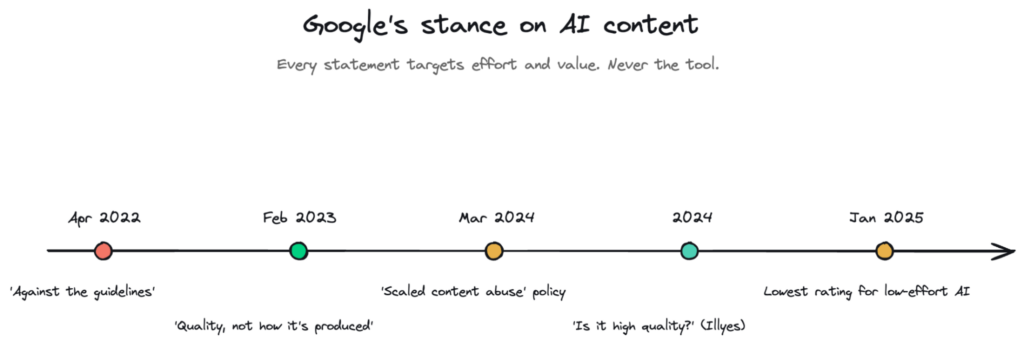
- April 2022, the old position. John Mueller says AI content is “still against the Webmaster Guidelines”, lumping it in with auto-generated spam.
- February 2023, the reversal. Google publishes its official guidance: “Our focus on the quality of content, rather than how content is produced”, and adds: “Using AI doesn’t give content any special gains. It’s just content.”
- March 2024, the enforcement hook. A major core update lands, built to cut “low-quality, unoriginal content” in results by 40%. Alongside it, the spam policy is rewritten around “scaled content abuse”: “many pages generated for the primary purpose of manipulating search rankings and not helping users.” The industry felt it immediately: manual actions rolled out in bulk and hundreds of sites were deindexed within the first week.
- January 2025, the quality bar. The Quality Rater Guidelines assign the Lowest rating to pages that are “auto or AI generated… with little to no effort, little to no originality”.
- The one-liner. Gary Illyes, 2024: “it’s not whether the AI wrote it, but whether it’s high quality”.
Read the timeline carefully and every single statement targets effort, originality and value. Never the tool.
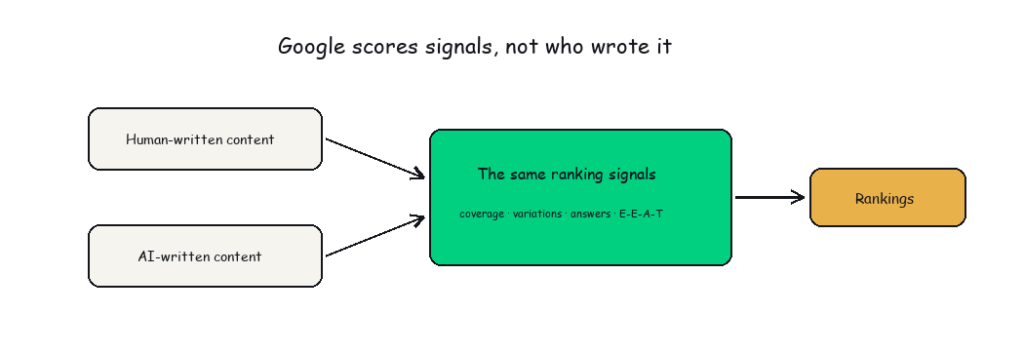
Can you trust it? Yes, but not because Google is being honest. Because it has no choice: Google cannot reliably tell who wrote your content. Kyle Roof ranked a page written almost entirely in lorem ipsum just by placing the keywords correctly, and only a human manual action ever stopped it; his repeats were still ranking in July 2025. If Google cannot see gibberish, it cannot reliably see AI either: slop can slip through, and well-produced AI content passes clean. AI detectors cannot tell either (Stanford: 61% of human essays by non-native speakers falsely flagged; OpenAI shut down its own detector), and there is no evidence Google runs one at all.
Google’s own engineers have admitted as much, in a slide that was never meant to go public:
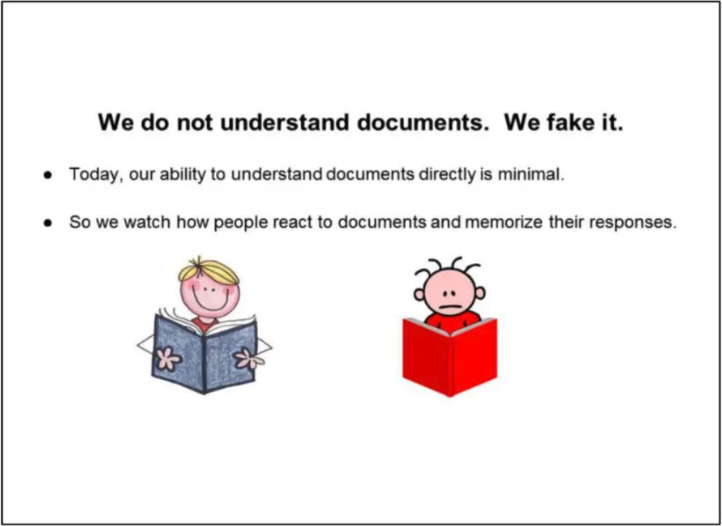
Internal Google slide released in the DOJ antitrust trial (Exhibit UPX0203): “We do not understand documents. We fake it.”
So the stance boils down to this: Google only cares about quality, it cannot tell who wrote your content, and it judges quality through signals it can measure. The rest of this page tests that against the data: how AI content actually scores on those signals, what happens when it fails them at scale, and how to produce AI content that passes.
Does AI Content Rank in Google?
Yes. In July 2026, Ahrefs’ Ryan Law studied AI content across top-10 ranking pages: 5.3% of top-3 results were 100% AI-generated, 9% were at least 80% AI, and pages blending AI with human work earned 2 to 3 times the impressions of heavily-AI pages. The counterweight comes from Semrush: #1 results are 8x more likely to be human-written. So AI content ranks, blends outperform pure AI, and the very top still skews human. The key findings across the studies:
- The amount of AI in a page changes its odds of ranking, not its position once it does. Across 600,000 pages already ranking in the top 20, the correlation between AI use and position was 0.011, statistical noise, and Surfer’s million-keyword study found the same. The gaps above happen a step earlier: heavily-AI pages are more often too weak to qualify at all. Google is not marking down AI; weak pages just tend to be AI-heavy.
- AI-heavy pages still get indexed, just slightly less often. Indexation drops from 49% for low-AI pages to 40% for very-high-AI pages: a real gap, but nowhere near a ban.
- Sites using AI even grow faster. Ahrefs’ survey of 879 marketers found 29.08% vs 24.21% median organic growth.
- What actually predicts rankings: topical coverage. The strongest on-page factor in Surfer’s data: top-10 pages average 74% topical coverage vs 50% for the bottom of the SERP, keyword variations beat exact-match density, and length only matters as a by-product of covering the topic. That is the bar AI content has to clear, whoever wrote it.
AI content can rank perfectly well; most of it simply is not good enough to rank: too thin, too generic, nothing new. And published carelessly at scale, it can actively harm your site, covered below.
At Prosperity we have tested this ourselves. AI content on our own test websites can rank extremely well. But the variable is quality, and quality comes down to the method of generation. Raw, one-prompt output is bad, while a proper generation process with thorough review behind it produces content that ranks. This is the entire article in one sentence: AI content is judged by the same standards as everything else, answer the intent fully, cover everything the reader came to ask, add something unique. Hitting those does not guarantee a ranking, it just gives the page a real chance, and AI very rarely gets there on its own.
The community reports the same: 46% of marketers in HubSpot’s survey say AI content improved their rankings, and Orbit Media’s blogger survey finds the winners combine AI with original research, expert quotes and heavy editing. It always comes back to quality.
Which is also why AI content has such a negative stigma in SEO. AI is not good at producing quality content when you just ask it to write an article on a topic, and most people do exactly that: ask it to spit out an SEO article, publish, and wonder why nothing happens.
Kyle Roof’s team has put numbers on exactly how short raw output falls. PageOptimizer Pro benchmarked 13 major models, scoring each draft against the on-page targets the SERP demands: content length, subheading count, title tags and the terms Google’s own language processing expects to see. Raw output failed nearly every check: only 7 of 13 models wrote a title tag, only 2 landed in the target subheading range, and just one hit the content-length target, with the best of the rest writing 127 words of core content against a 183-word floor. Even when prompted for “SEO-optimised” content, the best models topped out in the low 70s on POP’s 100-point score, when content generally needs around 80 or more before it starts to move. The only writer to score 100 was POP’s own purpose-built one, which is this article’s point in miniature: the process gets you there, a one-line prompt does not.
Should You Use AI Content for SEO?
The answer depends on your goals, resources and preferences. What we can say is that AI is a genuinely great tool for content work, and neglecting it outright is not productive. Our recommendation is to integrate it properly into your content process: use it for research and drafting, backed by a proper review process, with a human owning the facts and the final copy. The real decision is how far to take it, and both sides of that trade have a real case.
The Case for Using AI Content
- It is 4.7x cheaper, human labour included. Ahrefs puts an AI-assisted post at $131 all-in vs $611 for a human-written one. Both numbers are what you pay people: the $131 already covers the human editing and fact-checking, and the raw generation itself costs cents.
- It is faster, and it improves weaker writers the most. In a randomised trial published in Science, ChatGPT cut writing time by 40% and raised output quality 18%, with the biggest gains for weaker writers.
- It handles jobs too big to do by hand. AI can refresh the stats and FAQs on hundreds of pages at once, map coverage gaps across a full library, and repurpose every post into video and social. Basically, all the work that never got done when it had to be manual.
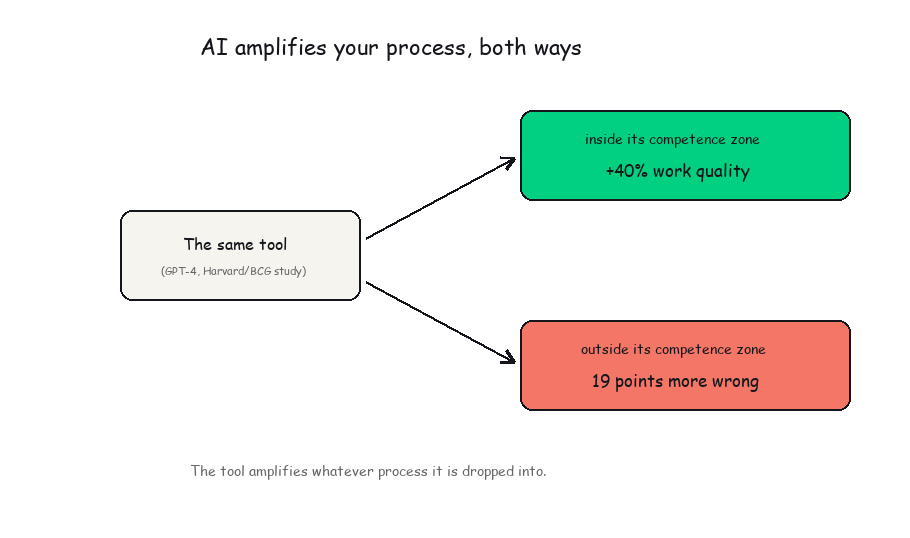
The catch: every one of those benefits also lowers the cost of producing bad content. A Harvard/BCG study found consultants using GPT-4 produced 40% higher quality work inside AI’s competence zone, but were 19 points more wrong outside it. The tool amplifies whatever process it is dropped into, which is where the case against comes in.
The Case Against Using AI Content
- Most AI content never ranks. In SE Ranking’s 16-month test, only 3% of 2,000 unedited AI articles were still in the top 100 by month six. This does not contradict the no-correlation studies above: those measure pages that already rank, where the share of AI makes no difference. This is about the far bigger pool of AI pages that never get there at all. Raw output fails the exact signals Google scores: too thin (400 to 1,400 words against SERPs averaging 2,500+), misses the term targets, under-covers the topic, and adds nothing new because models write the consensus and converge on sameness. In NP Digital’s 744-article head-to-head, human content pulled 5.44x more traffic by month five.
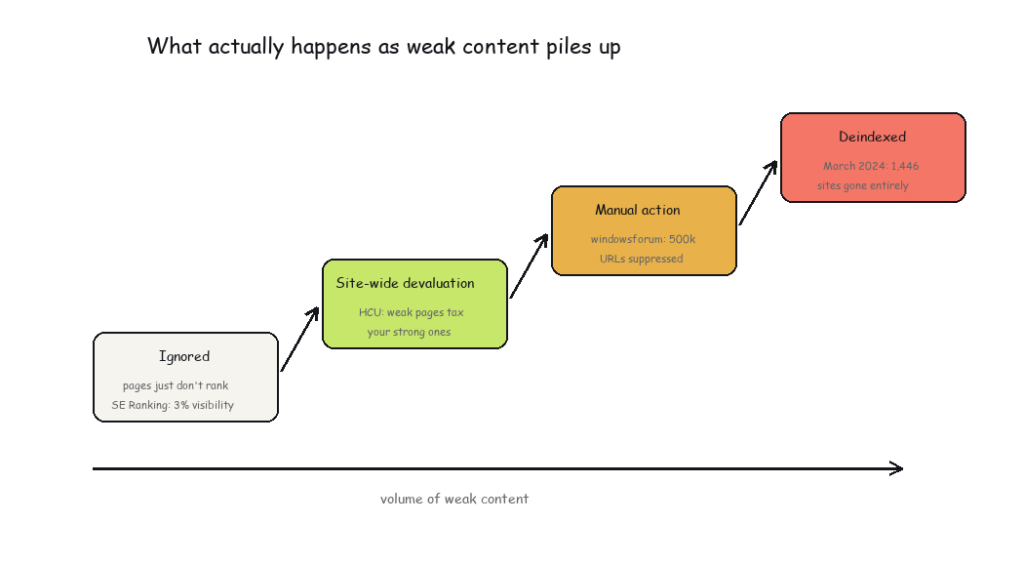
- Weak pages drag your whole site down. Google’s Helpful Content classifier is explicitly site-wide. Unhelpful content anywhere makes everything on the domain less likely to perform. Junk pages tax the pages that deserve to rank.
- Factual errors and hallucinations. Models invent statistics, quotes and product details with complete confidence. When a Cureus study asked ChatGPT to write medical papers with references, 47% of the citations it supplied were fabricated outright and another 46% were real but inaccurate; only 7% checked out. Unchecked fake facts are exactly what the Quality Rater Guidelines’ Lowest rating language targets, and a reader who catches one never trusts the page again.
- Readers disengage when they sense it. 52% of consumers disengage when they suspect content is AI-written, and simply labelling content “AI-generated” cuts reader preference by 13.7 points, even when the content is identical.
- The E-E-A-T gap. Google’s quality frameworks reward Experience, Expertise, Authoritativeness and Trust. Well-prompted AI can name an author and cite sources, but it cannot manufacture the substance behind them: no first-hand experience, no real credentials, nothing a reader or a rater can verify. That still has to come from you.
- Generic knowledge is exactly what Google no longer needs you for. Commodity content, the “what is X” and “10 tips for Y” layer of the web, was never valuable on its own, but it used to earn clicks because Google needed a page to send searchers to. AI Overviews ended that arrangement. Google now trusts itself to answer commodity questions directly, which means generic AI content is competing with the machine that distributes it. You can win the ranking and still lose the click.
Our Verdict: What to Use AI For on Each Page Type
You can always use AI; the real decisions are what job you give it and how much human review sits on top. Two rules travel with every page type: give the model the key information you want the page built around, and as much good information as possible about your product, your business and the topic itself, so it works from your facts instead of its guesses.
The hallucination data says this is the highest-leverage step: Stanford found general chatbots answering legal questions from memory hallucinated 58-82% of the time, while tools grounded in real source documents cut that to 17-33%. Several times lower, but never zero, which is why human review remains essential.
Dial your reviews to the stakes:
- Money pages: these need to be tight, so the review dial goes to maximum. AI can draft, structure and polish, but every line and every claim gets human review before it ships.
- Blog and informational content: run the full process below end to end; standard QA closes it out.
- YMYL topics: AI can still research, outline and draft, but these get the heaviest fact-checking and expert review of all; the cost of a hallucinated fact is highest here.
- Refreshes at scale: AI’s best job. Updating FAQs and stale sections across an existing library is freshness with almost no quality risk. If you want to update old stats, you’ll either need a highly refined skill/prompt, or a deeper level of human review.
How Should You Use AI for SEO Content Across Your Site?
Here’s how we recommend using it: a workflow where AI handles the jobs it is genuinely good at, every draft is built to hit the ranking factors the studies keep surfacing, and a human closes the gaps AI cannot.
The SEO Tasks AI Is Safe to Do
- Outlines and structures. Content skeletons, section headings, brief-building. AI is better at reading 50 pages than writing one.
- Research and brainstorming. Keyword ideas (grounded in real data), FAQs, background summaries, SERP analysis, coverage-gap mapping, evidence gathering.
- Rough drafting. First paragraphs and boilerplate to speed the workflow up, never the final copy.
The Ranking Factors Your AI Content Must Hit
Pulled straight from the studies, the checklist your AI content has to pass:
- Topical coverage is the strongest factor Surfer found: top-10 pages average 74% coverage vs 50% for the bottom of the SERP.
- Keyword variations beat exact-match density, which correlates near zero.
- Length is an outcome of covering the topic, not a target; coverage beats length in Surfer’s data.
- Direct answers early in each section, so both readers and machines get the answer cheaply.
- User-friendliness. Clear formatting, scannable sections, plain language. Machines estimate it, humans feel it; this is the factor a human pass improves most.
Best Practices for Using AI Content in SEO
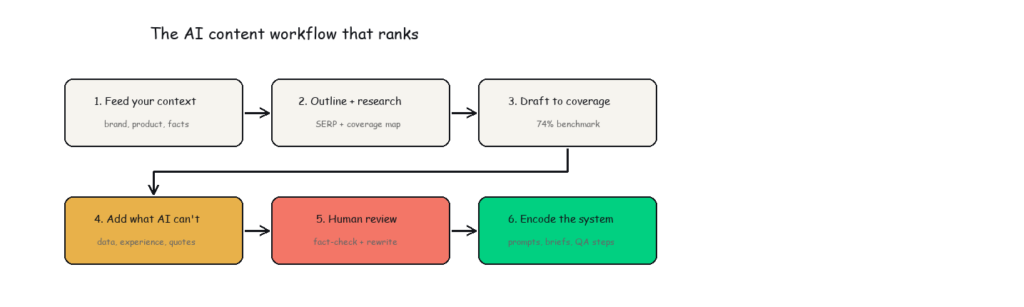
- Feed the model your key information first. Product details, positioning, target customer, brand voice and the facts the page must get right. The more context about your business it has, the less it guesses. A standing setup works well here, call it a knowledge base or a second brain: a folder of brand, product and audience docs, plus how you want your content written, that the model reads before every draft. This beats prompting a chatbot directly, where every new article starts from zero and everything you taught it last time is forgotten. The one caution is token bloat; feeding the whole thing into every prompt buries the facts that matter, so pull in only what the page needs.
- Outline and research with AI. Use it for the safe tasks: analysing the SERP, mapping what the page needs to cover, and building a skeleton outline for the writer to work from.
- Draft to a coverage target, then edit hard. Draft toward the 74% coverage benchmark, then add what models cannot. In a March 2026 study of law-firm websites, pages blending 26-50% AI took the best average positions, and Ahrefs found low-to-moderate AI pages earn 2-3x the impressions of heavily-AI pages.
- Add what a model cannot generate. Personal stories, expert quotes, real examples and, above all, your own data: publish proprietary numbers as primary-source pages, then repurpose them into the formats AI search favours. This is the substance Google’s Lowest rating punishes the absence of.
- Always human review. Fact-check and rewrite every draft before it goes anywhere near the CMS. The difference between AI content that ranks and AI slop is the process, not the model.
- Encode the process into reusable systems. Save the prompts, briefs and review steps that worked, so every article gets the same treatment rather than depending on who wrote it that day. And the more tools and APIs you give the AI, the more powerful it gets: we personally recommend Apify for reading forums and seeing what people are actually talking about, YouTube transcripts, and the Ahrefs API for live SEO data.
What Not to Do With AI Content
- Don’t publish raw output. Human content pulled 5.44x more traffic by month five, and telling some models to “optimise for SEO” actually makes the draft worse.
- Don’t mass-publish. Scaled content abuse is the actual policy name; the March 2024 sites died site-wide.
- Don’t chase word count over coverage. Padding a page to hit a number adds nothing Google scores.
- Don’t scale outside your lane. Off-topic publishing raises sitewide risk. HCU casualties were disproportionately sites scaling beyond their expertise.
- Don’t gate on detector scores. 61% false-positive rates on some human groups. QA against reader value instead.
Want more information about implementing AI processes to help you produce better content at a faster rate? Get in touch with our SEO content writing team.
Does Google Penalise AI Content?
Not for being AI. What Google penalises is low-quality content published at scale, and AI just happens to be how most of it now gets made. So the honest answer splits by scale.
At Small Scale: No
A handful of weak AI pages will not hurt your site, they just won’t rank. Google has never published a threshold for what counts as “small”, but its own Helpful Content guidance targets sites with “relatively high amounts” of unhelpful content, so think proportion rather than page count. A few weak pages diluted across an established site are noise, while a site where thin AI pages make up a big share of everything published starts to fit the pattern.
SE Ranking’s 16-month experiment is the cleanest proof going: 2,000 unedited AI articles spread across 20 fresh domains, about 100 pages each, so no single site was publishing at mass. The result: zero manual actions, a fade to 3% top-100 visibility by month six, and 1.09 million impressions for just 1,381 clicks. Not penalised. Invisible.
At Large Scale: Yes
And it is not subtle. The potential punishments are concrete: site-wide devaluation from the Helpful Content system, manual actions that suppress whole sections of a site in search, and full deindexing, where the domain disappears from Google entirely. Google’s Helpful Content system made unhelpful content a site-wide signal, and the September 2023 HCU victims lost 80-90% of their traffic and largely never recovered.
Following the March 2024 core update, Madeleine Lambert of Originality.ai analysed 79,000 sites: 1,446 sites were deindexed entirely, and 100% of the publicly identifiable ones had published AI content. These were overwhelmingly mass-publishing operations, but some reputable sites got caught in the sweep, including one with an Ahrefs Domain Rating of 70 and an estimated 1.2 million monthly organic visits before it was removed.
The algorithm is weak at judging individual page quality (Roof’s evidence), so Google enforces at the pattern level, publishing velocity, site-wide AI ratio, network footprints, mostly via manual actions and site-level classifiers (Lambert’s evidence). Individual quality pages are safe. Industrialised AI publishing is what dies.
And the reason Google fights this pattern so hard is commercial. More than 70% of Alphabet’s revenue is advertising, and Google Search alone brought in $224 billion in 2025. All of it depends on people trusting the results enough to keep searching. Every slop page that ranks chips away at that trust and nudges users toward ChatGPT, Reddit and TikTok, and every junk URL crawled, indexed and stored costs Google money for nothing in return. Weak content at scale is not just spam to Google; it is an attack on the product that pays for everything else.
Google has since published the engineering behind this. A 2026 Google research paper describes the Scalable Cluster Termination System (S-CTS), a spam defence that uses text embeddings to detect the shared mathematical footprint of mass-produced AI content, then terminates entire networks of coordinated accounts at once. The authors are explicit that it distinguishes “Creative AI Use” from “Adversarial Slop” and targets “coordinated, mass-produced behaviors rather than isolated uploads”.
It runs on video platforms, not confirmed in web search, but the blueprint is unmistakable. And the freshest search-side example fits the same shape: in July 2026, windowsforum.com received a manual action for “thin content with little or no added value”, suppressing more than 500,000 forum URLs, after the site’s AI chatbot had auto-posted over 111,000 replies. Google never said the word AI. The penalty came straight from the existing rulebook.
The rule: punishment targets the mass-production footprint, never the authorship of a single page.
Where AI Content and SEO Are Heading: Our Predictions
Argue with us on LinkedIn.
- Generic commodity content is finished, no matter who wrote it. Commodity content is the interchangeable layer of the web: definitions, “what is X” explainers, basic how-tos, anything with one right answer that reads the same on every site that publishes it. Zero-click searches went from 58.5% in 2024 to 68% by early 2026, and AI Overviews cut top-result CTR by up to 58%; if your article answers a question with one right answer, the machines have it covered. The less obvious consequence: you can keep your rankings and still watch the traffic go, so rankings stop being the metric that matters for that layer. Audit how much of your organic traffic rides on one-right-answer queries, treat that share as already gone, and move the budget to pages machines cannot answer away.
- Clicks concentrate on what AI cannot be. Original data, first-person experience, strong opinion, tools, genuinely timely or niche coverage, and increasingly anything that proves a real human is behind it: video, faces, voices, original photography. The durable win is being the cited source: +35% organic CTR when cited, and a citation is a brand impression even without the click.
- Brand becomes the biggest SEO asset, because AI recommends the names it already knows. When someone asks “what is the best X”, the model names the brands it has seen mentioned most often and most consistently across the web; mentions are becoming what links used to be. It is already happening: 22% of Surfer’s customers now discover the product through ChatGPT. And branded search is the one query no AI answer can intercept: someone typing your name wants you, not a summary.
- The final form: fewer, denser, original pages, plus whatever models cannot commoditise. Our open spitball: heaps more UGC and community content, hyper-specific local and niche pages where models have thin data, and living pages updated relentlessly.
Frequently Asked Questions
Can AI content be harmful to SEO?
Yes, in three ways. Raw AI content usually fails the quality signals and never ranks, wasting the spend. At volume, weak pages trip Google’s site-wide systems and drag your strong pages down with them, up to full deindexing. And readers punish it too: 52% disengage when they suspect content is AI-written. All three are avoidable with a real production process.
Can Google detect AI content?
Not reliably at the per-page level. Kyle Roof’s Lorem Ipsum pages still rank, and two large studies show AI-detection scores do not predict rankings. Google’s real detection works at the pattern level: velocity, site-wide ratios and footprints, enforced mostly through manual actions. Google has even published the blueprint: its S-CTS spam system uses text embeddings to catch the shared footprint of mass-produced AI content and terminates whole networks at once (deployed on video platforms so far, not confirmed in search).
Is AI content bad for SEO?
Not inherently. Sites using AI grew 5% faster in Ahrefs’ survey. What is bad for SEO is unedited AI at scale: pure-AI cohorts collapsed to 3% visibility in SE Ranking’s test. The output decides, not the tool.
Isn’t AI content always statistically average?
Only if you leave the model to write from its base knowledge, which is where the objection comes from. Ryan Law’s rebuttal is the right one: a retrieval-equipped workflow pulls live sources, original data, statistics and expert input, and runs research at a scale no human can (hundreds of sources checked, not five blog posts skimmed). Average output is a workflow choice, not a ceiling; the workflow we recommend above is how you make the other choice.
How much editing does AI content need?
Enough to add effort, originality and added value, the exact three things Google’s Lowest-rating language targets. The sweet spot in the data: pages 26-50% AI (heavily edited drafts) took the best average positions in the law-firm study.
How does AI content perform in AI search?
The same rules apply: nobody filters on who wrote the content. 10.4% of AI Overview citations are themselves AI-generated, the pages that get cited cover roughly twice the facts an LLM needs, and being cited lifts organic CTR by +35%.
Make your information cheap to extract: direct answers early, tight structure, low fluff. We cover the full approach in our State of AI Search white paper and our guide to ranking in Google’s AI Overviews. If you want it done for you, check out our answer engine optimisation service.
Will AI replace SEO?
No, whether you mean the channel or the job. As a channel, Google still handles roughly 200-370x ChatGPT’s search volume, and AI answers cite pages that rank, so ranking well now feeds AI visibility rather than competing with it. As a job, the work is shifting rather than disappearing: less commodity writing, more original data, brand building and content machines want to cite.
Who owns AI-generated content?
Purely AI-generated output cannot be copyrighted; there is no human author. AI-assisted work with human expression, selection and arrangement can be (US Copyright Office, January 2025).
How much of the web is already AI content?
A lot. Ahrefs sampled 900,000 new pages and found 74.2% contain at least some AI content (only 2.5% are pure AI), and Graphite found AI crossed 50% of all new articles in November 2024, then plateaued. Treat the numbers as estimates; they come from AI detectors, which have wide error bars. Most of that flood is generic commodity content, which is one counterintuitive upside: genuinely good content now cuts through the noise more easily, not less. For why models write the way they do, see how LLMs really work.
The Bottom Line of AI Content for SEO
Google doesn’t penalise AI content, and the data says it can’t reliably tell what’s AI in the first place. What it scores is signals of quality and relevance: keyword targeting, topical coverage, depth, original information. Well-produced AI content sends those signals and ranks; we’ve proven it on our own test websites. Most AI content doesn’t, and that’s the real story. It isn’t penalised, it’s ignored, and published at scale it starts taxing the pages that deserve to rank.
You can use AI on every page type. What should change is the job you give it and how much review sits on top. Money pages need to be tight, so they get the heaviest human review before anything ships. Beyond that, use AI aggressively, for research, drafts, refreshes and repurposing, and spend the time it saves on the only things that still earn clicks: original data, first-hand experience, and a brand people search for by name.
If you want content built to rank in Google and get cited by AI, that is exactly what our content marketing services do. Talk to us.
Last updated: August 2026.
