
Digital PR Statistics 2026: What the Data Shows About SEO, GEO and AI Search
Digital PR
Digital PR Statistics 2026: What the Data Shows About SEO, GEO and AI Search

 ChatGPT
 Claude
 Perplexity
 Grok
Grok
 Google AI
 You
You
 WhatsApp
 LinkedIn
Digital PR is the practice of earning backlinks and brand mentions from authoritative publications by pitching journalists original, newsworthy stories. Each earned link works like a vote of confidence from the press, and search engines treat it that way. Digital PR has always been measured against SEO outcomes. Increasingly, it is also measured against GEO (generative engine optimisation) outcomes: whether your brand shows up when ChatGPT, Gemini or Google’s AI Overviews answer a question.
Top 10 Digital PR statistics
- 84% of the links AI tools cite come from earned media; paid content is just 0.3%. (Generative Pulse by Muck Rack, May 2026, 25 million+ cited links)
- Branded web mentions are the factor most correlated with AI Overview visibility (0.664), roughly three times stronger than backlinks (0.218). (Ahrefs, 2025, 75,000 brands)
- The #1 result on Google has 3.8 times more backlinks than positions #2–#10. (Backlinko, 2020, 11.8 million results)
- 96.55% of the ~14 billion pages studied get zero organic traffic from Google. (Ahrefs, 2023)
- Users click a traditional result on just 8% of searches that show an AI summary, versus 15% without one. (Pew Research Center, 2025)
- 48.6% of SEO professionals rate Digital PR the most effective link-building tactic. (Editorial.link, 518 SEOs; 2025)
- The most common authority band for links earned through Digital PR is DR 70–79, at 20.62% of placements. (Reboot Online, 2024 campaign data)
- “Data or research” is the #1 resource journalists want more from PR, named by 47%. (Cision, 2026, 1,899 journalists)
- Press releases account for just 1.1% of AI citations, yet practitioner usage rose from 68.8% to 79.1%. (Generative Pulse, May 2026 + BuzzStream, 2026)
- 83.1% of practitioners say AI has made Digital PR more important, but only around 40% have a repeatable process for earning AI citations. (BuzzStream, 2026)
Digital PR statistics for SEO
The #1 result on Google has 3.8 times more backlinks than positions #2–#10
Backlinko’s 2020 analysis of 11.8 million search results remains the largest public study of what top-ranking pages have in common. The number of referring domains (distinct websites linking to a page) showed a stronger correlation with rankings than any other factor measured. A correlation study can’t prove links cause rankings, but it tells you what every page at the top has: a deep, diverse link profile.
Backlinks by ranking position, via Backlinko (2020)
96.55% of pages studied get zero organic traffic from Google
Across Ahrefs’ 2023 study of roughly 14 billion pages, only 3.45% received any organic Google traffic at all. Ahrefs attributes the drought to several causes: no backlinks, but also no search demand and no topic match. The takeaway for Digital PR is the first one. Pages with more referring domains consistently have more traffic and rank for more keywords.
48.6% of SEO professionals rate Digital PR the most effective way to build links
In Editorial.link’s survey of 518 SEO professionals, Digital PR was rated the most effective link-building tactic by 48.6%, ahead of guest posting (16%) and linkable assets (12%). Still, the margin over every other tactic is large.
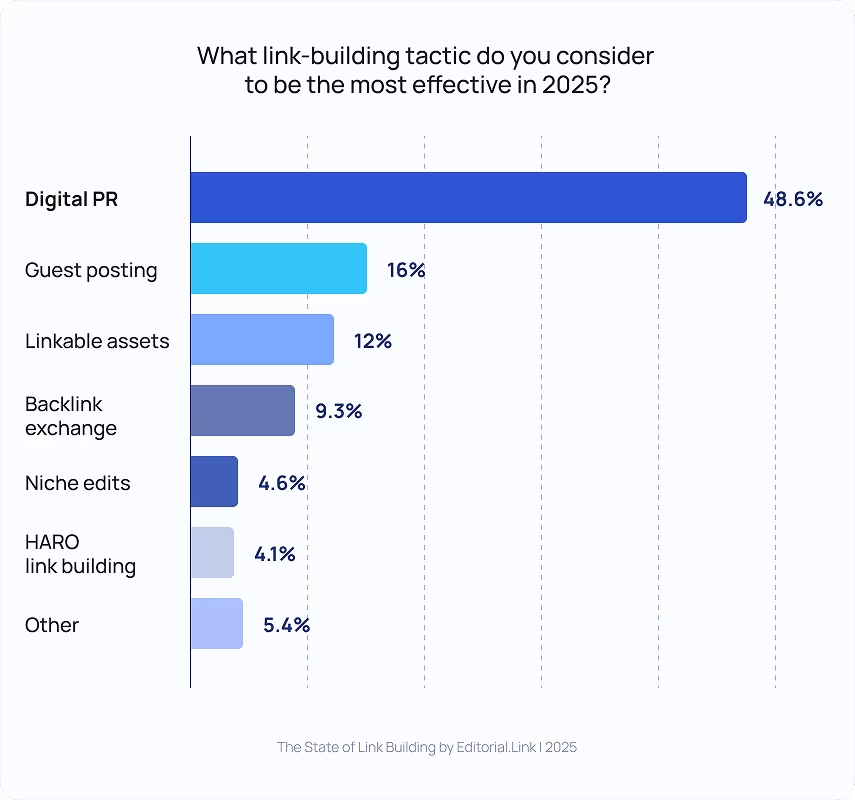
Most effective link-building tactics, via Editorial.link (year not stated)
20.62% of Digital PR links land in the DR 70–79 band
Domain Rating (DR) is Ahrefs’ 0–100 scale of a website’s link authority; major national news sites typically score 70 or higher. Reboot Online’s analysis of its own 2024 campaign links found DR 70–79 was the single most common authority band for coverage earned through Digital PR, with the average earned link around DR 61 and 7.83% of links at DR 90+. That skew towards high-authority domains is the difference between Digital PR and volume link building.
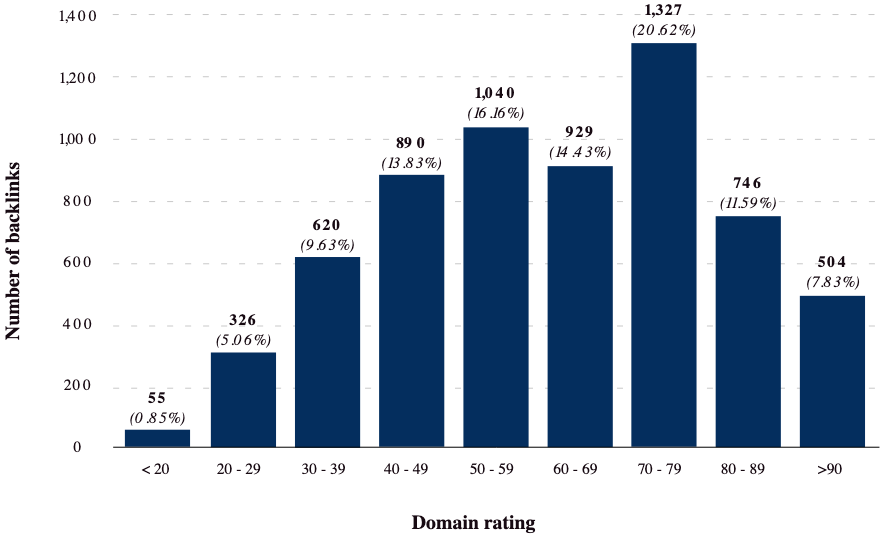
Earned links by DR band, via Reboot Online (2024)
Our own campaigns show the same pattern. Across Prosperity Media’s data-led campaigns from 2024 to 2026, the average DR of earned backlinks (measured in Ahrefs) was 65.2, with 56.5% of links at DR 50+ and 36.5% at DR 70+.
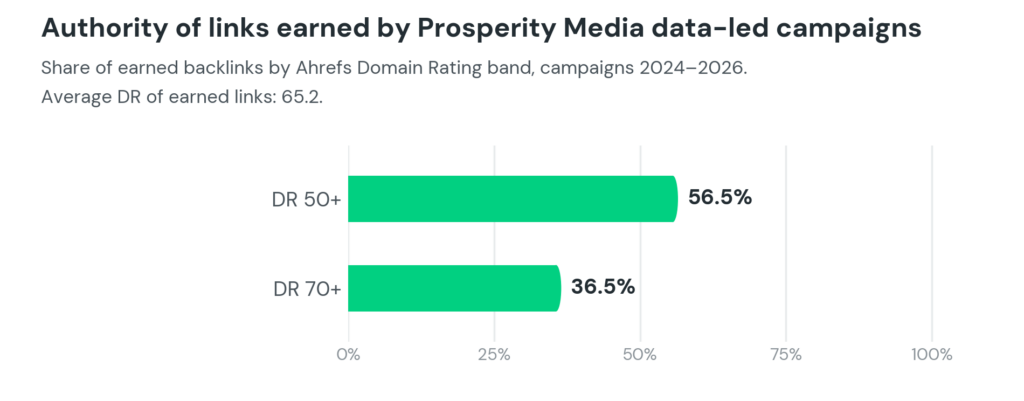
Authority of links earned by Prosperity Media data-led campaigns, measured in Ahrefs (2024–2026)
The 2024 Google leak confirmed Google stores site-level authority signals
When thousands of internal Google documents leaked in May 2024, analysis ran by iPullRank and SparkToro found attributes like “siteAuthority” among more than 14,000 ranking features. The documents reveal nothing about how heavily any signal is weighted, and Google disputed the conclusions drawn, but they confirm Google measures site-level authority. That is consistent with what practitioners see: one link from a trusted national masthead outperforming dozens from low-quality domains. Coverage in trusted publications also supports the authoritativeness and trustworthiness components of Google’s E-E-A-T (experience, expertise, authoritativeness and trustworthiness) quality framework.
One practitioner nuance: plenty of big-publisher coverage carries nofollow attributes, which tell Google to pass no ranking credit, and duplicated wire copy gets filtered out of Google’s index. The coverage still counts, because it builds brand-search demand, feeds the pool of mentions AI models draw on, and drives referral traffic. It is why mentions and links should be measured together, not links alone.
85.8% of practitioners name backlinks the most effective use of Digital PR
In BuzzStream’s State of Digital PR 2026, a survey of 150+ practitioners, backlinks topped the list of Digital PR’s most effective uses at 85.8%.
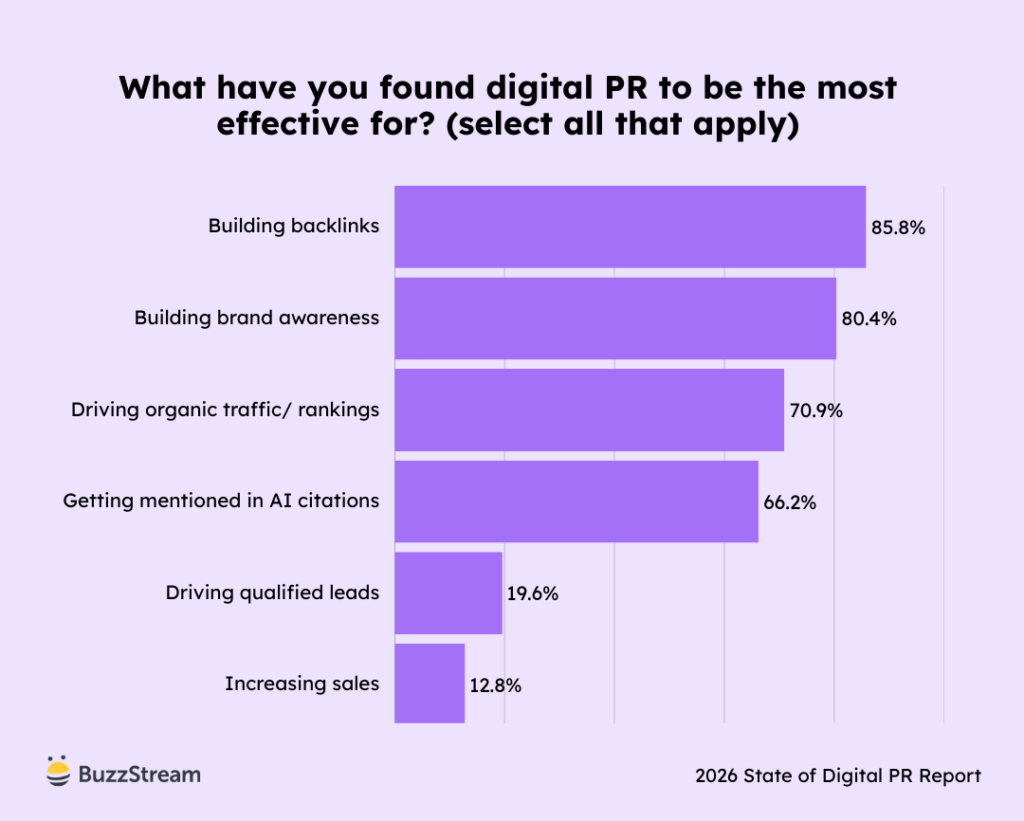
Most effective uses of Digital PR, via BuzzStream (2026)
The same survey found the payoff arrives quickly: 85.2% of practitioners said campaigns produce measurable results within six months.
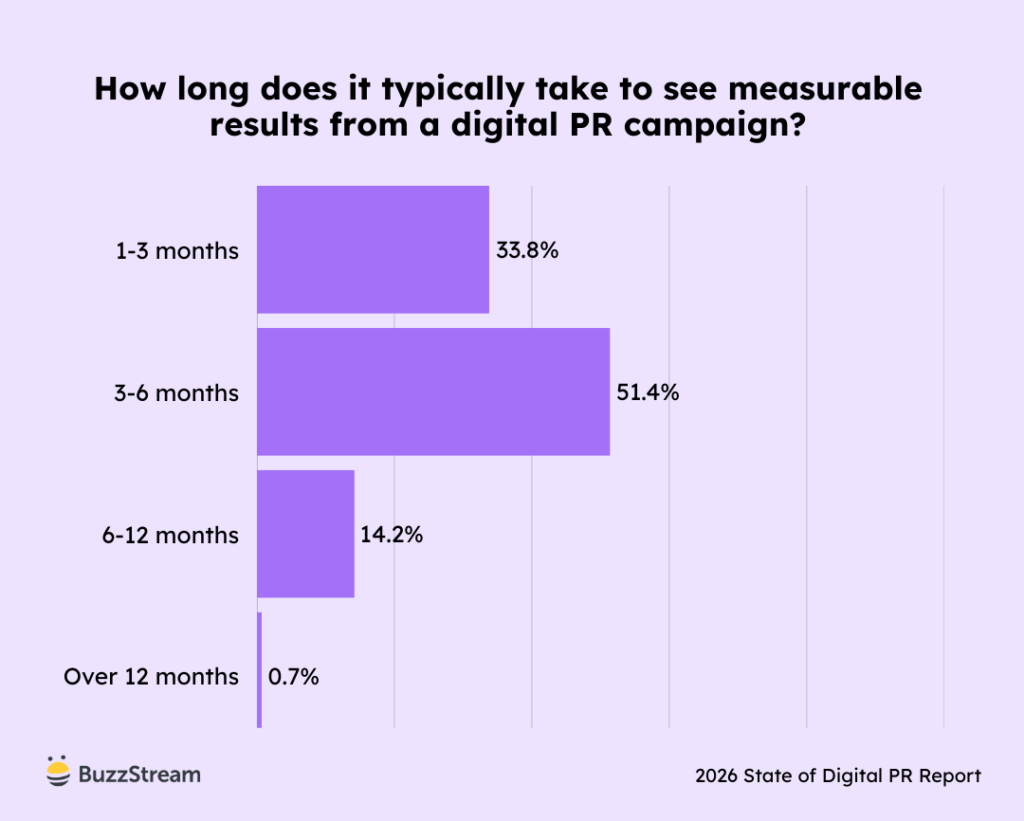
Time to measurable results, via BuzzStream (2026)
Digital PR statistics for GEO
AI search is now mainstream, and it suppresses clicks
- Google’s AI Overviews reach 2.5 billion users a month (announced May 2026). These are Google Search users being shown an AI layer rather than people seeking out a chatbot, which is exactly why it matters: the AI answer now sits on top of ordinary searches.
- ChatGPT passed 900 million weekly active users in February 2026.
- Among consumers who already use AI tools, 37% now start their searches there (Eight Oh Two, 500 respondents), though 85% of the same group still cross-check results on Google.
- Bain & Company’s survey with Dynata (1,117 US consumers, fielded December 2024, published February 2025) found about 80% of search users rely on AI-written summaries at least 40% of the time, and roughly 60% of searches end without a click to any website.
- Pew Research Center (March 2025 browsing data from 900 US adults, 68,879 searches) found users clicked a traditional result on just 8% of searches that showed an AI summary, versus 15% without one. Links inside the AI summary itself were clicked in just 1% of visits. Google disputed the study, but the direction matches Bain’s zero-click data.
If clicks are harder to win, the brand named in the answer holds the remaining prize. That is the case for the statistics that follow.
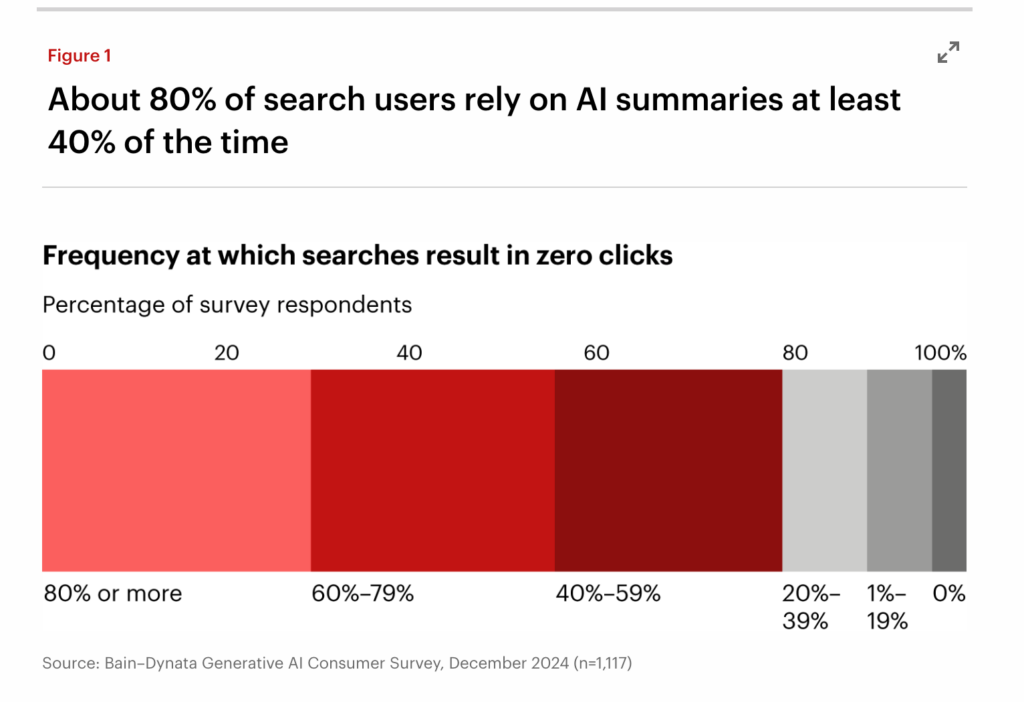
Consumer reliance on AI summaries, via Bain & Company (2025)
Brand mentions correlate with AI visibility three times more strongly than backlinks
In its 2025 study of 75,000 brands, Ahrefs measured which factors correlate with a brand appearing in Google’s AI Overviews. Branded web mentions came first at 0.664, roughly three times the correlation of backlinks at 0.218. The next strongest signals were branded anchors, meaning links whose clickable text is the brand name (0.527), and branded search volume (0.392). These are correlations, and big brands accumulate mentions, links and search demand together. Even so: what the web says about you matters more to AI visibility than links alone.
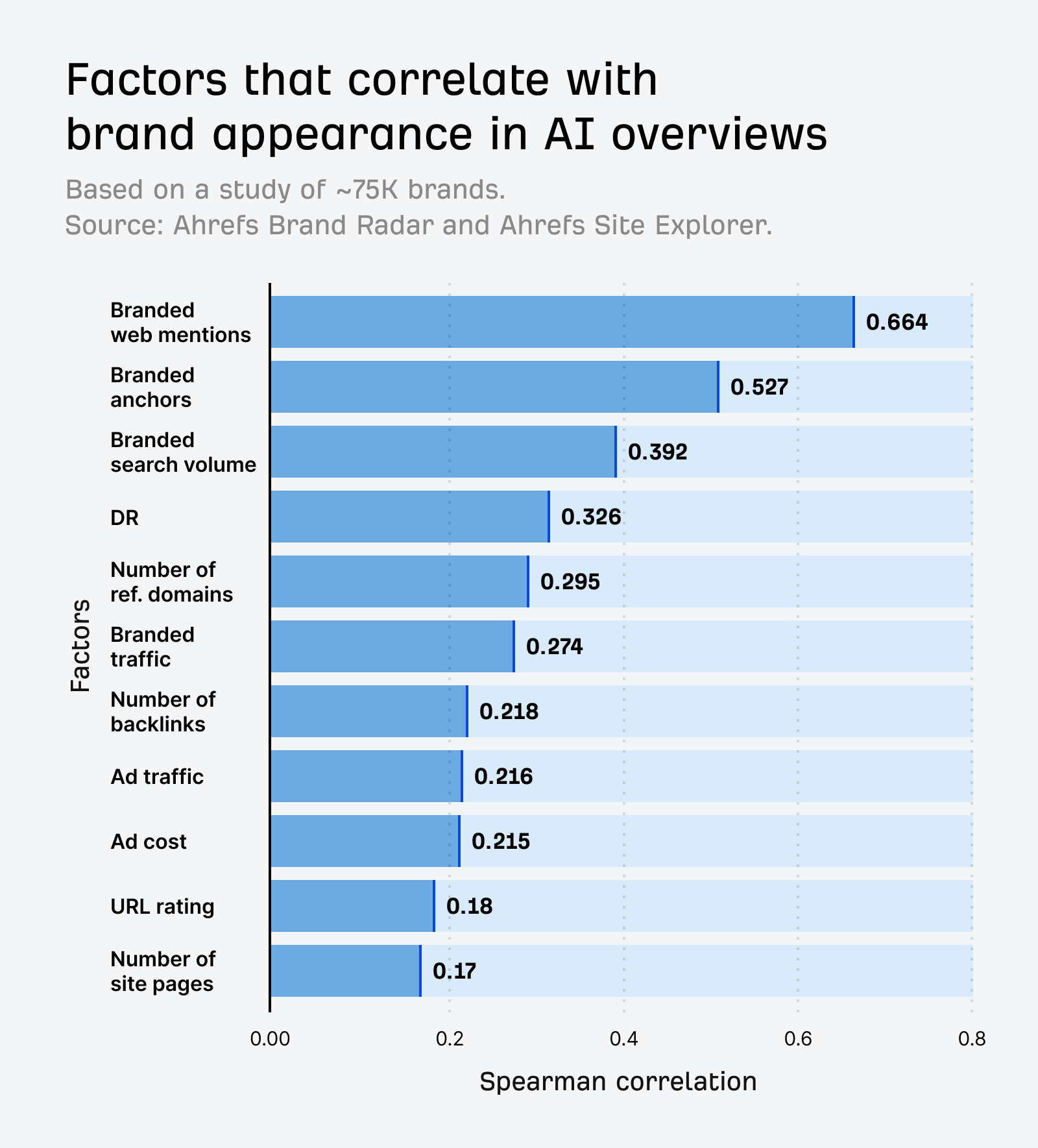
Correlation of factors with AI Overview visibility, via Ahrefs (2025)
In its 2026 follow-up extending the analysis to ChatGPT and AI Mode (Google’s chatbot-style search), YouTube mentions emerged as the strongest single signal at roughly 0.737, stronger than any traditional SEO factor tested. The likely reason: both Google and OpenAI draw heavily on YouTube content in their systems. For brands, that makes video presence part of off-site GEO strategy rather than a separate channel.
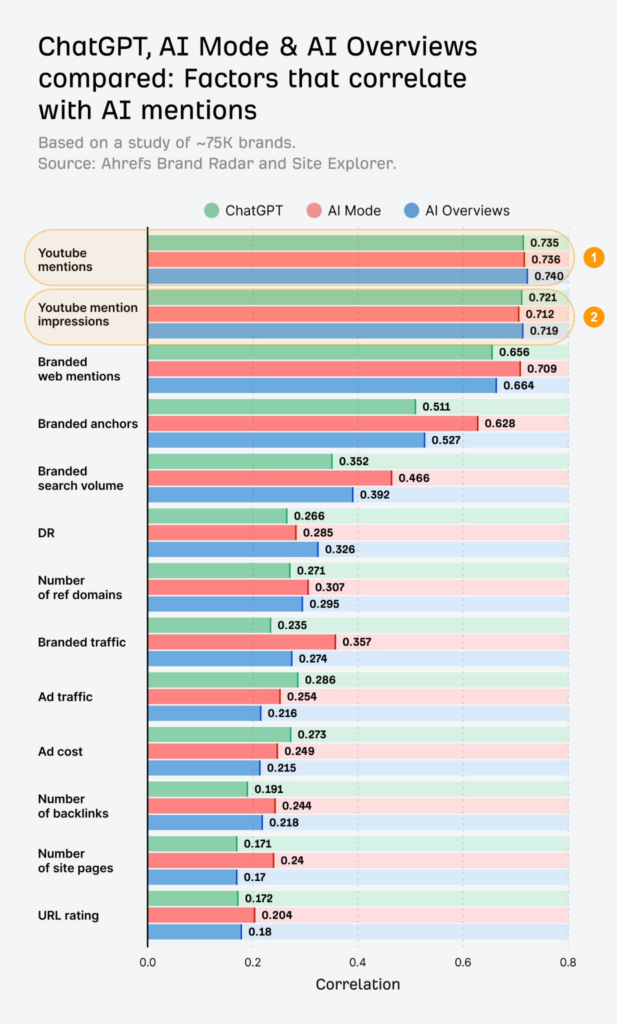
YouTube mentions as the strongest AI visibility signal, via Ahrefs (2026)
84% of the links AI cites come from earned media
Muck Rack’s Generative Pulse report (What is AI Reading?, May 2026) analysed more than 25 million links cited by ChatGPT, Claude and Gemini. About 99% of cited links come from non-paid sources; 84% come from earned media; journalism alone accounts for 27%. Paid and advertorial content is 0.3% of citations, and press releases just 1.1%. The remainder, roughly 15%, is almost entirely brands’ own content. When AI assistants go looking for sources to cite, they overwhelmingly reach for earned coverage.
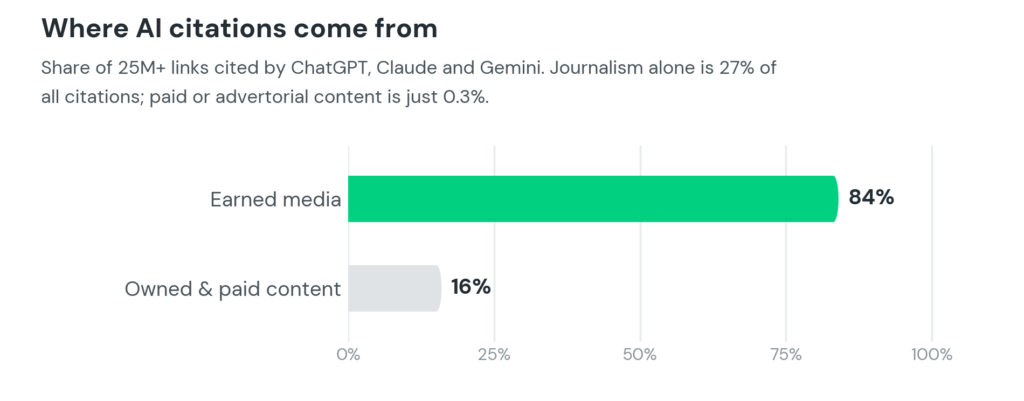
Where AI citations come from, data via Generative Pulse (May 2026)
The same report shows how differently each assistant cites. ChatGPT includes citations in 96% of its responses, averaging about five sources each; Gemini cites in 82% of responses (about eight sources); and Claude in just 55%, but averages around 13 sources when it does.
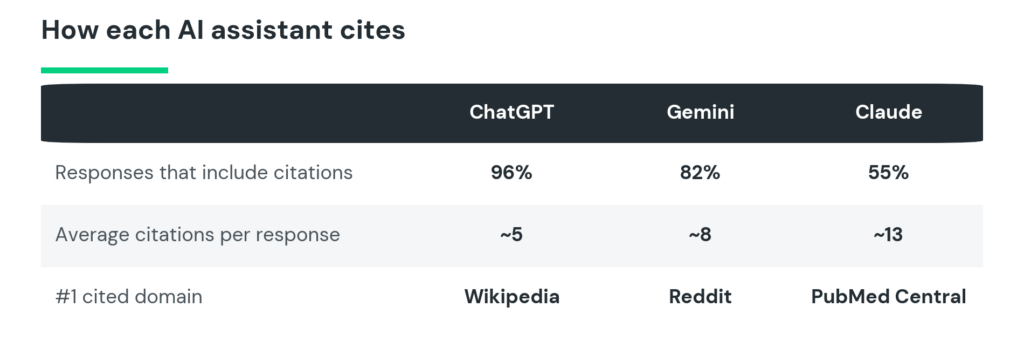
How each AI assistant cites, data via Generative Pulse (May 2026)
Three further findings from the report matter for Digital PR strategy:
- Industry-trend questions pull journalism. Queries about what is happening in an industry cite journalism in 46% of responses, more than double the rate of how-to queries.
- Recency is rewarded. 57% of journalism citations were published within the past 12 months, peaking sharply in the first month after publication.
- No outlet monopolises. AI models cite journalism across more than 20,000 distinct outlets; broad earned coverage beats a single big hit.
Case study: 70% of LLM citations for target and related searches reference one Digital PR campaign
A data-led campaign Prosperity Media ran for the accounting platform Reckon, ranking Australia’s best cities to start a business, now accounts for 70% of large language model citations for “best city to start a business” and related searches. The campaign page is cited in Google’s AI Overviews and AI Mode. One campaign produced both outcomes at once: the backlinks that lift search rankings and the mentions that AI models cite. That is the practical link between the SEO and GEO halves of this report.
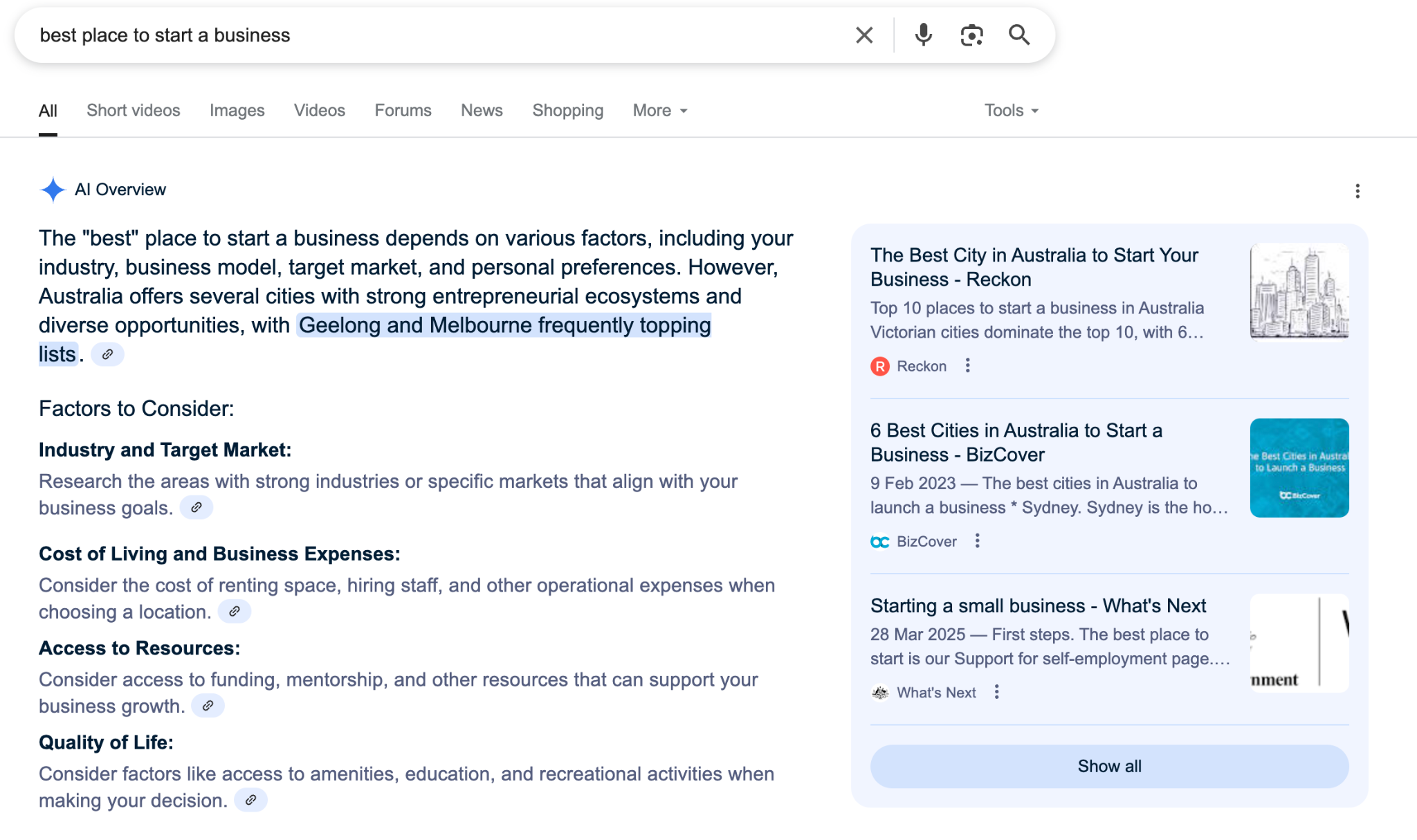
Reckon being referenced in Google AI Overviews
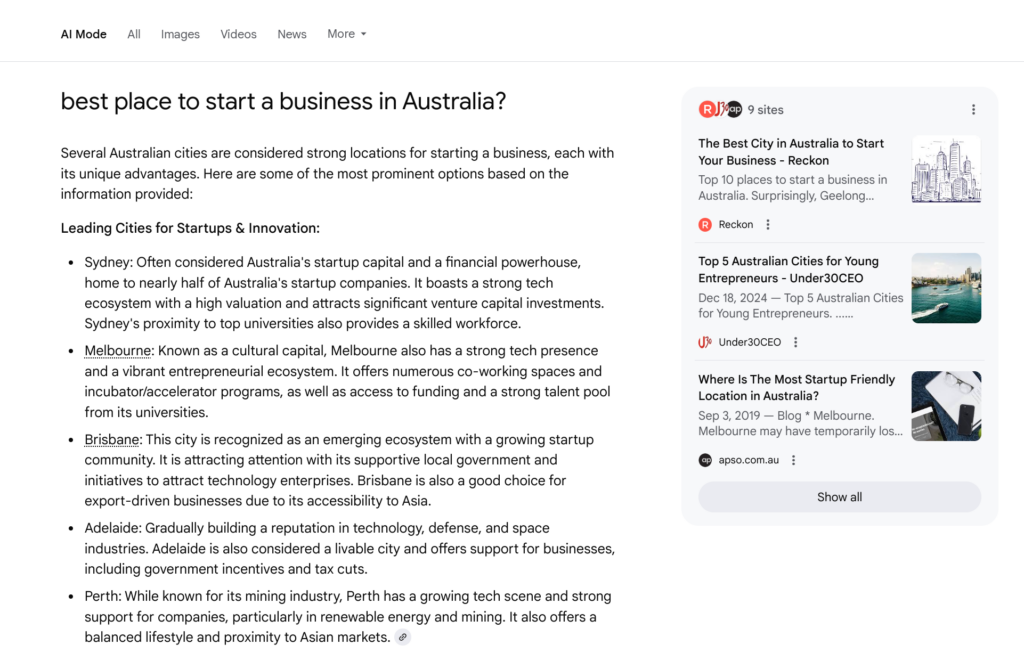
Reckon being referenced in Google AI Mode
Digital PR campaign statistics
95.9% of practitioners pitch data-led content, the #1 campaign tactic
In BuzzStream’s 2026 survey, 95.9% of Digital PR professionals pitch data-led content, making it the top tactic for the second consecutive year. The appeal is straightforward: original research, surveys and analysis of public data give journalists a citable, defensible hook, the kind of material that earns coverage and, increasingly, gets pulled into AI answers.
Journalists ask for data more than anything else
Cision’s 2026 State of the Media Report surveyed 1,899 journalists across 19 markets, including Australia.
Data or research was the resource they most wanted more of from PR, named by 47%. PR-provided content was their top source of story ideas (66%), and 33% said credible data or research makes them more likely to engage with a pitch, behind only relevance to their beat and audience (79%).
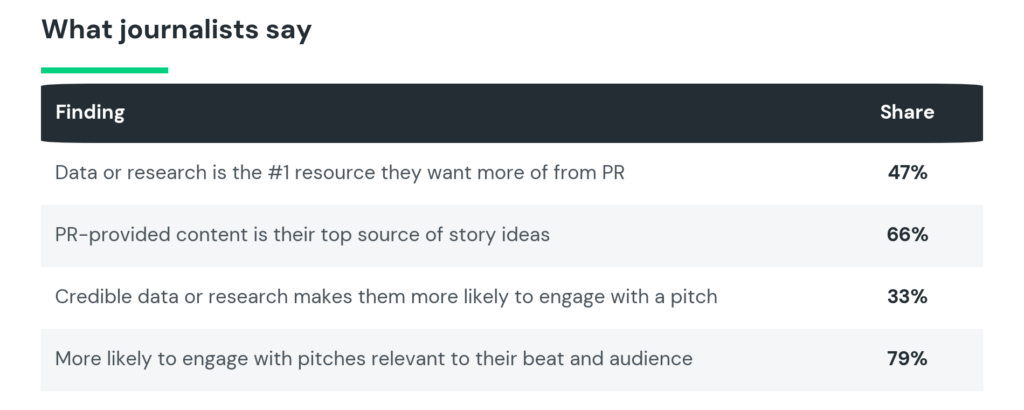
What journalists say, data via Cision’s 2026 State of the Media Report
The industry is doubling down on the format AI cites least
Press-release usage among practitioners rose from 68.8% to 79.1% in BuzzStream’s 2026 data. Yet in Generative Pulse’s analysis, press releases account for just 1.1% of what AI cites. Two datasets, one conclusion: the industry is investing more in the format with the weakest citation footprint, while the data-led earned coverage journalists actually want is what AI reaches for.
The three campaign types that earn coverage
- Hero campaigns: large, data-led flagships built on a dedicated landing page; the biggest coverage and the strongest links.
- Quick-win campaigns: reactive commentary on breaking news, or fast single-stat studies.
- Product and service PR: tied to a product moment or genuine point of difference. In Australia this often earns affiliate links rather than standard editorial backlinks, which limits the direct SEO value; the brand visibility still counts for GEO.
Finance is now the hardest vertical to earn links in
BuzzStream’s 2026 data ranks finance as the most difficult vertical (23.6% of practitioners, up from sixth place the year before), followed by health (20.3%) and education (19.6%). These “your money or your life” topics face the heaviest editorial scrutiny, and they reward a credible, data-led approach more than any other vertical does. For the local picture, see our Australian SEO and content marketing statistics.
The AI-readiness gap: 83.1% believe, 40% have a process
BuzzStream’s 2026 survey found 83.1% of practitioners say AI has made Digital PR more important, and 78.4% now track AI visibility for clients, with 66.2% counting AI-citation mentions among Digital PR’s most effective uses. Yet only about 40% have a repeatable process for earning AI citations.
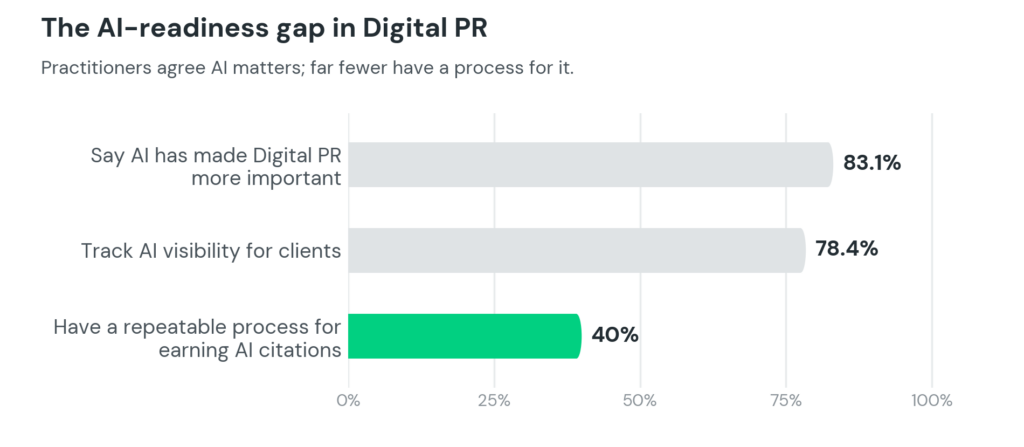
The AI-readiness gap, data via BuzzStream’s State of Digital PR 2026
What this means for brands
- Judge PR by mentions and links together. Links still correlate with rankings; mentions correlate with AI visibility. One earned placement produces both.
- Lead with data. It is the #1 thing journalists ask for and the backbone of the coverage AI cites.
- Rethink the press-release habit. 79.1% of the industry is scaling the format that earns 1.1% of AI citations.
- Check whether AI mentions you today. With most of the industry still lacking a repeatable process, having one is still an advantage rather than table stakes.
The bottom line
Search is splitting into two front doors: the classic results page and the AI answer. The statistics in this report point to one strategy that opens both. Earned, authoritative coverage delivers the links that correlate with rankings and the mentions that correlate with AI visibility, from the same campaign, at the same time. Most of the industry believes this matters; fewer than half have built the process. That is the gap worth moving on.
Want to talk about what a Digital PR campaign could do for your brand across search and AI? Get in touch.
