
Accuracy, Authority, & Audience Trust: Integrating Journalistic Principles into Your Content Writing
Content Writing
Accuracy, Authority, & Audience Trust: Integrating Journalistic Principles into Your Content Writing

 ChatGPT
 Claude
 Perplexity
 Grok
 Google AI
 You
 WhatsApp
 LinkedIn
It’s not controversial to say that the internet is the great mediator of today. Communication and information are defined by the digital world: its algorithms, its data analytics, and the platforms that host this content.
As these technologies continue to develop—and develop rapidly—the more content is created and disseminated, the greater the oversaturation of information, the more mediated our lives become. And thus, an attention economy is developed. How we become ‘noticed’, how we are ‘discovered’, is the foremost objective for any business or brand or person.
The result of an attention economy is the overlap of media-communications industries, wherein we borrow strategies and techniques, styles and frameworks, from one another to accommodate whatever new algorithmic update we find ourselves navigating. The advent of AI has seen these approaches change yet again. We are no longer just working to reach audiences, but also to be cited by LLMs.
So, what do we do to stand out then in the torrent of content audiences are faced with every day?
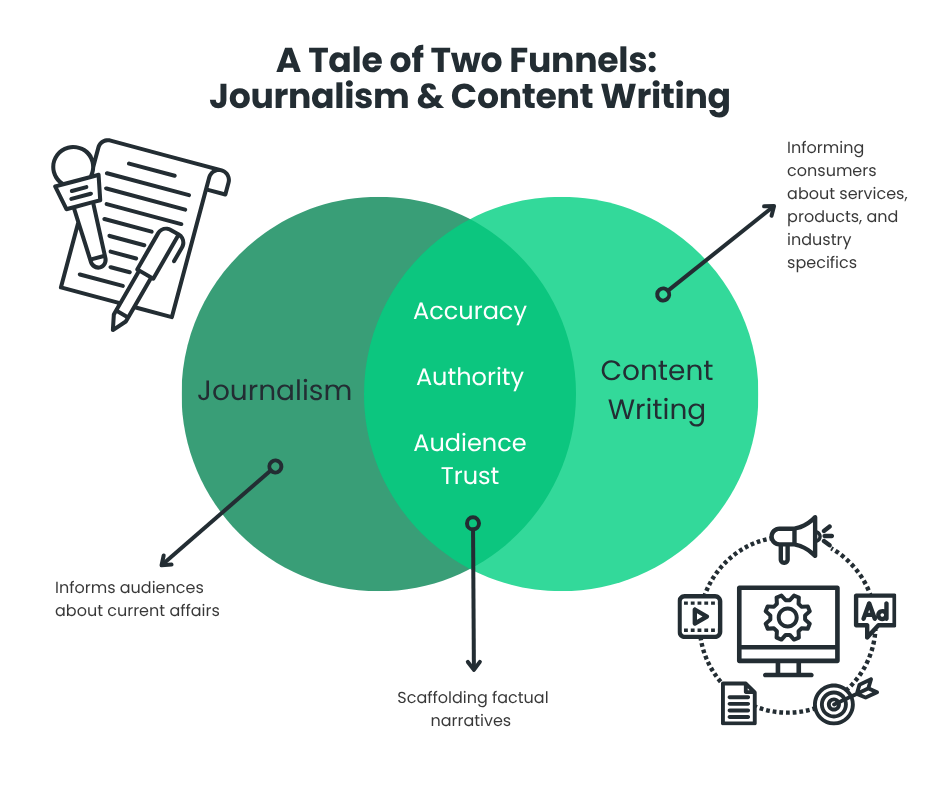
A Tale of Two Funnels: Journalism & Content Writing
Coming from a journalism background, I have found three key overlaps in my role as a content writer:
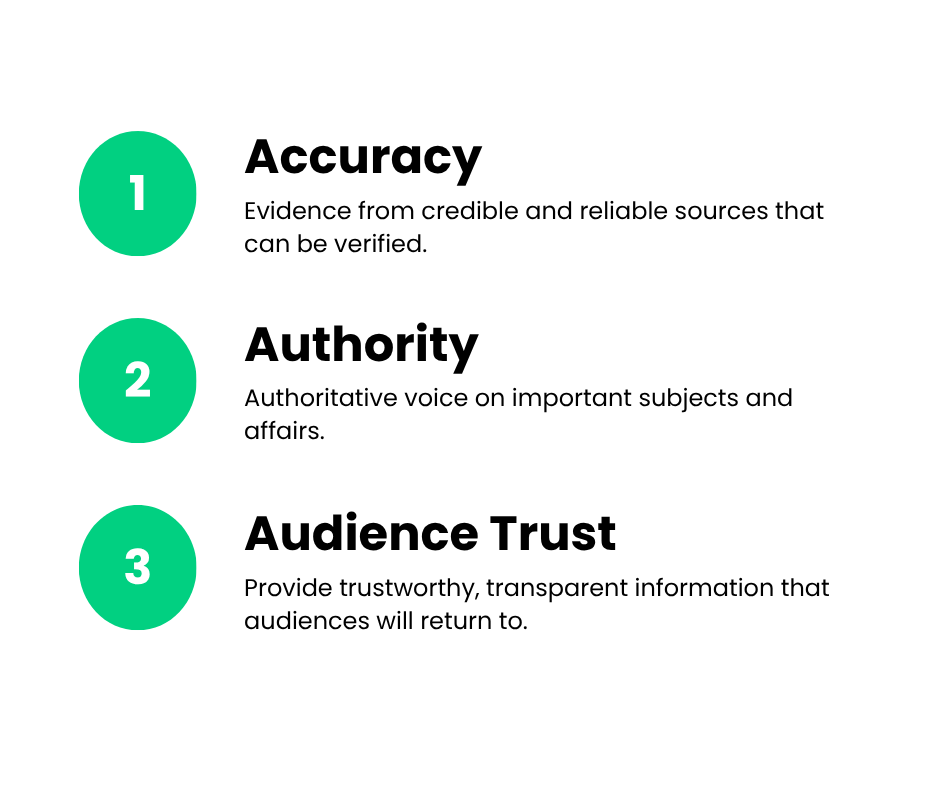
These are the three principles I return to when I’m writing and editing content. That’s not to say that there is a one-to-one comparison between content writing and journalistic prose; each has its distinct styles and goals in its communication.
Journalistic writing is meant to inform audiences about current affairs, whereas content writing is about informing consumers about services, products, industry specifics, and so on. Where they overlap is in the necessity of scaffolding narratives using factual information. Beneath that is the empathy question I find myself continually asking: What does the audience need to know about ‘X’, and how should I tell them?
Answering this question well has become essential. We must find the audience amidst the overwhelm of content. They want quick answers, simple solutions, and a clear path forward through the deluge. Any writer, then, no matter the industry they operate in, must target these wants directly. Adding LLMs to the mix complicates this further, but with the right approach, a balance can be struck.
Reaching this balance means structuring our content around:
- Using accurate, well-researched evidence that is drawn from reliable sources
- Building authority on topics, subjects, and brands before LLMs do it for us
- Curating audience trust with transparent, empathetic content that centres consumers
Double Tap: Accuracy
The more online content produced, the more mistrust has grown within consumers. In 2025, 3 in 4 Australians said the spread of online misinformation needed to be addressed and 86% of generative AI users expressed concern about the accuracy of information being given to them by said models. Now in 2026, only 4% of Australians believe AI technologies are worthy of trust, and 3% trust social media sites.
Operating in an online environment marked by distrust and scepticism means rebuilding trust with audiences through accurate content production, which is then cited by LLMs. Fidelity to accuracy is a guiding principle in journalism practice and relies on rigorous fact-checking and reliable sources with verifiable information.
In a content writing context, this means building a web of sources that are a mix of:
- Industry standards
- Statistical analysis and case studies
- Government bodies
- Legislation and codes of practice
Additionally, information should be fact-checked and quality assessed at multiple levels to ensure content holds up under scrutiny.
Cut Through the Slop: Authority
Once a base of reliable sources is built, you can start building topical authority on industry subjects. Because there is an overabundance of information online, customers want quick, easy explanations and answers. Content like explainers, listicles, and more has arisen out of this desire, with AI overviews being the latest attempt to help navigate consumers through digital spaces.
This is where a quality GEO strategy is needed. In a similar way to why Google needs to index websites, AI needs to scrape the internet in order to deliver its answers to users. As Frank Duignan discussed at the 2026 Sydney SEO Conference, an LLM will cite from webpages that align with its aggregative instincts. For content writers, this means:
- Using statistics and data to supplement or integrate within copy
- Drawing on your existing web of authoritative sources through external links
- Providing clear context through page headings and subheadings
- Writing in a direct answer-first tone in digestible chunks of copy
- Providing consistent copy across the entire website with no contradictions
- Updating old or outdated content regularly
Of course, these elements should be balanced with naturally flowing copy that is engaging for human readers and written to a high quality.
If information on a website is missing or wrong, AI will fill in the gaps for you. Correct grammar, clarity on processes, products, and services, as well as quantifiable results or evidence, are integral to correcting AI citations.
Some questions to consider on authority:
- What are LLMs saying about the brand, and does it align with the brand narrative and image?
- If the information is wrong, how can we correct it on-site?
- Is information about the brand’s story, products, and service consistent?
- What industry regulators, legislation, and government schemes or sites can you use as sources?
Keep the Heart: Audience Trust
In recent journalism studies, academic Jacob L. Nelson proposed the idea of an “imagined audience.” This audience is constructed by—imagined through—journalists’ perceptions of who they believe will be digesting their stories. In turn, this affects how journalists decide what stories to cover and how to cover them.
In an ideal world, journalists will act in line with the public’s best interests. This directive can be summarised in the key question: Who needs to know about this and why? Of course there are other compounding interests—personal, socio-cultural, economic, and otherwise—that will influence their reporting, but regardless, the audience will be the ultimate end-point.
Similarly, content writers must also produce with an imagined audience in mind, and in line with the interests of the business they are writing for. This imagined audience can be more aptly described as the “imagined consumer” or “ideal customer.”
To reach this imagined customer, content writers must try to understand them and place them at the centre of content ideation and writing. It also requires trust. Journalists most easily appeal to audiences through their projection of objectivity, balanced reporting, and fidelity to “truth.”
For content writers, building trust can be more contentious because of the commercial intent behind our writing. Still, it is possible to build trust with audiences when we use empathy to accurately situate them within the bounds of a brand’s emotional core and its services. When writing, I find myself reflecting on the question: Who is this service or product for, and how will it help them?
Answering this question will inevitably lead back to the beginning of the writing process, grounding content in accurate information that becomes authoritative, leads to audience trust, then (hopefully) continues on to conversion.
This results in producing digestible content that is cleanly structured and clear in its communication and reaches its intended audience.
Conclusion
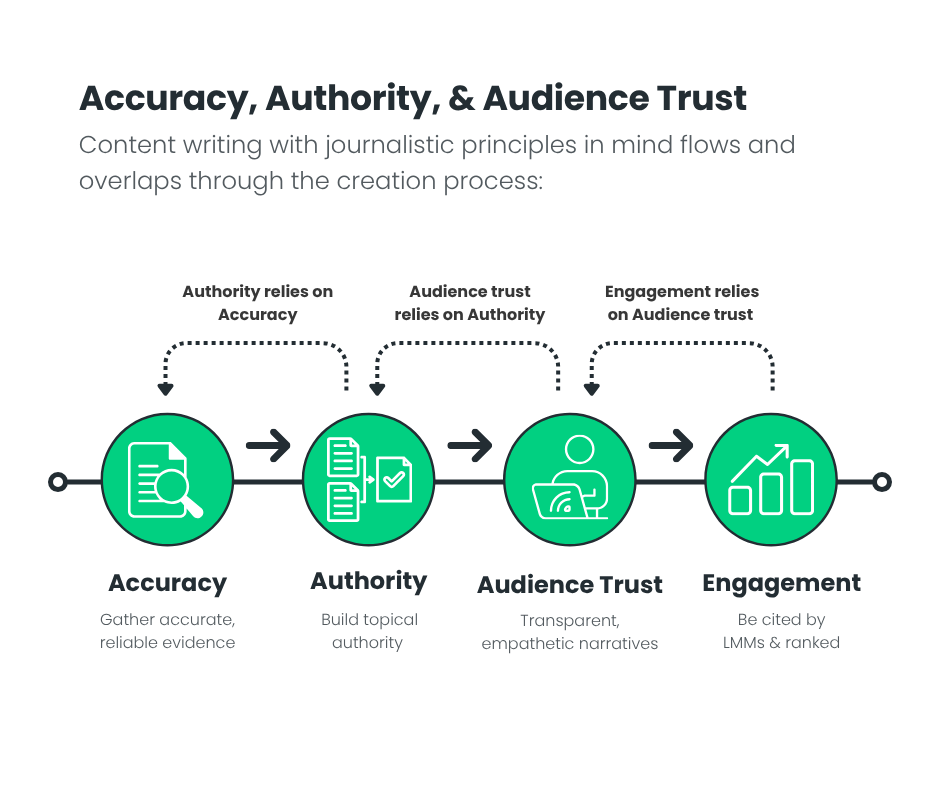
To wrap things up, if brands want to reach their imagined customer, their content must reflect an investment in technology that is not at the expense of the audience’s experiences. Building content around reliable sources helps build authority and, in turn, audience trust and engagement. I have found that integrating these principles into my content writing process has produced evergreen, citable content that forges a stable bond with customers.
